


The Nineteenth Century (Prior To, And Early, Victorian). Continued
Description
This section is from the book "Style In Furniture", by R. Davis Benn. Also available from Amazon: Style In Furniture.
The Nineteenth Century (Prior To, And Early, Victorian). Continued
But when the effort was made to inspire another nation, living under totally different conditions, and possessing a totally different temperament, with enthusiasm for the same symbols, forms, and fancies, the task became impossible of execution. Much that was pregnant with meaning to the subjects of Napoleon, who rejoiced in the overthrow of one monarchy and the setting up of another, appealed but slightly to their neighbours on this side of the Channel, who were not by any manner of means in a similar mood, and had no desire to be. A determined attempt was organised, nevertheless, to force the "Empire" down their throats, whether they wanted it or not; and, as the attempt was clumsily made, the result was that the erstwhile beauty of the English home, which it had taken so many years to bring to the rare state of perfection that it had attained, suffered terribly; indeed, it almost disappeared altogether for a time.
It seems most curious, withal, and notwithstanding the reason advanced above, that our designers could not extract something better from the "Empire" than they did; the style itself, whatever else may be said about it, was refined, stately, and dignified in the extreme. That its imitation here should lead to such fearfully hopeless ugliness, seems to indicate that there was something radically wrong with the imitators. It must be admitted, however, that they had a very difficult task to perform; indeed, they endeavoured to accomplish the impossible, and naturally failed.
The English cabinet maker attempted to ape the magnificence of the "Empire" without the opportunities, or the means requisite, to enable him to do so successfully. He set himself to reproduce as nearly as possible, and in a form which would be within the means of the average householder, models designed and made for the palaces of an emperor, and into the production of which the question of cost had probably never entered. The elaborate carving, the chimerical figures, the delicate brush-work, and above all the ormolu mounts - all features which were part and parcel of the original style, and without which it was no style at all - were far too costly for employment in the conditions under which the British furnisher had to work. In the great mass of his productions any dependence upon the aid of such accessories could not for one moment be entertained, and even elaborate shaping of the woodwork itself was seldom permissible, by reason of cost. The early Victorian designer was not to be daunted, however; so he went to work to find a substitute for all these characteristic elements which were forbidden him. He finally decided to atone for their absence by increasing the wood, determining that, if his creations could not impose respect by the weight of their magnificence, they should, at least, do so by that of their timber. That is the story in a nutshell, and it is a painful one. True, the "English Empire" was relieved by some redeeming features, and was productive of a few graceful forms, particularly in chair work; but they constituted somewhat rare exceptions to the dreadful and all-pervading rule.
However, though it was essential to sketch this phase of English furnishing, there is not the least occasion to dwell upon it, for the vast majority of the examples of the work of that period are not endowed with the slightest suggestion of artistic merit; are of no value to collectors; and can serve only to remind us of the depths to which we sank in the matter of applied art during the earlier part of the reign of Victoria; depths which were proudly "sounded," for the benefit of the world, at the memorable exhibition of 1851.
Two Studies in Sheraton-Empire (See page 319 for reference)
Nineteenth Century. Plate 98
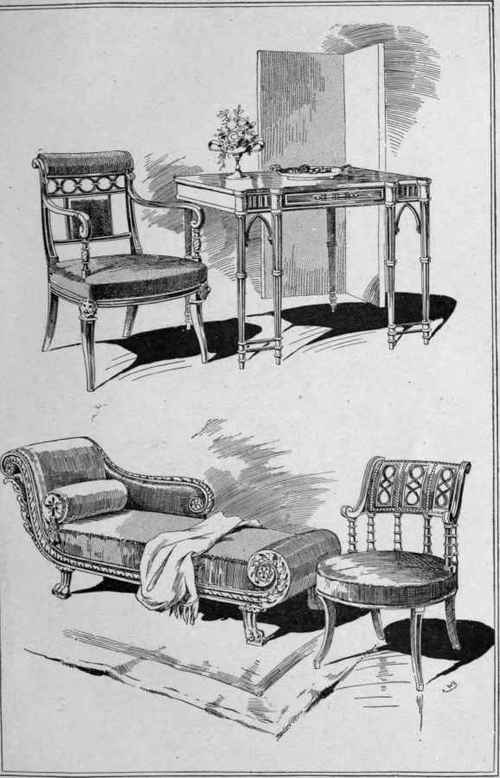
Reference in Text. See page 319
If any reader should desire to study the furniture of that period more closely than he will be able to do here, he cannot do better than refer to the special volumes issued by the Art Journal at that time, which are to be found in most reference-libraries, and illustrate the glories (!) of that exhibition. I have also, in the chapter on "Other Georgeian Types," given the names of several other illustrated works dealing extensively with English furniture and decoration of that "dark age." I much prefer that the examples should be found there than in these pages. Tasteful furniture was, of course, not altogether unknown to our forefathers of the days of which I am now writing; but such as then existed was on the lines laid down by Chippendale, Heppelwhite, Sheraton, and even earlier masters, or else consisted of such English renderings of the "Empire" as were more refined than the majority of those interpretations. So matters went on for many a long year without any very great effort being made to improve them.
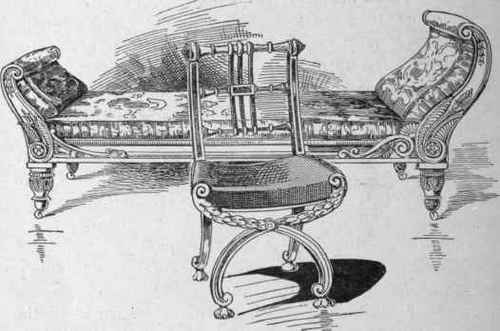
It is necessary, I suppose, to illustrate some examples of the style of this period, so on the single plate included in this melancholy chapter, and on the preceding page, I present a few studies of English "Empire" at its best. That they are possessed of some little merit may be accounted for by the fact that they came from the pencil of Sheraton; but as they were designed in the declining years of that old master, and in answer to a demand which, I venture to think, was by no means in accord with his own personal preferences, they have not been included in our deliberations upon his representative work. The two sofas are not ungraceful in line, and the arm-chair is a sensible and comfortable model which has done good service for many years; but the two remaining chairs have an appearance of weakness that is far from being in keeping with true "Sheraton." The table illustrated is not, of course, on "Empire" lines, but is suggestive rather of the Gothic, and - well - it might be worse.
Continue to:


My Books

