


III. Diffuse-Porous Woods
Description
This section is from the "Educational Woodworking For Home And School" book, by Joseph C.Park . Also see Amazon: Educational Woodworking For Home And School.
III. Diffuse-Porous Woods
[A few indistinctly ring-poroua woods of Group II, D, and cedar elm may seem to belong here].
A.Pores Varying In Size From Large To Minute; Largest In Spring Wood, Thereby Giving Sometimes The Appearance Of A Ring-Porous Arrangement
1. Heavy And Hard; Color Of Heartwood
(especially on longitudinal section) chocolate brown (No. 116) Black Walnut.
2. Light And Soft; Color Of Heartwood Light Reddish Brown
(No. 55) Butternut.
B. Pores All Minute And Indistinct
Most numerous in spring wood, giving rise to a lighter colored zone or line (especially on longitudinal section), thereby appearing sometimes ring-porous; wood hard, heart wood vinous reddish; pith rays very fine, but very distinct. (See also the sometimes indistinct ring-porous cedar elm, and occasionally winged elm, which are readily distinguished by the concentric wavy lines of pores in the summer wood) (No. 57) Cherry.
C. Pores Minute Or Indistinct, Neither Conspicuously Larger Nor More Numerous In The Spring Wood And Evenly Distributed
1. Broad Pith Rays Present
a. All or most pith rays broad, numerous, and crowded, especially on tangential sections, medium heavy and hard, difficult to split (Nos. 112 and 113) Sycamore.
b. Only part of the pith rays broad.
a'. Broad pith rays well defined, quite numerous; Wood reddish white to reddish (No. 47) Beech.
b'. Broad pith rays not sharply defined, made up of many small rays, not numerous. Stem furrowed, and therefore the periphery of section, and with it the annual rings sinuous, bending in and out, and the large pith rays generally limited to the furrows or concave portions. Wood white, not reddish (No. 52) Blue Beech.
2. No Broad Pith Rays Present
a. Pith rays small to very small, but quite distinct.
a'. Wood hard.
a". Color reddish white, with dark reddish tinge in outer summer wood (Nos. 79-82) Maple.
b". Color white, without reddish tinge (No. 76) Holly. b'. Wood soft to very soft.
a". Pores crowded, occupying nearly all the space between pith rays, a"'. Coloryellowish white, often with a greenish tinge in heartwood (No. 115) Tulip Poplar, (No. 116) Cucumber Tree. b'". Color of sap wood grayish, of heartwood light to dark reddish brown (No. 69) Sweet Gum.
b". Pores not crowded, occupying not over one third the space between pith rays; heartwood brownish white to very light brown (Nos. 45 and 46) Basswood. b. Pith rays scarcely distinct, yet if viewed with ordinary magnifier, plainly visible, a'. Pores indistinct to the naked eye.
a". Color uniform pale yellow; pith rays not conspicuous even on the radial section (Nos. 53 and 54) Buckeye.
b". Sapwood yellowish gray, heartwood grayish brown; pith rays conspicuous on the radial section (Nos. 67-68) Sour Gum. b'. Pores scarcely distinct, but mostly visible as grayish specks on the cross section; sapwood whitish, heartwood reddish (Nos. 48-51) Birch. D. Pith rays not visible or else indistinct, even if viewed with magnifier. 1. Wood very soft, white, or in shades of brown, usually with a silky luster (Nos. 105-110) Cottonwood (Poplar).

Fig. 242. Wood of beech, sycamore, and birch. (For explanation of letters see Fig. 236).
Diffuse-Porous Woods. Additional Notes For Distinctions In The Group
Cherry and birch are sometimes confounded, the high pith rays on the cherry on radial sections readily distinguishes it; distinct pores on birch and spring-wood zone in cherry as well as the darker vinous-brown color of the latter will prove helpful.
Two groups of birches can be readily distinguished, though specific distinction is not always possible.
1. Pith rays fairly distinct, the pores rather few and not more abundant in the spring wood; wood heavy, usually darker (No. 48) Cherry Birch and (No. 49) Yellow Birch.
2. Pith rays barely distinct, pores more numerous and commonly forming a more porous spring-wood zone; wood of medium weight (No. 51) Canoe or Paper Birch.

Fig. 243. Wood of maple.
The species of maple may be distinguished as follows:
1. Most of the pith rays broader than the pores and very conspicuous (No. 79) Sugar Maple.
2. Pith rays not or rarely broader than the pores, fine but conspicuous. a. Wood heavy and hard, usually of darker reddish color and commonly spotted on cross section (No. 80) Red Maple.
b. Wood of medium weight and hardness, usually light colored (No. 82) Silver Maple. Red maple is not always safely distinguished from soft maple. In box elder the pores are finer and more numerous than in soft maple.
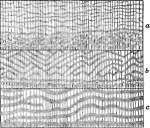
Fig. 244. Wood of elm. a, red elm; b. white elm; c, winged elm.
The various species of elm may be distinguished as follows: -
1. Pores of spring wood form a broad band of several rows; easy splitting, dark brown heart (No. 64) Red Elm.
2. Pores of spring wood usually in a single row, or nearly so. a. Pores of spring wood large, conspicuously so (No. 62) White Elm.
b. Pores of spring wood small to minute. a'. Lines of pores in summer wood fine, not as wide as the intermediate spaces, giving rise to very compact grain (No. 63) Rock Elm.

Fig. 245. Walont. p.r., pith rays; c.l., concentric lines; v, vessels or pores; su.w., summer wood ; sp.w., spring wood.
b'. Lines of pores broad, commonly as wide as the intermediate spaces (No. 66) Winged Elm.
c. Pores in spring wood indistinct, and therefore hardly a ring-porous wood (No. 65) Cedar Elm.

Fig. 246. Wood of cherry.
Continue to:


My Books

