


Lesson XIV. The Chisel. Continued
Description
This section is from the book "Manual Training: First Lessons In Wood-Working", by Alfred G. Compton. Also available from Amazon: First Lessons In Wood-Working.
Lesson XIV. The Chisel. Continued
When you have worked with the chisel or other cutting tool some time, it becomes dull, and does not cut well. If you examine its cutting edge you will find that instead of being quite invisible, as it was at first, it is visible as a bright shining edge, and instead of feeling very keen to the end of the finger, it is smooth and rounded. Under a glass it would appear as at a, Fig. 38, rather than as at b. The keen edge must be restored by sharpening on the oil-stone.
A plane-iron and a chisel are sharpened in the same way, and it is of the utmost importance that this should be done properly. Having put a few drops of oil on the stone, take the chisel in the right hand, place the beveled face on the stone and press it down with two or three fingers of the left hand held near the edge of the blade. At first place the tool on the stone so that the beveled face touches all over, Fig. 39, a. Then raise the right hand a little, so that only the small bevel shall touch, as at b. Be careful not to raise the hand too high: it is only necessary to just miss rubbing the large bevel. If the hand is raised too high, the edge will be worn away too much, and the angle of the chisel will be too large. Until the right way of holding has become habitual, it may be noted that the height of the end of the handle above the surface of the stone should be about six-tenths of the length of the tool and handle. Thus, if the entire length of the chisel is 10 inches, the middle of the circular end of the handle should be 6 inches above the stone. In rubbing the tool on the stone, the hand must be pushed to and fro parallel to the stone, not rising and falling a little, which would make the edge of the tool round.
Exercise 26. Sharpening A Chisel

Fig. 38.
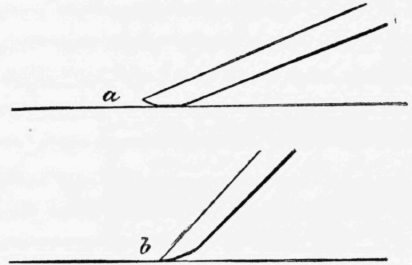
Fig.39.
If the chisel has not been neglected too long it will not be necessary to rub it much.
It is only necessary to remove the roundness just described. When this is done, the metal will begin to turn up a little on the back, making a roughness called a "wire-edge," as shown, exaggerated, in Fig. 40. This wire-edge is removed by laying the flat side on the stone and giving the tool a few light strokes. It must not be at all tipped up during this operation, nor the operation continued long, or the back will be rounded and the tool spoiled. The operations being repeated once or twice, more and more lightly, a fine keen edge will appear.
In using any cutting tool, it will be found much the best plan to sharpen it frequently. If this is done, it will require only a slight rubbing each time, and the best quality of work can be done with a tool thus kept in order.
When the tool has been sharpened very often the short bevel near the edge becomes wide, and much work is then required to sharpen it on the oil-stone. It must then be ground on the grind-stone. The long bevel, which makes the smaller angle with the back (D B, Fig. 34) is to be held on the stone, until it is ground away so far that it runs quite out to the edge at A. In doing this take care.

Fig .40.
1. To hold the tool steady at the proper inclination.
2. To keep plenty of water on the stone, so as not to heat the tool. Heat would soften and spoil it.
3. To turn the stone towards the chisel, particularly near the end of the grinding. Turning it from the chisel will turn up a "wire-edge," as in Fig. 40.
4. Never to let the stone touch the back of the tool.
When the bevel A B, Fig. 34, has been carried out to the edge, which will make the latter rough, a moderate rubbing on the oilstone will give it a smooth, keen edge.
Having now pared one edge of your piece of wood straight and smooth, each of you may exchange pieces with his next neighbor, and repeat the operation on the opposite edge. This exchange is made for the purpose of giving you an opportunity to examine and become acquainted with the two kinds of wood that have been distributed through the class. The pine is of the kind called white-pine. It is soft and straight-grained, and planes to a smooth, glossy surface if the piece is a good one. The tree is a fine evergreen which grows to a height of one hundred to one hundred and fifty feet in the woods of the Northern States and Canada, and sometimes has a trunk six feet in diameter. Its leaves are long slender needles (Fig. 41), growing in groups of five, each group making, if the several parts are pressed together, a complete cylinder. You can find small specimens of the tree in woods and parks almost everywhere, but the large ones are to be seen only in the wild Northern woods, and even there are getting scarce. It is very different in its mode of growth, the shape and grouping of its leaves, and the character of its wood from the yellow-pine and the pitch-pine, and you ought to endeavor, as opportunity offers in the workshop and elsewhere, to make yourself acquainted with these different species and their uses. The white-wood is the wood of the tulip-tree, which is also a large, handsome tree, with fine straight trunk, and with curious, square-cut leaves, as in Fig. 42. It is not an evergreen, but a deciduous tree; that is, it loses its leaves in the fall. It bears, in June, a coarse, tulip-shaped, yellow flower, from which it is named. Its wood, as you see, is not white, but greenish-yellow. It is very straight-grained, free from knots, soft and easily worked, and is much used in house-carpentry, and in furniture and pattern-making.

Fig. 41.
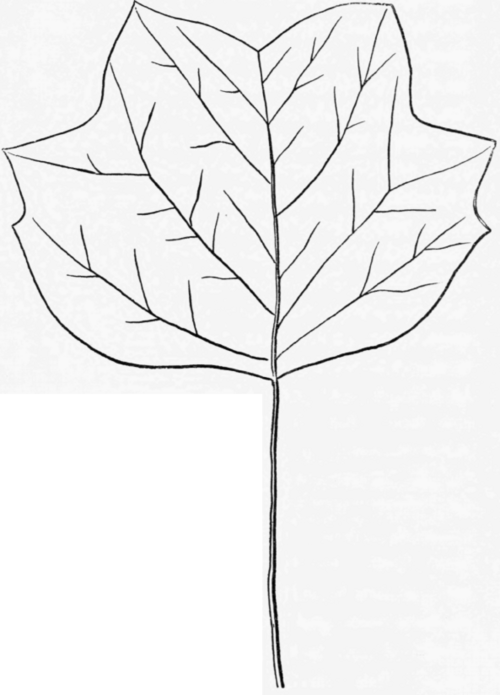
Fig. 42.
Continue to:


My Books

