


Lesson XVIII. Gluing
Description
This section is from the book "Manual Training: First Lessons In Wood-Working", by Alfred G. Compton. Also available from Amazon: First Lessons In Wood-Working.
Lesson XVIII. Gluing
A Box properly dove-tailed together would preserve its shape without glue or any other joining material, unless subjected to considerable strain. To hold it in proper shape in spite of strains it must be fastened with glue; and when properly glued it is impossible to get it apart without breaking, except by soaking it in water.
To prepare glue, soak it over-night in enough cold water to cover it, and in the morning cook it gently for an hour or two in the inner bowl of the glue-pot, stirring it from time to time, and taking care that the water in the outer pot does not boil away and allow the glue to burn. When ready for use, the glue, if thoroughly hot, will flow from a stick or brush in a smooth thread, running off pretty freely, but not in drops. It is very important that it should be of just the right consistency. If too thin, it will soak into the wood without acting as a cement. If too thick, and especially if cold, it will make a jelly-like layer over the wood, preventing the pieces from coming in contact. It is not easy to describe the proper condition of the glue, but when you have seen it a few times you will have no difficulty in recognizing it. It may be remarked that the beginner is in general disposed to use it too thick rather than too thin; at the same time it is unmistakably too thin, if it falls from the brush in drops with the sound of dripping water.
After getting the glue of the proper consistency it is equally important to have it thoroughly hot when used. It is worse than useless to allow yourself to be led by impatience into using the glue before it is just right. Not only must the glue be hot, but the pieces to which it is to be applied must be heated till they are hot to the touch; and the room in which the gluing is done must be warm and free from draughts. No open window must be allowed near work that is being glued (except in the case of veneering, when heat is supplied in another way). Lastly, the work of gluing must be done quickly, so that the wood and the glue shall have no time to chill, and as much of the glue as possible must be driven out from between the pieces by forcing them close together.
Bearing these particulars in mind you may now proceed to glue your box together. First put it together without glue. Set two hand screws to a width equal to the width of the box. The proper way to open or close a hand-screw, when it requires much change, is to take one of the screw-handles in each hand, hold it with the open jaws towards your face, and then revolve one hand round the other, making the jaws turn quickly between your arms, and being careful of course that they do not hit your face as they turn. After a little practice this becomes very easy, even with rather large screws. After you have thus turned the screw to about the right width, place it, points downward, on the box, which is resting on the bench, move it along near to one end, but not so near as to rest on the dove-tails, and turn the front screw A, Fig. 55, till the jaws touch at the edge C D. Then turn the back screw B, till they take a firm hold at both edges. Considerable care is required in this operation, to avoid putting too much pressure on one part and too little on another. If you tighten the front screw A too much, the pressure on the back edge will be excessive when you come to screw up the hinder one. If you do not tighten it enough, the screw will bite at the point and not at the back. If you find your first attempt unsuccessful, you must always loosen the back screw before trying to readjust the front one. When the adjustment is right, the jaws should appear exactly parallel when the screws are well tightened, and should press equally on point and heel. Either of the positions in Fig. 56 is faulty, and tends to break some of the dovetails, while leaving others open at the joints.
Exercise 33. Setting Hand-Screws
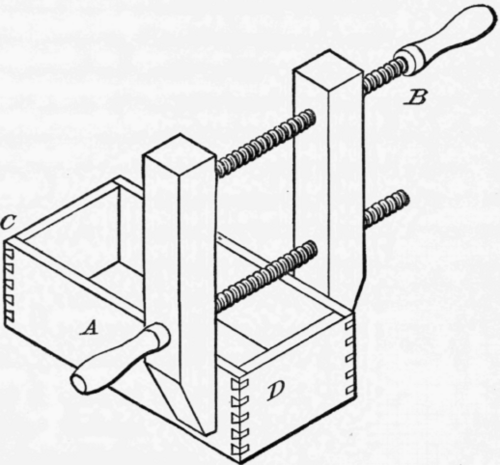
Fig.55.
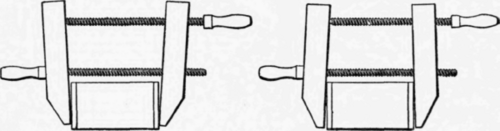
Fig. 56.
Having set one screw at each end so that it shall press properly, closing all the joints and leaving the box in good shape, loosen the back screws a little and the front screws still less, only just enough to allow the hand-screws to be taken off easily, and lay them on the bench ready for use. See that the corners of the box are conspicuously numbered so that you can quickly place them together again in their proper order. Place them in front of a fire, or in an oven, or on top of a stove. If the last, they must, if the stove is very hot, be raised a little from the top on small pieces of wood, to prevent them from burning, and in either case should be turned from time to time. When they are well warmed, lay them one on top of another on your bench, in the order in which they are numbered, and, with the least possible loss of time apply the glue. This may be applied with a brush of suitable size, in the following way. First pass the brush crosswise over the wide sides of the pins, not letting the glue run over the ends or backs; enough glue will run in on the inclined faces of the pins, or a little may be rubbed in there with the end of the brush. Next pass the brush crosswise over the inside faces of the dove-tails, allowing a little to run inside, but none on the ends or the out side faces. When the two pieces are driven together, every surface of contact will have glue on it, and all the outside surfaces will be clean. Put them together quickly, driving them close with the mallet or hammer (striking on a strip of wood so as not to bruise them), apply the hand-screws, and tighten them up as they were before. A good deal of glue will be forced out of the joints. This must not be allowed to dry on the wood, as it is very hard to get it off when it is dry. Scrape off most of it with a chisel, without scratching the wood, and wash off the rest with a piece of clean rag or a bunch of shavings wet with hot water.
As success in this, as in all gluing operations, depends greatly on quickness, it will be well, the first time, to rehearse all the movements with a dry brush without glue, and not apply the glue till you are sure you can perform all the movements rapidly and without confusion.
Exercise 34. Gluing
If the joints are good and the screws properly applied, the box will preserve its shape. As there is always, however, some risk of distorting it, it is best to examine it carefully as soon as it is screwed up. The hand-screws will prevent you from applying a square, outside, and you will only be able to apply a small one inside, or to test the squareness by the eye, or by measuring the two diagonals, which ought to be equal. The winding may be tested by setting the box on your bench. Any error in squareness or winding must be corrected by loosening the screws, and applying a suitable pressure at once, before the glue sets. After this the screws are to be carefully tightened again, and must not be disturbed for three or four hours, when the glue will be quite dry.
Continue to:


My Books

