


Tool Sharpening
Description
This section is from the book "Manual Instruction: Woodwork. The English Sloyd", by S. Barter. Also available from Amazon: Manual Instruction: Woodwork.
Tool Sharpening
The sharpening of tools is necessary to their proper management and use, and this is especially the case with good tools, where quality may be very much discounted by allowing them to get blunt. The practice of sharpening is useful, too, as a means of inculcating care and attention on the pupil; and, moreover, much expense will be saved by keeping the tools in proper order, instead of sending them to a practical man.
The sharpening of cutting tools is not an operation which can be satisfactorily performed at a first essay, and it must be borne in mind that beginners' attempts at woodwork will result in more damage to tools than the fair wear resulting from their use by experienced men.
We will first consider the sharpening of tools with simple cutting edges - plane-irons, chisels, etc.
If a tool has been slightly dulled, it is sharpened by rubbing on a stone.

Fig. 90.
The choice of a stone is a somewhat perplexing question, arising from the great variety in the market. The best stone for general purposes is the Washita, or Ouachita. It is of a very light grey colour, almost white, and, in choosing either this or any other stone, a good even colour and texture, with an absence of veins, flaws, or shells, should be looked for. This stone should be quick cutting in its action, and its quality in this respect may be roughly tested by running the edge of a finger nail down the surface once. If a good stone, the nail will be noticeably worn, and on the stone itself a very slight impression should be made, a fine hair-like scratch appearing.
The Turkey stone is an exceedingly good kind, but not so fast-cutting in its action as the preceding. On the other hand, it gives an even finer edge on the tool; it is of a creamy, opaque, yellow colour.
The Arkansas is a fast-cutting stone, and gives an excellent edge, but its price is quite prohibitive.
Stones are usually about 8 ins. to 12 ins. long, by 2 ins. to 8 ins. wide and thick.
To assist in the cutting of a tool edge, oil is poured in small quantity on the stones. Oils of various kinds are used, but the best will be found to be olive, or 'sweet,' oil. The reader should on no account use paraffin (except, perhaps, occasionally for cleansing purposes), as it has the effect of hardening, and so decreasing, the cutting power of the stone, for it must be borne in mind that the softer the stone the faster it cuts.
When not in use the oiled surface of the stone is very apt to accumulate any foreign gritty matter which may be floating in the air, and which will wear both iron and stone unevenly. To prevent this occurring, the stone is set firmly in a piece of wood, and a lid is made to fit over it, which should invariably be put on when the stone is not in use.
Plane-irons and chisels, when new, are ground on the back at 25° to the face, but the sharpening angle is usually about 35°, and, in sharpening, the iron must simply be held steadily in this position, as in fig. 91.
To do this properly is, however, a difficult operation, for the most trifling deviation from the angle of 35° will make the cutting angle of the iron slightly round, instead of quite flat.

Fig. 91.
As the substance of the iron wears away from frequent sharpening, the extent of this flat surface becomes larger, and the difficulty of keeping it perfectly flat becomes greater.
In rubbing the iron on the stone it must be remembered that it is as important to wear away the stone evenly as it is to hold the tool properly, for if the surface of the stone becomes hollow in the middle, it necessarily makes round sharpening edges on the tools, instead of flat ones.
In sharpening, and especially on fast-cutting stones, the extreme edge is not entirely removed, but, owing partly to the pressure on it, and to the slight resistance to the forward movement offered by the stone itself, a very small portion is turned up, and when examined this 'wire edge' will be visible, though, perhaps, the iron may be quite sharp. To remove the wire edge, turn the tool flat on its face, as in fig. 92, and rub it two or three times along the stone.

Fig. 92.
It is of the utmost importance that in doing this the face of the tool should be quite flat on the stone. If necessary, after rubbing on the stone in this way, the sharpening may be finished on a piece of buff leather.
Sometimes, to finish the removal of this wire edge, the tool is stropped in the palm of the hand, but this practice is obviously very dangerous, and should not be taught.
A dangerous method of testing the keenness of a sharpened tool is to rub a finger lightly across the edge, but this should on no account be permitted. As a rule the best test is a careful scrutiny of the tool, when, if the edge is visible in a fine shining line it may be regarded as imperfectly sharpened; if the edge is invisible, it is keen.
Fig. 93 shows how the size of this sharpening surface increases by the successive removal of layers of the metal. Now as this goes on, the amount of surface to be kept true in sharpening increases; and as the stone is, perhaps, not absolutely level throughout its whole length, the sharpening surface cannot be rendered quite flat. The tool rapidly gets dull, does not do its work well, and gives more trouble in sharpening. It is now reground - i.e. the obtuse angle of 170°, formed by the grinding and cutting angles, is removed, the edge of the tool being once more made to 25° as when new.
The grindstone is used for the purpose of reducing this surplus metal; it is much coarser than the oilstone, and cuts much faster in consequence, especially as it is revolved very rapidly. In order to make sure of getting the proper angle the 'support' is used. The tool is screwed firmly into this instrument, and the operation of grinding much simplified. Fig. 94 shows this grinding support in use.
The grindstone recommended is from the Bilston quarries, and from 16 ins. to 24 ins. diameter, with 3 1/2 -in. edge, will be found very suitable dimensions. It should be in a high iron frame, and should have both hand and foot power. A trough containing water to assist in the grinding and keep the tools from heating and losing temper is provided; and, to prevent, as far as possible, the particles of wet grit from flying off tangentially from the stone and making the user dirty, the grindstone should be boxed in with a high wooden frame, leaving a small segment of the circumference of the stone visible.
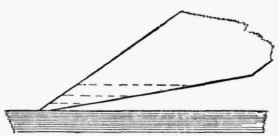
Fig. 93.
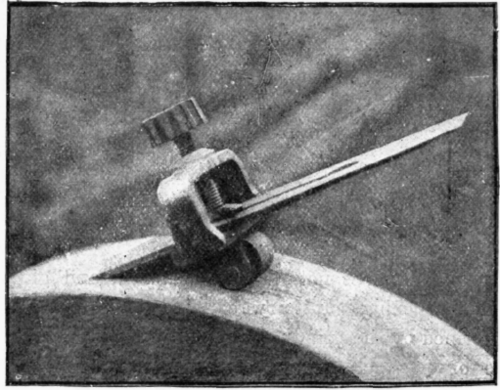
Fig. 94.
Fig. 95 shows the grindstone cased in with wood, and in use by two boys. The lad who is holding the tool is not using the grinding support already alluded to, but an equally good, and much cheaper, improvised one.
Across the top of the framing is nailed a piece of wood, with a hole mortised in it. Through this hole the tool to he sharpened is thrust, and can he held very steadily while being ground.
Grinding should take place over the whole surface of the edge of the stone in order to wear it evenly; hut if it should become uneven, it can be made true by wearing down the more prominent parts against a bar of iron, held firmly in one position.
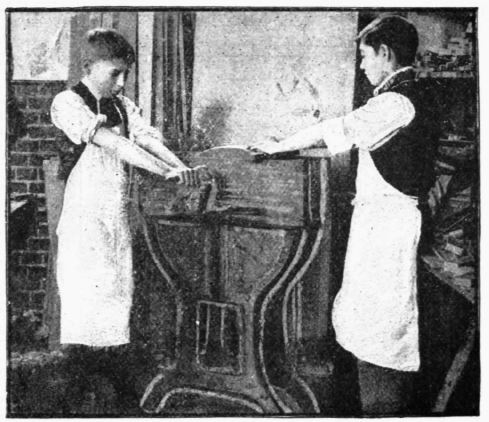
Fig. 95.
Stones will get too hard if exposed to sunshine; on the other hand, if allowed to stand in water the stone will become soft in one half. The water in the trough should, therefore, be run off, after use, through the outlet provided for the purpose.
Bent tools, like scribing gouges, are not sharpened on the flat oilstones, but are rubbed with a small prepared piece of Turkey or Washita stone, which serves the purpose.
The slip should be oiled, as in the case of the larger oilstone, and rubbed firmly and steadily; and though the use of the slip requires care and experience, no special advice beyond that of attention is possible.
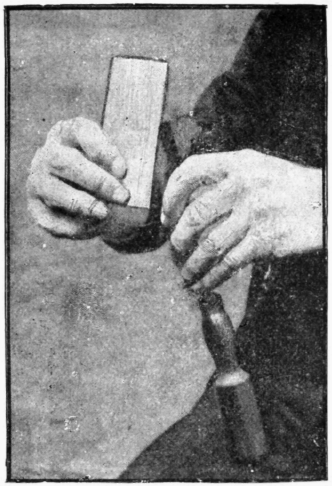
Fig. 96.
Fig. 96 shows the method of using a slip.
Saws are very difficult to sharpen, and, as before mentioned, unless the teacher be an artisan, he had better not attempt it. The sharpening will be done at a tool shop or by a practical man at a merely nominal charge.
Continue to:


My Books

