


A Shoulder Chest
Description
This section is from the book "Handy Man's Workshop And Laboratory", by A. Russell Bond. Also available from Amazon: Handy Man's Workshop And Laboratory.
A Shoulder Chest
When called to do outside jobs, it is very necessary to have some suitable box or chest in which to carry a few tools, either in the hand, on the shoulder, or on the back if a bicycle is used. The writer is acquainted with a mechanic who took more interest in making his shoulder chest than any other furnishings of his shop, claiming that it would be an advertisement of what he could do if called upon.

Fig. 22 - The shoulder chest.
The chest is illustrated in Fig. 22, and detailed in Fig. 23. A trunk strap was put through the handles and thrown over the shoulders, when he mounted a wheel to go to his job, or the strap shortened to make a comfortable handle, if within walking distance of his employment.
The chest should be made from half-inch stuff; chestnut being a good wood, because the grain shows off to an advantage when the finished article is given an oil polish.
Select a prettily-grained piece of board, sufficiently large to cut the whole box. The sides are to be marked out in such a way that when the chest is put together, the markings of the grain will match all round, as seen in Fig. 22.
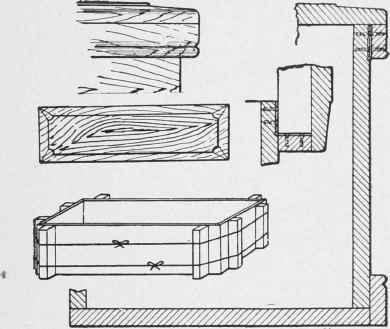
Fig. 23 - Construction of the chest.
The detail view, Fig. 23, gives a general idea of the construction, and needs but little explanation. The board from which the sides and ends are cut is 8 inches wide by 7 feet in length, accurately divided into four parts, 9 inches and 2 feet 9 inches long, and the edges chamfered 45 deg., when they should be nailed together with long fine nails, and glued. The beaded finishing strips, top and bottom, are cut in the same manner. The top strip is 1 inch deep, and the bottom 1 1/2 inches. The strips of wood from which they are cut are 7 feet 4 inches long. Allowance must be made for the saw cuts, both in the sides and the strips. The bottom is made from a plain board. 9 inches wide by 2 feet 9 inches long. The top is 5/8 inch thick. 10 1/8 inches wide, and 2 feet 10 1/8 inches long with a panel 1/8 inch deep, gouged at the corners and chamfered down to 3/8 inch all round. 1 1/2 inch from the edge, as shown in the illustrations. When the mitered edges of the sides and the finishing strips are glued, they can be held until perfectly dry, by an arrangement of blocks and cords, as shown in Fig. 23. There should be a clearance space between the lid and the box, all around, of about 1/16 of an inch. The corners throughout should be nicely rounded, so that there will be no sharp edges to annoy one when carrying the chest.
Hinges and a flush lock should be nicely let in the front and back, as shown in detail in two of the views. The hinges must be attached to the box first, and then to the lid, when open full. A neat brass chain will prevent the lid from accidentally opening too far. The handles should be fairly strong, and attached very securely to the ends of the chest. A neat tray, 3 inches wide by 1 1/2 inches deep, of 1/4 or 3/16-inch stuff", is made to fit the chest.
Continue to:


My Books

