


Desk Or Drawing Table
Description
This section is from the book "Handy Man's Workshop And Laboratory", by A. Russell Bond. Also available from Amazon: Handy Man's Workshop And Laboratory.
Desk Or Drawing Table
A shop should be furnished with some kind of a writing shelf or desk, and since it is often necessary to make sketches or accurate drawings of details, a drawing board and desk combined will answer well. Very often an old drawing board can be obtained, which can easily be trimmed up, and made into a drop-leaf arrangement secured to the wall. A good size is 23 by 31 inches, which will accommodate a standard-size sheet of paper, but on account of the construction in this case, the width had better be 24 1/2 inches.
Soft pine, free from knots and well seasoned, should be procured, and accurately planed and glued together along the joints. Two battens running across the grain of the board should be secured to the underside, by means of round-headed screws, sunk in below the surface, and bearing upon iron washers. (See Fig. 24.) The holes should be bored larger than the screws, the hole in the washer being the same size. This will prevent the board warping, and it is very easily constructed. Make the board 1 inch thick; the battens and braces also; the cupboard from 24-inch stuff; and the shelves, pigeon-hole partitions, and small cupboard of 1/2-inch material.

Fig. 24 - How the battens are secured to drawing board.
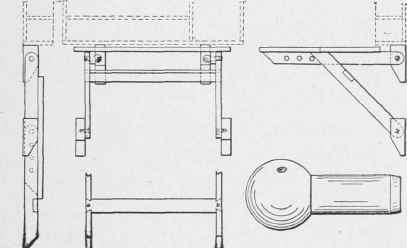
Fig. 25 - Details of the drawing board.
Fig. 25 is drawn to scale, showing the front and side views. The cupboard (see Fig. 26) is 6 inches deep outside measurement, and 3 feet in length. The shelves are 4 1/2 inches apart, making the total height 16 inches. The small cupboard is 9 1/2 inches square inside. It should be furnished with hinges and handy man's workshop and laboratory lock. A small block of wood, tacked in the corners, will prevent the door closing too far inside. The pigeonholes can be either plain or furnished with drawers, and the general design altered to suit individual tastes, but an arrangement of some kind in which to keep pens, ink, pencils, writing material, smaller and finer grades of tools, notes, sketches, books, and clippings from the press or magazines. Nothing can be more useful than a place to keep all such things, for accumulate they will.
The brackets upon which the cupboard rests, and to which the battens are connected, and also the brackets at the foot of the braces, can be made from 2 by 3 stuff cut 7 1/2 inches in length, and secured {irmly to the wall of the shop. Make the battens and braces 1 inch by 2 1/2, of hard wood, secured to the brackets with large screws. the holes being a trifle large in the battens, and the screws not driven all the way home. The cross-brace is dovetailed into the supporting braces, as shown in Fig. 25. The length of the batten- and braces is 2 feet 4 inches and 2 feet I inch, out to out. beveled to an angle of 45 degrees at one end and rounded at the Other. Care must be taken to secure the fixed ends not more than 1 1/4 inches from the near edge of the wall brackets, or the board will not close up properly when folded against the wall, as shown at the left in Fig. 25.

Fig. 26 - General view of the drawing board and cupboard.
Three holes for adjusting the board at several angles are bored 2 1/2 inches apart, the first one being 4 1/2 inches from the end. A round peg, shown in larger detail in Fig. 25, is made to fit the holes, and kept from getting lost when the board is down, by a short length of wire attached to a staple in the underside of the board. Make the bottom of the cupboard about 3 feet 6 inches from the floor, which will give about an inch clearance for the braces when the board is down, out of use.
The working edge of the drawing board should be trued up for the butt end or head of the T-square to work against. In selecting a T-square, sight along the working edge, to see that there are no imperfections, and select one where the blade is on top of the head, so that the triangles will slide over it. A T-square, two triangles, triangular scale, and a small set of instruments can be purchased at a very reasonable cost.
Fig. 26 gives a fairly good idea of how the board and cupboard will look when complete. If much sketching or laying out is to be done, a high stool will be found convenient.
Continue to:


My Books

