


An Easily Made Magneto Machine For Physiological Effects
Description
This section is from the book "Handy Man's Workshop And Laboratory", by A. Russell Bond. Also available from Amazon: Handy Man's Workshop And Laboratory.
An Easily Made Magneto Machine For Physiological Effects
As one of the diversions of an evening's entertainment for a company of young folk there is perhaps nothing that will contribute so much to the general enlivenment as some means of giving electric shocks. Of the various devices for producing -hocks nothing is more convenient and satisfactory than the magneto machine.

Fig. 209 - A magneto machine of simple construction.
A simple magneto-machine of novel construction designed especially for physiological effects is here described. Fig. 209 shows the completed machine. Fig. 210 gives details of construction.
Four ordinary 5-inch horseshoe magnets, d, are clamped in a bundle with their like poles in contact upon a horizontal brass shaft, a, 3/16 of an inch in diameter. The magnets are held, two on each side of the shaft, by clamping plates, b, of thick sheet brass, drawn together against the faces of the magnets by small brass machine screws.
At their butts the pairs of magnets hind directly upon the shaft: at their open ends they clamp upon a rectangular strip of No. 22 sheet brass, c, half an inch wide soldered transversely upon the shaft near the ends of the magnets.
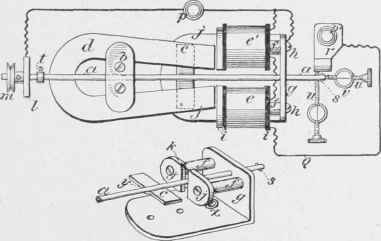
Fig. 210 - Details of the construction.
At its middle the brass strip has bent into it a shallow cross-groove, y, conforming to the shape of the shaft, the depth of the groove being just sufficient to bring the plane of the wings of the cross-piece coincident with the shaft's axis.
In front of the magnet's poles are fixed, horizontally, two bobbins of fine insulated wire, e e'. The bobbins have 3/8-inch .soft iron cores, f,1 1/2 inches long, attached by small machine screws. h. to the vertical limb of an iron yoke, g, made of 2 x 1/8-inch strap iron bent at right angles and attached to the base of the instrument with wood screws.
The bobbins are formed by driving tightly upon the cores centrally apertured disks, i. of vulcanized fiber or hardwood 1/8 inch thick and 1 1/4 inches diameter. The space between the bobbin heads for each coil should be 1 1/8 inches. An insulating wrapping of paper is shellacked upon the cores between the heads and fitted tightly up against them. The spools are wound full of No. 36 single-wound silk-covered copper wire, 2 3/4 ounces being required for each spool. The windings of the two bobbins are joined together like the windings of an electro-magnet.
The ends of the bobbin cores are provided with flat pole-pieces, j, made of 1/8-inch strap iron, attached to the cores with flat-headed machine screws. The pole-pieces are rounded at their outer ends to conform to the shape of the bobbin heads, whose diameter they equal in width, their inner ends being left straight with a vertical space, k, between them whose width equals that of the opening between the poles of the magnets. The bobbins should be placed only just far enough apart to admit the free passage of the shaft between them. One end of the magnet shaft is journaled in the bobbin yoke, and projects 1 inch beyond it. The opposite end turns in a support. l, made of 1 1/4 by 1/8-inch strap iron carrying at its upper end a grooved hand-wheel 6 inches in diameter, which is belted with a waxed cord onto a 7/8-inch grooved pulley, m, carried by the shaft.
The magnets should revolve as closely as possible to the pole pieces, much of the effectiveness of the machine depending upon the nearness of approach at this point; therefore, the pole pieces are dressed perfectly flat and level and set so as to face the magnets squarely. Should the magnets differ slightly in length they should be clamped together and all ground to uniform length.
The coils are in permanent electrical contact with the magnet shaft through its bearings, by way of the connection uniting the bobbin yoke and hand-wheel standard, and carrying the binding post, p. The terminal, Q, connects with a vertical sheet bra-s spring, r, 1/2 an inch wide, bearing against the side of the projecting end of a, and carrying the binding post p'. All these connections are made underneath the base, the terminals passing through an insulation lined hole, r, in the bobbin yoke.
For varying' the strength of all currents given by the machine the magnet shaft has an end play of about 5/16 of an inch to allow of changing the distance of the magnets from the bobbin, this movement being limited by a set-collar, t, and regulated by an adjusting screw, u, held by a split metallic post, v, the screw bearing against the end of a. A similar screw, u, passing below a serves to hold the spring, r, permanently out of contact with a when desired.
With the spring held away from the shaft, the ordinary coil currents traverse the wires to the posts p and p', yielding pleasant effects of moderate intensity.
With the spring in contact with the shaft a short circuit is formed through g, l, a, r, Q, whose interruption at proper moments causes the powerful shocks of the self-induced or "extra" currents. The short circuit is broken twice during a revolution of the magnets at the instant when the coil current attains its maximum, which is just as the magnets reach a horizontal position before the coils. The breaks are effected by the pressing of the spring away from a by the projecting ends of a small plug, s, of hard wood driven tightly into a 1/16-inch hole drilled through the shaft 1/8 of an inch from its end in a plane parallel with the cross-piece, c, the ends of the plug being filed away until they project barely above the shaft's surface.
The facility with which sinusoidal electrical impulses of slow period can be produced with this machine renders possible certain curious physiological effects not obtainable with induction coils, one or two of which effects will be mentioned. The best results are obtained with sponge hand-electrodes wet with salt water. Set the machine for the sinusoidal current with r and a out of contact. Place the sponges upon the closed eyes and revolve the magnets very slowly. A bright globe or aureole of violet light will alternate before the vision from one eye to the other as the current changes polarity.
Press the electrodes firmly against the head directly behind the upper parts of the cars, and turn slowly. The experimenter's room, with its whole contents, will seem to rock and tip in a most pronounced and riotous fashion.
Place the electrodes upon the temples, well forward, and move them about slightly until the exactly proper spot is found, and the eyes will be violently winked alternately in a vigorous manner. By holding one of the electrodes in the hand and exploring the face with the other, nerve centers can be found whose stimulation will cause various other amusing facial contortions; thus, reckless twitching of the mouth and chin, dog-like wrinklings of the nose, etc.. may be effected. These experiments are perfectly harmless and need not be feared. When not in use the magnets should be protected by broad flat armatures of strap iron laid upon the sides of the bundle near the poles.
Continue to:


My Books

