


Machine For Winding Coils
Description
This section is from the book "Handy Man's Workshop And Laboratory", by A. Russell Bond. Also available from Amazon: Handy Man's Workshop And Laboratory.
Machine For Winding Coils
A simple and inexpensive machine can be made as follows for winding No. 38 bare copper wire for making induction coils that give sparks up to 2 inches, without the use of a lathe: Make four pulleys of wood 4 inches in diameter by 1/2 inch thick, and cut a groove in each pulley for a string belt. Fasten two of the pulleys on one end of a round piece of wood A, about 1 inch in diameter. Space the pulleys 1 inch apart. On the other end fasten a crank. Mount the round piece of wood in a couple of standards, so that it can be revolved by the crank. Put two small pins in the outside pulley B, to project from the face of the wheel about 1/4 inch. This will act as a face plate to hold the coil. Drill two holes 1/4 inch deep in one end of the coil, to slip on the two small pins, so that the coil will revolve when the crank is rotated. The rear end of the coil is held by a screw C, in the same way as it would be held in a lathe. The feed screw D is 14 inches long by 3/8 of an inch in diameter, and has 16 threads per inch cut for a length of 12 inches. In the middle of the unthreaded 2-inch space a piece of wood E, 1 inch thick, is fastened, with a screw that rum through the wood and iron. At one end of the piece of wood a clutch is arranged to slide either way. Two of the 4-inch pulleys have a number of holes around the outside. A pulley is placed on each side of the clutch on the feed screw. The clutch will engage the holes in the outside of one of the pulleys. By moving the clutch, one pulley will be engaged and the other released. One pair of pulleys is connected by a straight belt, the other by a crossed belt. It will be seen that the feed screw will carry the wire to one end of the coil. When the clutch is thrown, it will engage the holes in the other wheel, changing the direction of rotation of the feed screw, and the wire spool will be moved to the other end of the coil.
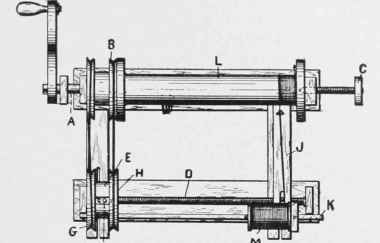
Fig. 211 - Details of the coil winder.

Fig. 212 - General view of the coil winding machine.
The wire will wind trne, and the coils will have the same pitch as the feed screw. Two slots are cut in the cross pieces of the frame for two small bolts to be used for tightening the belts. The two string belts are placed entirely around each wheel, to prevent slipping.
Continue to:


My Books

