


Focussing Cameras
Description
This section is from the book "Workshop Receipts For Manufacturers And Scientific Amateurs. Supplement Aluminium To Wireless", by The Chemical Publishing Co.. Also available from Amazon: Workshop Receipts For Manufacturers And Scientific Amateurs.
Focussing Cameras
Focussing is carried out by means of the large milled knob fitted to the left-hand side of the camera, as shown in Fig. 22.
This works very simply, and will adjust the focus to a very fine degree, being worked on racks built into the sides of the camera.
The front is stiffened by side struts of considerable strength, and when extended is extremely rigid. The reflex hood, which is so essential a feature of the camera, is housed in a special top frame, secured by an adequate catch. On releasing this catch the hood springs up into position automatically. Particular attention has been paid to the form of this hood, the top of which is purposely made soft, so that it will fit the face comfortably.
The ground glass, on which the image is projected by the lens, is fitted with the smooth side uppermost. This prevents reflection.
The hood frame is hinged and can be raised for cleaning the top focussing screen.
The mirror is silvered on the surface, and therefore gives a perfectly pure bright image, and quite free from halation.
When not in use it can be raised and locked by turning a small knob fitted to the side of the camera.
The shutter release, Fig. 22, which also raises the mirror, will be found conveniently placed for the thumb at the right-hand side of the camera. A slight pressure on this raises the mirror to the level of the top focussing screen, and when the shutter is set (as will be described hereafter) this action will also release the shutter, and will enable the rays from the lens to pass through on to the sensitive plate, held in the back of the camera in the plateholder.
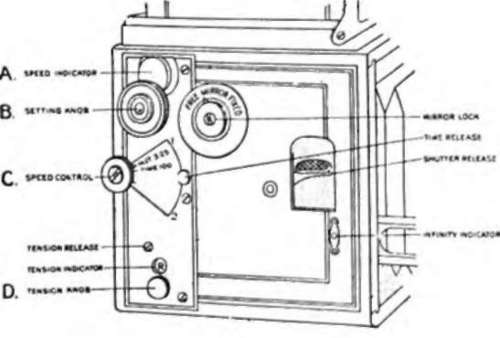
Fig. 22.
Revolving Back
The back of the camera is fitted with a frame, which revolves, and is perfectly light tight. Thus the plate can be moved to the upright or horizontal position at will, even though the shutter may have been set, and the slide of the plateholder withdrawn.
N.B.-The postcard size model is not fitted with a revolving back, and is made for horizontal position. To provide it with a revolving back the body of the camera has to be very considerably increased, making it very cumbersome and heavy to carry.
When upright pictures are required, the camera may be turned very easily on its side, and the exposure made.
Plateholders
The plateholders or dark slides, which are all metal, and very accurately made, hold one plate each.
These slide into a special metal frame at the back of the camera, and are held in position by a spring catch.
Alternately the camera may be fitted with double book form mahogany plateholders, which carry two slides, and are opened somewhat in a similar manner to a book. These slides are particularly useful for colour photography and Auto-chrome plates.
The back is provided with a hooded focussing screen, so that when time exposures are being made the top screen need not be used, and focussing may be carried out through back.
The Focal Plane Shutter
The shutter fitted to the Popular Pressman Reflex camera is extremely simple, and very reliable. It has no adjustable slit with tapes liable to wear, nor need the camera be turned away from the actual exposing position, in order to consult a speed plate or dial. The shutter is constructed on what is known as the " fixed slit " principle, and consists of one long blind, with three slits of varying sizes, which are passed in front of the plate by means of a very simple mechanism.
The range of speeds may be varied from 1 /15th second to l/1000th, so that it will readily be appreciated that practically every subject which comes within the range of photographic activity can be taken to the best advantage with a Popular Pressman Reflex camera.
Manipulation
Exposure depends on two factors :
(1) ;The size of the slit passing across the plate.
(2) ;The speed at which the slit passes across the plate.
Setting The Shutter. Instantaneous Exposures
The speed indicator (A, Fig. 22) has two slots marked " R." (rapid) and " E.R." (extra rapid). When the shutter is wound up a speed will be shown at each successive stage in the indicator.
If a " rapid " speed is required, set the tension knob D to " R."
If an " extra rapid " speed is required, wind the tension knob until " E.R." appears in the tension indicator.
If an intermediate speed is required, put on whatever proportiona le tension you consider necessary.
For exposures from 1/15 to I/3U, turn knob C to position 2. For exposures from 1/60 to 1/1000, turn knob C to position 1.
Time Exposures
Turn knob C to position 1, and wind the blind until "15 (one fifteenth sec.) and 30 (one thirtieth sec.) " appear in the indicator.
Exposure is then made by time release, a first pressure opening the shutter, and a second closing it.
N. B.-When making the time exposure, it should be remembered that the mirror must be locked out of position. The mirror lock should be turned to 44 fixed " and the mirror raised.
The provision of a separate release for time exposures is to avoid moving the mirror, which might cause movement in the subsequent result.
Example 1
Exposure required 1/350th sec. (knob C at position 1). Wind up until 350 appears-tension at " R."
Example 2
Exposure required 1/500 sec. (knob C at position 1). Wind up until 350-1,000 appears- tension half-way between R and E.R.
When And Where To Use Various Exposures
1/15th to 1/30th.-Portraits and groups under trees, or in shadow, interior pictures where light is extremely good, and full aperture can be used. Not fast enough for moving objects.
1/60th to 1/150.-Objects moving comparatively slowly, snap-shots in a good light, where aperture of f/8 or f/ll is desirable to obtain definition all over the plate.
1 /350th to 1 /1000th.-Sports pictures, and all fast moving objects. Largest aperture should almost invariably be used.
N.B.-When taking pictures of objects moving very rapidly, try to avoid taking up a position directly at right angles to the direction in which the object is moving. Endeavour to place yourself either in front or behind the object.
Do not approach nearer to the object than is absolutely necessary, as movement becomes relatively faster, the nearer the camera is to the object.
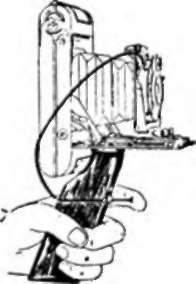
Fig. 23.
Fig. 23 shows an ingenious device which enables one to make an exposure holding the camera at arm's length, and to fire the shutter as though it was a revolver. It is particularly useful where a high obstruction or a crowd makes the ordinary method of using a camera impossible.
Continue to:


My Books

