


Painting By Spraying
Description
This section is from the book "Workshop Receipts For Manufacturers And Scientific Amateurs. Supplement Aluminium To Wireless", by The Chemical Publishing Co.. Also available from Amazon: Workshop Receipts For Manufacturers And Scientific Amateurs.
Painting By Spraying
It is now many years since the first paint spray was invented, and such tremendous progress has now been made that the spray painting method is recognised to be the most economical and efficient method of finishing all classes or articles and surfaces ranging from small photographic work, cameras, gramophone cases and other small objects up to the painting of buildings, bridges and battleships.
This finishing system enables all classes of paints, enamels, varnishes distemper, and other liquid coatings to be efficiently applied to all kinds of surfaces by means of compressed air and the system is so rapid that practical experience of many different industries has proved that one operator can easily equal the work of from four to eight men working with a brush, depending on the nature of the job.

Fig. 137.
On large surfaces the average area that can be covered by one operator with the Aerograph spray is from 30 to 40 square yards per hour, allowing for the operator to move his tackle from point to point, but these speeds can be considerably increased if he is working on the ground or on straightforward work.
Two operators using the spray at a well-known Kursaal recently did a job in six hours which in previous years had taken four men one week to do with the brush.
One Railway Company stated that during the repainting of one of their stations one man had satisfactorily sprayed 195 yards in 21/2 hours-which is approximately 75 square yards per hour.
A further example of the speed of application is that of an Omnibus Company who reported that their chassis had previously taken four hours to brush, but are now sprayed in half an hour.
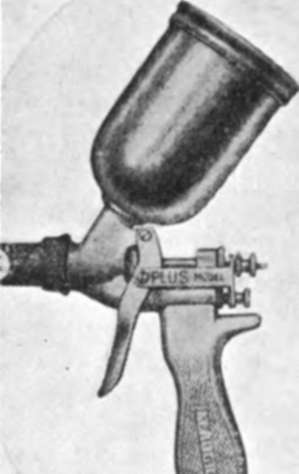
Fig. 138.
Speed of application is not the only advantage of the Aerograph finishing system, as it also produces an incomparably superior finish to brush work.
The coating applied is absolutely free from brush marks, sags, waves and other blemishes, and the paint is applied so evenly that in nearly every case it is found that one coat is equal in every respect to two brushed coats.
The Spray, Fig. 138, is advised for use in the average paint shop where small quantities of different colours are used, but it can be quickly adapted for the continuous supply of one colour from a large overhead container if desired, and in this case the paint tubing from the large overhead container is connected to the spray by means of a special tap in place of the small container shown in the illustration.
If it is required to spray large quantities of the same colour, or the spray has to be used at various, angles to coat the work effectively the Aerograph Painting Unit is more suitable, Fig. 139.
The complete painting unit comprises the " H" Model Spray, a complete set of tubing and the paint container, which is of two gallon capacity, and is fitted with a pressure gauge and regulating valve.
A simple turn of this regulating valve enables the operator to constantly control the flow of paint to the spray so that materials of varying thickness may be used with the utmost efficiency.
Both the "Plus " Model, Fig. 138, and the "H " Model Sprays, Fig. 139, have a revolving air cap which gives either a horizontal or vertical fan spray for covering large surfaces, or a small round jet for touching up purposes by simply turning it.
An adequate volume of air at the correct pressure is absolutely essential for spray painting, and the selection of the right type of Air Compressor is of the utmost importance.
Compressed air always contains a certain amount of water, oil and dirt, and these undesirable factors must be removed if a satisfactory surface is to be obtained.
The Aerograph Air Purifier ensures a supply of clean, dry air at the spray, and also permits the operator to easily vary his pressure for different liquids without having to leave the spraying point to adjust the regulator of the Air Compressor.
Under certain conditions it may be necessary to instal some form of exhaust plant to remove the fumes arising from the finely atomised paint and a complete Painting Plant, Fig. 141, which is widely used for the painting of bridges, buildings, ships, gasometers and constructional iron work.
Directions for Setting up Spray Painter Unit, Fig. 139 :-1, Attach Hose "A "to main air supply.

Fig. 139.
Aerograph plant ensures cleaner and more healthy conditions for the workers than are usually found in most brush shops where little provision is ever made for changing the air in the room.
The Aerograph " A " Pattern Handpiece, Fig. 140, is used for all classes of photographic and artistic work, and will produce a fine hair line or considerable masses of colour and broad surfaces as in the treatment of seas, skies and clouds.
At the other end of the scale is the Aerograph Portable Spray 2, Attach hose " Al " from paint pot to handpiece. 3, Attach hose " P " for paint or liquid supply from tap of pressure paint pot to handpiece. 4, Thoroughly mix and strain material to ensure that it is free from any foreign matter. 5, Tighten thumb screws on paint container until same is airtight. 6, A stirrer " D " for agitating the paint is provided. Paint should be occasionally stirred to maintain proper consistency. 7, Regulating valve " C "for controlling the air pressure on paint.
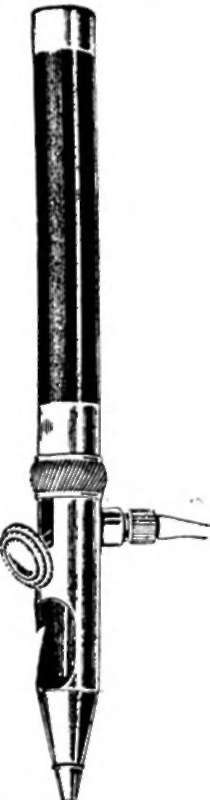
Fig. 140.
Working Instructions
When using the Spray, to obtain best results, the operator should be trained to release the finger lever at the end of each stroke, and work in overlapping bands ; this ensures a level coating.
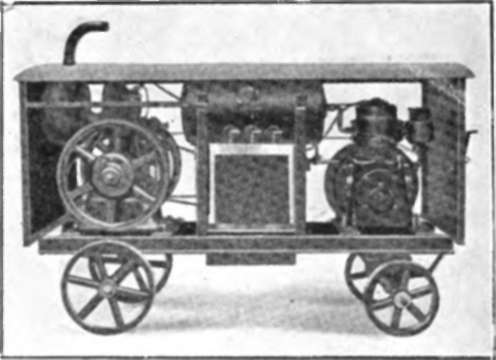
Fig. 141.
The adjustment of the Air Valve " C " on paint pot regulates the flow of the paint or liquid to the nozzle of the handpiece. It is necessary to take particular care that just sufficient pressure is placed on the paint to give a steady flow to the nozzle- -too much pressure will send the paint out faster than the air can atomise. Screwing down the nut on the top of the valve increases the pressure. If too much pressure is placed on the paint, turn off air supply and unscrew the filler cap and release the air, then by adjustment of valve the correct pressure can be easily obtained.
Continue to:


My Books

