


A Lecture By Francis Murphy, The Temperance Orator. Continued
Description
This section is from the book "Haven's Complete Manual Of Practical Phonography", by Curtis Haven.
A Lecture By Francis Murphy, The Temperance Orator. Continued
The Chairman. - Mr. Murphy, you have only three minutes to catch the boat
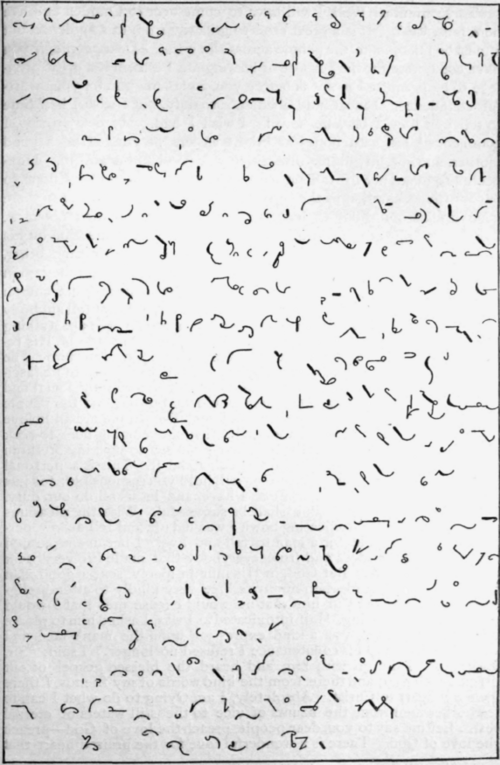
Three minutes! Well, I will have to come over to Camden and live here for a week. It is a great cross to go away from this audience, but I must be punctual to the people across the water. Dear people, if you have come here for the purpose of hearing me, I esteem it a great privilege to be permitted to speak before you, and thank you for your heartfelt confidence. I must hold obedience to duty, but I wish I had time to tell you how I became saved. I wish I had. My dear friends, I commenced life with hopes as bright as any of you. Had a good mother, and she taught me that which was good and beautiful. I expected to make her life radiant with sunshine, and would have done so but for the fascination of the intoxicating bowl. Some people say there is no fascination about it, but there is a great fascination about it. Notice the jollity of the drinking man, the cheerful expression on his countenance. How hearty the drinking men meet with each other. "Here you are, Bill! Let's go in and take something." And they go in and set them up and down. Do you "know what is hurting the church to-day. We are so quiet about our religion. We do not tell anybody about it. We are afraid to pray in prayer meeting. We are walking in the highway of the saints, but when we get up at the stile of His redeeming love we can hardly tell whether we are saved or not. The people are not in love with our religion. If everyone were to be fascinated by their religion, and would talk about it, showing by genial and kindly conduct their character, they would find peace, and the people would come in through the church windows. The people are all in love with a religion that you talk about, and they are coming here to seek for it. And this, I think, is the best that I can say to you, my brethren here who have signed the pledge - speak about it. This is a personal responsibility. Remember that God will hold you responsible; for you have a duty to perform the same as I have, and let us all do our duty. Trust in God, and verily thou shalt be successful. With the pleasures that lie around the intoxicating bowl, I was led off, and fell as low, perhaps, as it is possible for a man to fall and live. I became separated from wife and children and from everybody that made life very dear and precious to me. But God, in His infinite mercy, sent a good man to speak to me. And when he invited me very kindly to attend religious service, I begged of him that he would excuse me; that I would not disturb his meeting. Half intoxicated as I was, I asked him to please excuse me, but there was a kind expression upon the man's face, and when I looked into his countenance I refused no longer. I said: "Sir, I will go." I did go with him, and heard the blessed gospel of our precious religion; and there, from the kind words of my friends, I there gave my heart to Christ. Absolutely, I am trying to do what I can to lead other men from the haunts of vice to the still waters of eternal rest. Let me say to you, dear people, preach the love of God-preach the love of God. There is a wonderful love for the bruised heart that he cannot tell anything about himself, and we know not how much we can forgive until we are an outcast. I wonder, if your boy should ask your forgiveness of a great crime that you knew him to be guilty of, would you give it? You would say: "I will forgive my boy." Why? Because he is your boy. Therefore, let me say to you: keep this work going in this place with acts of cheerfulness and love, and of kindness. Good night.
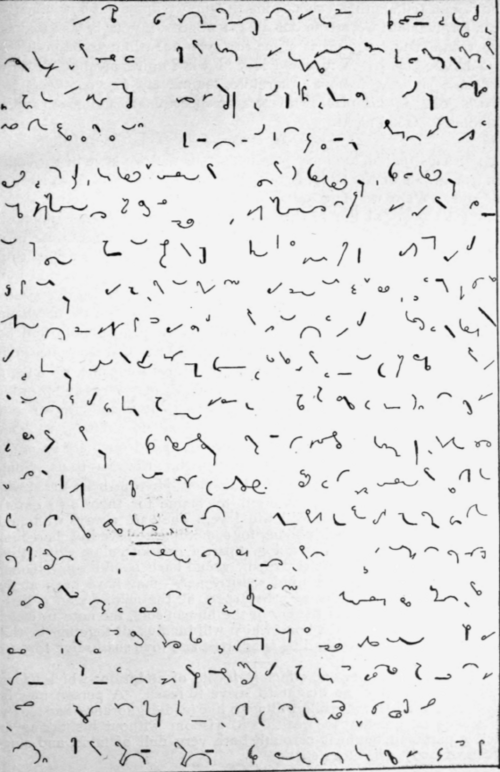
Perhaps one of the most positive proofs that we have of the soul's independence of the body, is our great need of love and of something to love. Were we mere animals, creatures doomed to perish after a few brief years of life in this world, that which contents the brute would content us. To eat and sleep well, to have an easy time of it, would be enough. As it is, we may have these things, and health to enjoy them and yet be utterly wretched. Neither can mental food satisfy us. "Some one to love" is our heart's cry. When the atmosphere of tenderness is about us, we rejoice; when people are harsh and unkind, we suffer. We begin life, wishing to love all people, and believing that they love us. Experience hardens us. Our dear ones grow fewer; but, as long as reason lasts, we must love some one, we must at least imagine that some one loves us. The parents, sisters and brothers and that dearest friend whom we promised to love and cherish until death, these come into our lives and fill them up. Afterward come the little children, frail, helpless babies, who need our care so much, and friends to whom we are not kin, yet who grow dear to us. Some have many loved ones, and some but one. Heaven help those who have none, though they are often to blame for their own empty heartedness; for kindness will win love. They are always wretched, and they often show their craving for something to love by cherishing some dumb animal, such as a dog, a parrot, or a kitten, on which they lavish caresses which, better spent, would have bound some human heart to theirs. Pride - morbid sensitiveness-may have been at the bottom of their loneliness, and these pets fill the aching void a little. Some one to love! It is the cry of the human soul, the note to which every heart responds; the bond which will bind us all together in that world where mourners shall be comforted and love shall reign forever.
That life is a poor one which is devoid of ambition; which has no object to work for; no height to strive to reach. A person may be good and kindhearted while willing to live in idle ignorance and let the world go on growing in wealth and wisdom without his taking an active part in it, but he is certainly both very dull of mind and slug-glish of body who does so.
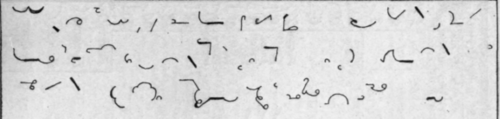
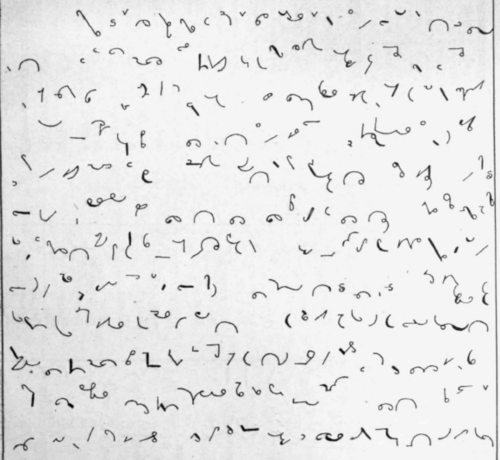
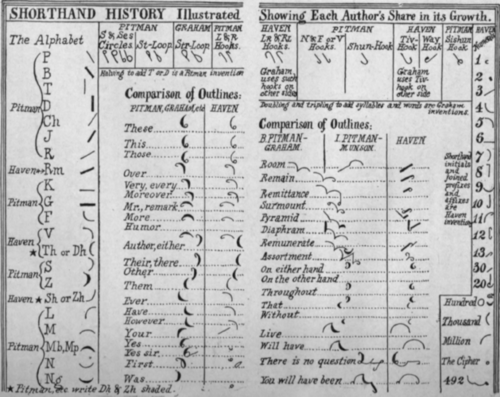
The upper right-hand quarter of any circle (see the Haven V) is the easiest quarter to write ; the lower left-hand quarter of any circle (see Pitman V) is the hardest quarter to write ; and Pitman. Graham. Munson, etc., make it still harder by thickening it. V being a very frequently occurring sound, it should have an easily written outline. Haven's use of the easiest quarter of a circle for that sound adds ten per cent. extra speed to such shorthand writing, besides facilitating phrasing and easy junctures. See examples in Comparative Outlines above.
There are many backward written characters in Pitman. etc., which are written forward in Haven, meaning greater speed for the latter. Hooks, initial and final, are also on common sense plan in Haven style, whereas in Pitman, etc., they are arbitrary.
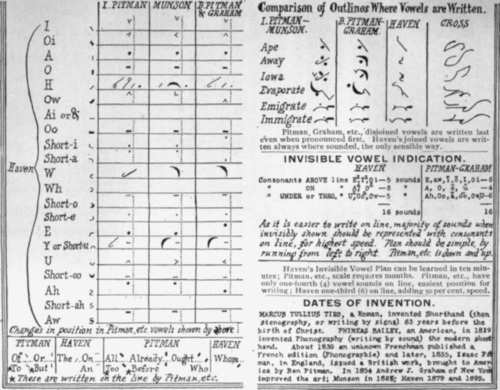
The necessity for writing a vowel occasionally in reporting is not a matter of system, but of the language. Haven uses them no more than others, but when used on the Haven plan, they are always distinct and quickly placed. Pitman, Graham, etc., vowels are uncertain, as it is hard to place them quickly in proper position to their consonants. Haven's need no position, because joined where sounded.
Haven's Practical Phonography Rains its- ...
Simplicity - By an alphabetical scheme containing but one sign for a sound and simple signs at that; by its easy invisible vowel scheme, its abolition of unnecessary rules, and the general avoidance of arbitrary principles ; doing a way with the need of shorthand dictionaries and_ phrase -books
Speed - By easy flowing curves, joined vowels, the absence of compound letters, no syllable dis junctures, a preponderance of light outlines, and unparalelled facility for legible phrasing.
Legibility - By the ability to join vowels where they belong and thus write proper names in full when necessary ; by theomission"of exceptional applications of principles, the necessity for no clashing of arbitrary word-signs, and the ability to indicate the number of syllables in words.
The points enumerated on these two pages make Haven's Practical Phonography the most rapid system extant; the only method of shorthand writing available for one writer when phonography or penmanship are employed; and the only method wherein the notes of one writer, when correctly written, can be read with certainty by any other writer of the system.
Continue to:


My Books

