


Position Vocalization
Description
This section is from the book "Haven's Complete Manual Of Practical Phonography", by Curtis Haven.
Position Vocalization
As in this lesson are represented words having two joined consonants, it is necessary to state that, in general, the invisible vowel sound is indicated by the first consonant of a word, no matter what position the other consonants may happen to be in, as in sign 41, the invisible vowel O in ropes being indicated by the position of the first consonant R, and not by the second consonant. This is the rule. But like most rules in life it, of necessity, has an exception, but only one: That exception existing in instances where the small consonants, Hay, Way and Whay, or the horizontal consonants, K, Gay, M and N, are followed by a descending letter, as in signs 42 to 47, inclusive, in which case the invisible vowel is determined by the position of the second consonant, instead of the first. But it is only when the second consonant is a descending one that the exception applies, as otherwise the regular rule governs Way, K, Gay, etc., as well as other consonants.
In words of two syllables, such as berry and funny (signs 49 and 50), the concluding letter Y is pronounced somewhat like the short-i in bit, or like an E. Those words, then, in spelling by sound, must be spelled ber-e, berry; fun-e, funny; and, being spelled phonographically with those sound letters, they must be written accordingly; hence the final letter Y in those and similarly constructed words is written with the E sound of Y indicated invisibly, but not by position, because not necessary.
It is impossible, in writing words of two or more syllables, always to give each syllable the proper position required by its particular vowel. As a general rule, only one syllable in a word can be accommodated in this respect, and the syllable thus honored should be either the first, as in sign 50, or the syllable containing the most conspicuous vowel, which is generally the accented one. There are instances, however, in which it is not necessary to apply this rule. Those instances are found in words, the phonetic outlines of which are so extended that their meaning is sufficiently distinct without recourse to any especially significant position, and which are, therefore, written in the second position, the easiest position in which to write. Sign 52 in Exercise.
It may be asked what rule will determine whether sign 50 in Exercise spells fun or funny, since both words contain the same consonants, F and N. To this the author replies that each alphabetical consonant may indicate an invisible vowel after it, and there being two full-sized consonants (F and N) in funny, there may also be two vowels indicated, one after each consonant, as there happens to be (f u and n-e), which, vowels and consonants, spell funny. Fun would have been written with only one full sized consonant (an F), the N in fun being indicated in another manner, the explanation of which is reserved for future lessons.
It would be unprofitable to students were the author to take up space in the descriptive part of a lesson to presuppose instances ahead of the principles already described in the lesson. And, furthermore, such a method, in addition to being a waste of time, would have no other effect than to confuse.
It is, therefore, best for students not to worry themselves about future possibilities - wondering whether such a manner of writing a word will or will not cause confliction with other words not in the lessons, etc., etc. Better learn the lessons just as they are, reading the Exercise as the Key says, and writing words in the Key as the Exercise directs, and the student will be sure not to go astray. Remember that everything cannot be explained in one lesson, and that if students will be satisfied to take instruction as it comes, they will find all their questions answered and all their conundrums solved by the time the last lesson is reached, while most questions will solve themselves as one progresses.
Students must expect, at first, a little difficulty in reading purely consonant outlines, but this difficulty will diminish with each lesson, and entirely disappear with practice in reading.
In sign 39 in Exercise, the big circle-Ses is written above the line for the word cease, and in sign 40, the small circle-s is also added inside the large circle to make ceases.
Additional practice in joining the circle-S and Ses is given in signs 33 to 38, inclusive. The word necessity, sign 51, is spelled ne-scs-te, as it is easy to read it in that shape, while such outline is easily written.
Accustom yourself to holding your pencil between the first and second fingers, and not between the thumb and first finger. The latter may be correct for ordinary penmanship, where the letters all slant in the same direction, but in shorthand the letters slant in so many ways, many of them backward and perpendicular, that to accurately write such shorthand characters it is necessary to hold the pencil as advised.
Exercise IV
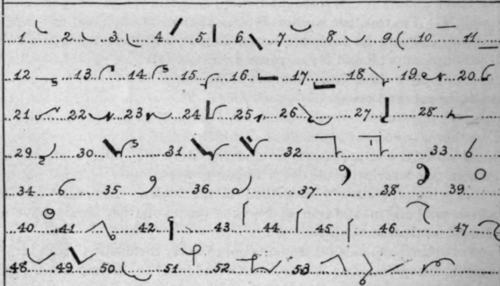
Key IV.
1, Fee; 2, foe; 3, few; 4, joy; 5, dough; 6, bough; 7, knee; 8, know; 9, thou; 10, key; 11, cow; 12, caw; 13, low; 14, law; 15, allow; 16, ago; 17, ague; 18, payee; 19, snowy; 20, Louis; 21, Uriah; 22, Noah; 23, Owen; 24, Dale; 25, Howe; 26, Pine ; 27, Doe; 28, Hook; 29, Shaw; 30, Beu-lah; 31, Boyle; 32, Katie; 33, chase; 34, sale; 35, sash; 36, shows; 37, size ; 38, sizes ; 39, cease; 40, ceases ; 41, ropes ; 42, wooed ; 43, hit ; 44, hate ; 45, hut; 46, myth ; 47, mouth ; 48, ferry; 49, berry ; 50, funny ; 51, necessity; 52, customary; 53, Ripe peaches are wholesome.
Continue to:


My Books

