


Respecting Practice
Description
This section is from the book "Haven's Complete Manual Of Practical Phonography", by Curtis Haven.
Respecting Practice
A plan of practice in writing which will much accelerate the student's proficiency, is that of practicing in precisely the same manner a regular phonographic reporter works. To accomplish this object, procure a reporter's note book, either by purchase or making it yourself. These books are about the size and shape of a common pass-book, and nearly half an inch thick, to admit of lengthy reports being taken; but, unlike most other note books, they open at the bottom instead of at the side, and when in use, only one side of the paper is written on - that which is nearest - and, afterwards, when those pages are all written upon, the book is turned and the other sides are ready for use. This method always secures a good foundation for the phonographic writing, and prevents in a great measure awkward illegibility.
Some teachers claim that a good plan of study for the purpose of gaining familiarity with a large number of words, is for the student to get a common spelling-book and practice on all the hard words therein. Practice of this sort, it is claimed by such teachers, will go a great way toward making easy the path which leads to rapid writing. This is in a measure true, though only of the student who has thoroughly memorized all the Exercises of the lessons - for others it will simply delay progress. In fact, any attempt of the student, until he has finished the lessons, to write words not in the lessons as far as he has learned, is to be deprecated, for the reason that, until all the principles of the art have been learned, he is sure to make imperfect outlines for words containing principles at which he has not arrived, and his eyes are unfortunately too apt to make mental pictures of such wrong outlines, and when he comes to practice for speed, after the lessons are finished, he will find difficulty in avoiding those bad outlines. Every lesson should be well learned before the student makes any attempt at writing words not in the lessons he has learned. Then, when all are learned, he will, by having in mind all the principles, be enabled to more readily form words not in the lessons.
Exercise X
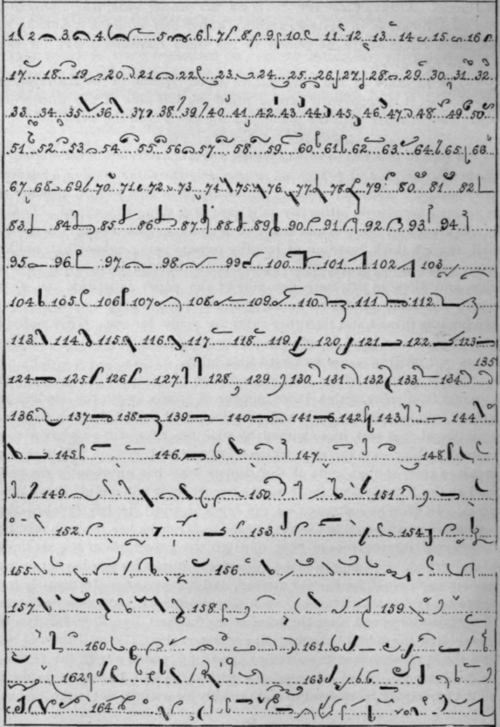
Key X.
1, they are; 2, may be; 3, we may be; 4, they may be likely; 5, you may be certain; 6, it will; 7, which will; 8, much will; 9, at all; 10, for all; 11, of all; 12, to all; 13, on all; 14, and all the; 15, and will you; 16, who will; 17, in all; 18, my own; 19, our own; 20, have been; 21, more than; 22, softer than; 23, no one; 24, none; 25, some one; 26, at one; 27, at once; 28, and our own; 29, on our; 30, but our; 31, of ours; 32, of our own; 33, to ours; 34, to our own; 35, by your; 36, by our; 37, who are; 38, each are; 39, which are; 40, or not; 41, but not; 42, did; 43, I did not; 44, I go not; 45, I had not; 46, be not; 47, have not; 48, I will not; 49, we will not; 50, we are not; 51, I think not; 52, am not; 53, may not; 54, we mean; 55, we meant; 56, we may not; 57, we meant not; 58, we might not; 59, clear off; 60, set off; 61, set forth; 62, call forth; 63, we are of; 64, which are of; 65, out of; 66, or if; 67, but if; 68, and of; 69, which have; 70, all have; 71, who have; 72, I have; 73, to have; 74, I have been; 75, I have to be; 76, to have been; 77, it has been; 78, such has been taken; 79, let us; 80, sent us; 81, send us; 82, talk; 83, task; 84, transaction; 85, desire; 86, dissection; 87, destroy; 88, desolate; 89, dissolute; 90, last; 91, lost; 92, lowest; 93, wheat; 94, white; 95, stock; 96, stack; 97, marked; 98, market; 99, greatly; 100, gradually; 101, read; 102, re(a)d; 103, murder; 104, days; 105, saith; 106, said; 107, survey; 108, circle; 109, circular; no, vagrancy; 111, va-grans; 112, va-ga-ran-cy; 113, member; 114, remembrance; 115, brother; 116, brethren; 117, equal; 118, equaled; 119, imaginary; 120, imagination; 121, govern; 122, governor; 123, again; 124, against; 125, angel; 126, angelic; 127, Dear Doctor; 128, measured; 129, measure their; 130, over; 131, over their; 132, overthrow; 133, overcome; 134, every; 135, everyone; 136, everything; 137, organs; 138, organize; 139, organic; 140, organism; 141, organization; 142, Tell the difference; 143, The truth of a question; 144, Liberty is the best government; 145, Till you agree to call; 146, The organ, then, belongs to Mr. White; 147, To the Christian, eternity means union; 148, Delivered from an awful internal danger; 149, Many people appear to be more able than lucky; 150, Mercy and Truth are attributes of Jehovah; 151, The very measure I began to fear is on appeal; 152, Learn to humor the aged, but kindly govern the child; 153, Denominate alone a degree of juvenile philanthropy; 154, A providential revelation was the defendant's testimony; 155, Poverty often applies the lash which leads to ultimate honor; 156, We base our opinions upon information often second-handed and withal faulty; 157, Above all things remember that principles need not be prejudices; 158, Until you assure me to whom they belong, you shall retain them; 159, Punishment is the pleasure of the cruel, the manner of a darkened mind; 160, Phonography has had its revolution here and most of its difficulties have vanished; 161, This generation can only imagine the remarkable glory which awaits the human race of the future; 162, True religion is from within, and is that divine belief which sees a brother or sister in every human countenance; 163, Generally the work which is well begun is nearly done; moreover, it is equally sure that the conditions will be less wearisome; 164, Your next lesson is number eleven. When through with it and the twelfth, begin all the lessons again and review each one thoroughly until your advance in the art has brought speed and ease in reading.
Continue to:


My Books

