


Small Visible Letters
Description
This section is from the book "Haven's Complete Manual Of Practical Phonography", by Curtis Haven.
Small Visible Letters
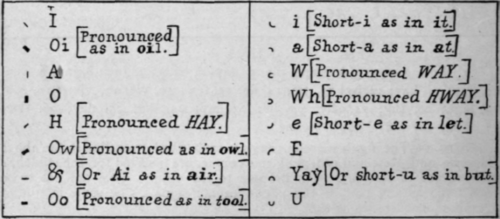
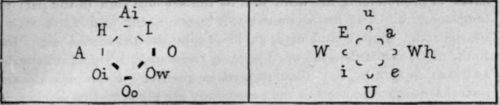
By the foregoing list of small signs, students are introduced to sixteen more letters of the Visible Alphabet, the three consonants (Hay, Way and Whay), and thirteen visible vowels - each pair of letters slanting or curving in the same directions and occurring in same order as their larger prototypes in Lesson I. And, that their distinctions of outline may be the better memorized, the new list is reproduced in comparative form in the diagram at top of opposite page.
The letters Hay, Way and Whay, like the letters of first lesson, are used to spell words by position, above, on or beneath the line, signs 1 to 7, inclusive, indicating invisibly I by position above the line, A on the line, and U beneath.
Do not imagine, because some signs of above list have capital letters near them and others small letters, that such distinction is represented by them. There is no occasion for capital letters in Phonography, any more than in speech, and the use of a small Roman letter opposite a sign is simply to help the student to remember that that sign has a short sound; and, upon the same principle, a Roman capital letter near a shorthand sign in the shorthand alphabet simply means that such shorthand sign possesses a long or ordinary sound.
Write the shorthand letters of the present list in the following directions: E and short e, either upwards or downwards, according to convenience; Ai, Oo, Yay and U, from left to right. The other signs in above list write downwards.
The signs representing the sounds of H, W and Wh, must always be called and referred to as Hay, Way and Whay; the signs opposite the small letters i, a and e should be called short-i, short-a and short-e; and the other signs in accordance with the letters opposite them, & or Ai being either pronounced and, or the same as A, excepting perhaps a trifle more prolonged, like the two a's in the word Baal, though even if A and Ai be pronounced exactly as one sound, no difficulty would arise in their use, as will be seen by future lessons.
The signs represented by the small letters i, a, e and u require particular attention, and, explanatory of their use, it is necessary to say that to spell by sound (which is the only way spelling is done in phonography), there must be, when writing them, a separate sign for each and every distinct sound; and, as I, A, E and U have each more than one sound, we, therefore, in phonography, when writing each sound, represent it by a separate and distinct letter, the long sound of I, as heard in the word bite, being represented by the first sign in the list heading this lesson; the short sound of i, as heard in the word bit, being indicated by the ninth sign in same list; the ordinary sound of A, as heard in the word fate, by the third sign in the list; the long sound of Ai, as indicated in pronouncing the word fail, by the seventh sign in the list; the long sound of E, as heard in the word feet, by the fourteenth sign in the list; the short sound of e, as in met, by the thirteenth sign; long sound of U, as heard in the word pure, by the sixteenth sign, and short-u, as heard in butt, by the fifteenth sign in the list. Examples showing how these signs are used to the consonants are given in this Exercise.
By this lesson the student will observe that the vowel sounds of I, A and U are not only represented invisibly, as described in the last lesson, but also that those sounds have visible letters. The reason for the existence of two ways of representing the same vowel sounds - visibly and invisibly - arises from the fact that both are equally useful and necessary. The invisible means of representation, as described in Lesson I, is most frequently used-always, when, in ordinary words, either of their sounds occur after a consonant, wherein it is possible to place the consonant in position to indicate the presence of a vowel without writing such vowel. But, vowel sounds often happen to be complete words of themselves, and therefore unaccompanied by a consonant, as with the personal pronoun I, or the article A; or, when a vowel sound would spell a word of itself, as the vowel signs O and U do in the last part of the Exercise to this lesson, wherein the first four words of the sentence "I owe you a new tie" are represented simply by the visible vowels I, O, U and A. Then, again, such sounds are sometimes initials of personal names, as I for Isaac, A for Adam, etc . -in which cases invisible representation could not be employed. Sometimes, too, though not frequently, personal names are best written with them, and generally foreign terms. Again, the vowel sounds of I, A and U were, in last lesson, represented invisibly after a consonant, not before one; and, as there often occurs instances in which the vowel sounds are the commencing letters of words and therefore precede the first consonant of such words, it sometimes becomes necessary to write them as in the Exercise to this lesson, signs 8 to 34 inclusive.
In those signs, 8 to 34, it will also be seen that such outlines invariably rest upon the line, that position being the proper one for all letters of the alphabet when not indicating invisible vowels, as well as when indicating the second place invisible vowels. It is only when a first or third position vowel is to be indicated invisibly that written characters are placed above, through or beneath the line.
Be sure to learn every Exercise strictly in accordance with the four rules preceding the Exercise of Lesson I.
Further use of the visible vowels will be explained in next lesson, in which is given the concluding letters of the Visible Alphabet.
Continue to:


My Books

