


Goosander
Description
This section is from "The American Cyclopaedia", by George Ripley And Charles A. Dana. Also available from Amazon: The New American Cyclopædia. 16 volumes complete..
Goosander
Goosander , an American fishing duck of the subfamily merginoe and genus mergus (Linn.); besides the goosander (M. Americanus, Cassin), the subfamily includes the mergansers and the smew. The bird is about 27 in. long, and 3 ft. in extent of wings; the bill about 3 in., of a bright red color; weight 5 lbs.; the female is considerably smaller. Common names of this species are sawbill, sheldrake, and, for the female, dun diver. The feathers of the forehead extend in an acute angle on the bill; the nostrils are large, and near the middle of the bill; the plumage is full, soft, and glossy; there is a slight crest in the male; the wings and tail are short, the latter rounded, with 18 feathers; the iris is carmine; the feet orange red in winter, vermilion in the breeding season; the bill narrow, compressed, with a conspicuous black nail, the edges with sharp recurved serrations; tarsi two thirds the length of the middle toe, much compressed. The head and neck are metallic green; lower neck and rest of body beneath creamy white, becoming salmon red; fore part of back black; lower back, rump, and tail feathers ashy gray; most of the wings creamy white, except the greater coverts, which are black at the base, forming a black bar, and the tertials narrowly edged with black; primaries black; sides with slight transverse bars.
In the female the head and neck are chestnut; above ashy, salmon-colored below; the black base of the secondaries is entirely concealed, and there is less white on the wings. In the European sheldrake (if. merganser, Linn.) the bill is relatively longer and narrower; the elongated feathers forming the crest are longer and more erectile, and begin almost at the base of the bill; and the bar of black on the wings is concealed by the lesser coverts. The American bird was considered the same as the European, until separated by Mr. Cassin in 1853. The goosander is found throughout North America, breeding in the temperate and northern regions, in the neighborhood of both salt and fresh water; it is abundant in the fur countries. It is strong and active, a powerful swimmer, excellent diver, and rapid flier; it swims very deeply, presenting a small mark for the gunner, diving at the flash or at the click of the lock; it can run very well on land. It is very voracious, feeding on fish, mollusks, and reptiles; it dives for its prey, rising to the surface with the fish or other animal in its bill, and swallows it head foremost; its flesh is tough and oily.
The nest is made near the water, of weeds and roots, and is lined with its down; it is about 7 1/2 in. in diameter internally, and 4 in. deep; the eggs, 7 or 8, are 3 in. long by two broad, smooth, elliptical, and of a uniform dull cream color; the young of a few hours old are excellent divers. The note is a harsh croak. They are easily caught, like the loon, on hooks baited with fish. In their digestive organs, the mergansers are more allied to the divers (colym-bidoe) than to the ducks (anatidoe), and seem to form a connecting link between the two.
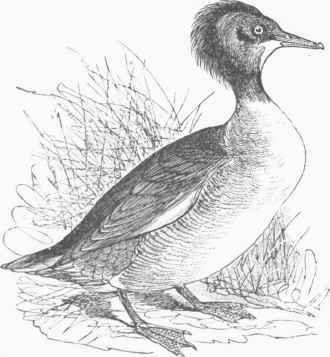
Goosander (Mergus Americanus).
Continue to:


My Books

