


Goose
Description
This section is from "The American Cyclopaedia", by George Ripley And Charles A. Dana. Also available from Amazon: The New American Cyclopædia. 16 volumes complete..
Goose
Goose , a web-footed bird, of the order an-seres and family anatidoe, of which the typical species are in the subfamily anserinoe. The other subfamily consists of the plectropterinoe, or spur-winged geese, in which the bend of the wings is armed with a spur or blunt tubercle; it contains the genera anseranas (Less.), of Australia; plectropterus (Leach), of Africa, having a naked protuberance at the base of the culmen and a part of the neck bare; sar-kidiornis (Eyton), of the warm regions of America, India, and Africa, having a large, rounded, laterally compressed caruncle on the top of the bill; and chenalopex (Steph.), of Africa and tropical America. Of the last the Egyptian or fox goose (G. AEgyptiacus, Linn.) is a species, bright-colored, and revered by the ancient Egyptians on account of its attachment to its young; it has been domesticated in that country. - The subfamily anserinoe, which includes the genera cereopsis (Lath.), anser (Linn.), bernicla (Stephens), nettapus (Brandt), and a few others, are characterized by a moderately long neck, bill elevated at the base, as long as or shorter than the head, narrowing to the tip, which is chiefly formed by a large nail, and region in front of the eyes feathered; the long tibia and tarsus elevate the body more than in others of the family, making them good walkers on the land, while they are also excellent swimmers; the plates on the front of the tarsus are small and hexagonal, as in the swans, and are not transverse scutellae as in the true ducks; the colors are rarely brilliant, white, black, and gray predominating, and both sexes, as in the swans, are colored alike.
In the genus cereopsis (Lath.) the bill is very short, with a large and broad nail; it belongs to Australia, where it wanders on the land in search of grasses, on which it principally feeds, being never seen on the water; the only species (0. Norm Hollandioe, Lath.) is of a gray color, of the size of the common goose, and is said to be easily domesticated. - The genus anser (Linn.) is characterized by a bill as long as the head, mostly red or orange colored; the lamella) of the upper mandible project below the edge of the bill as conical points; the nostrils open behind the middle of the commissure; the tip of the hind toe reaches the ground. The wild goose or gray-lag of Europe (A.ferus, Gesn.), the original of the common domesticated race, is of a gray color, with a brown mantle undulated with gray, and an orange bill. The bean goose (A. segetum, Gmel.) is by some considered a distinct species, and' by others a mere variety of the wild goose; the wings seem to be longer, and the forehead is marked with white spots; whether a species or a variety, the bean goose is probably more or less mixed with the former in some of the domesticated races.
Wild geese seek high latitudes in the breeding season and in summer, returning to the warmer parts of Europe in the winter; they are found mostly in meadows and marshes in the interior, where they feed in the daytime on aquatic plants, grasses, and grains; they walk well, and are very light on the water, on which they generally rest during the night; they do not dive, but plunge the head under water to the extent of their long neck; they are rapid and powerful fliers, migrating in two lines meeting at an acute angle; they are not polygamous, make their nests on the ground, and are very fond of their mates; the young are able to walk as soon as born, and feed of their own accord. The flight of wild geese is. performed without noise, and with an order which indicates considerable intelligence; each individual keeps its place in the ranks, the male bird at the head of the triangle or line, when it becomes fatigued, retiring to the rear, and the next one coming forward to take the leading and most fatiguing position. Their sight and hearing are acute, and while they feed or sleep a sentinel is always on the watch to give the alarm at the approach of danger.
The awkward gait, outstretched neck, gaping mouth, and disagreeable voice have obtained for the goose the character of stupidity, while in reality it is remarkably intelligent. The flesh is not very wholesome nor digestible. The Chinese tchin-tchu, or Guinea goose (A. cyg-noides, Gmel.), called from its size the swan goose, is more than 3 ft. long; the bill is orange, with a large knob or excrescence on the forehead; under the throat is a pouch, almost bare of feathers; the color above is pale grayish brown, with paler edges; a black lino on the back of the neck; anterior neck and breast yellowish brown; belly white; sides over thighs gray-brown and white; in some varieties the bill, knob, and legs are black; the throat may be wattled, and the plumage mostly or entirely white. Originally from China, they have spread extensively over Asia, Africa, and Europe, and have been imported into the United States; they mix freely with the common goose, producing fertile hybrids; they are very noisy and easily alarmed; they walk erect, with the neck much elevated, more like a swan than a goose.
Among the American species of the genus is the white-fronted or laughing goose (A. Gambelii, Harti.), which has been separated from the European bird (A. albifrons, Gmel.) on account of the greater length of the bill. The length is 28 in., and the extent of wings 5 ft.; weight about 5 1/4 lbs. The bill and legs are red; forehead white, margined behind with blackish brown; rest of head and neck grayish brown, paler on the throat; back and sides bluish gray, feathers anteriorly tipped with brown; breast and belly grayish white, with brownish black tints, white in the anal region; tail brown, white tipped; secondaries and end of primaries dark brown, rest of wing silvery ash, the greater coverts edged with white. This species is found over the whole of North America, but is rare along the Atlantic coast; they retire to the north in March and April, returning in October; they are not so shy as other species, and their flesh is considered a delicacy; their food consists principally of land plants. The notes are loud, resembling a laugh; hence one of their common names. The egg is 2 3/4 by 1 3/4 in., of a dull yellowish green color, with indistinct darker patches.
The snow goose (A. hyperboreus, Pallas) is larger, measuring 30 in. in length and 62 in extent of wings, with a weight of nearly 7 lbs. In the adult, the bill and legs are red; the general color pure white, with the primaries black toward the end and bluish gray at the base; the young, or blue-winged geese, have a more bluish and ashy tint, with patches of dark brown, constituting the A. coerulescens (Linn.), which some regard as a distinct species. It is found all over North America, breeding in the far north; when young, its flesh is tender, and far superior to that of the Canada goose; those that feed on the seashore have a fishy taste. The egg is yellowish white, 3 by 2 in. The usual food consists of grasses, rushes, insects, and in the autumn berries; it mates with the common goose, though the eggs are rarely if ever hatched. - The American wild or Canada goose belongs to the genus bernicla (Steph.), which is characterized by a bill shorter than the head, and by the black color of the legs; the lamellae of the upper jaw concealed by the margin of the bill; nostrils over the middle of the commissure; the hind toe elevated and rudimentary, not touching the ground.
The species of this genus migrate from the high latitudes of Europe, long, with an extent of wings of 50 in., and a weight of about 4 1/2 lbs.; in its color it is precisely like the Canada goose; the eggs are pure white, 3 by 2 in.; it is found throughout the northern and western parts of America; its flesh is of excellent flavor. The B. leucopareia (Brandt), from the west coast of America, is about 30 in. long, with an extent of wings of about 5 ft.; it resembles the Canada goose, but is smaller, and of a darker color, especially on the under parts. The brant goose (B. brenta, Steph.) is about 2 ft. long, with an extent of wings of 4 ft. and a weight of 3 1/4 lbs. This species may be known by the white crescent on the middle of the side of its black neck; the general color of the upper parts is brownish gray with lighter margins to the feathers; the wings and tail are darker, and the upper tail coverts white; lower parts grayish, passing into white behind. It is a salt-water bird, breeding in the north, and coming along the Atlantic coast on its return south in the middle of autumn; its flesh is considered a most savory food.
It is shy, a good walker, an excellent swimmer, and, when wounded, a most expert diver; its food consists of marine plants, mollusks, and crustaceans; it is easily tamed, and in captivity thrives well on grain, and produces young; the eggs are white. It is found on the Atlantic coasts of North America and Europe. It is replaced on the Pacific coast by the black brant (B. nigricans, Lawr.); the anterior part of the body of the latter is black, the rest dark plumbeous, with white patches on the throat, sides of rump, and tail coverts; the bill is wider than in the common brant. The barnacle goose (B. Ieucopsis, Bechst.) is 28 in. long, with an extent of wings of 4 2/3 ft., and a weight of a little over 4 lbs.; the forehead, cheeks, and lower parts are white, the belly with a bluish tint; the crown, neck, anterior back, rump, and tail black; mantle ash-colored. It is common in winter in northern Europe, especially on the western shores of Great Britain, but is doubtful as an inhabitant of the United States; it is a salt-water species, very shy, and highly esteemed as food; the eggs are yellowish cream-colored, about 3 by 2 in.
It owes its name of barnacle goose to the belief long entertained that it was produced by the barnacle, a cirriped articulate animal often found adhering to old wood; an opinion expressed so lately as 1636 by Gerard, in his "Herbalist." It has also been called tree goose from the belief that it originated from old and decayed trees. - There are several large species of geese in South America, of which the most remarkable are the antarctic (B. antarctica, Gmel.), the males snowy white, and the females black with transverse lines; and the Magellanic (B. Magellanica, Gmel.), ferruginous brown and black, with white wing coverts, and bar on tail. The painted goose (B. Canagica, Bon., or picta, Pall.), of large size, of a bluish gray color, with head, nape, and tail white, black throat with white dots, and quills with a black stripe anterior to the white tip, is common in the Aleutian islands, and is doubtless also found on the N. W. coast of the United States. - The last genus of an-serinoe is nettapus (Brandt), found in the lakes, rivers, and estuaries of continental India, Africa, and Australia. The bill is small and elevated, with short and widely set lamellae; the nostrils basal; wings moderate and pointed; tail short and rounded; the species are of small size.
Mr. Blyth says that "the Indian species seems totally incapable of standing or walking on the ground, but invariably flutters along it in a strange, scuffling manner, like a wounded bird; they always descend into the water, never alighting on the ground of their own accord." The Coromandel goose (N. Coromandelianus, Gmel.), of the size of a teal, has the head and neck white with black spots; crown black; lower neck with black lines; above brown with a greenish and reddish gloss; beneath white. - Prof. Baird places the genus dendro-cygna (Swains.) in the goose family, but most authors rank it with the anatinoe or ducks; it is allied to the geese more than to the ducks by the elevated base and large nail of the bill, the long legs, and the hexagonal scales in front of the tarsus; he describes three species as inhabiting the United States. - The common tame goose is the European wild bird domesticated, from which it varies considerably in color, though loss than ducks and fowls do from their wild originals; it tends to a general gray color, though the vent and upper tail coverts are always white; the males are sometimes entirely white, and the females generally cinereous and gray.
In England, Lincolnshire is famous for the raising of geese; on the continent, Hamburg, Bremen, and Emden, and their neighborhoods, raise the best breeds. The usual weight of a fine goose is 15 or 16 lbs., and by cramming with nourishing food this weight may be doubled; by confining the bird, to prevent motion, and employing fattening diet and stupefying substances, the body becomes loaded with fat, and the liver becomes enlarged and fatty with disease, forming the principal ingredient in the pates de foie gras so much esteemed by epicures. Geese are in the best condition for the table about Christmas time; in England the feast of St. Michael, and on the continent that of St. Martin, are almost universally celebrated by roast goose. Before the days of metallic pens, goose quills formed a considerable article of trade, the living bird being stripped once and sometimes twice a year for this purpose; the value of the feathers for beds and pillows is well known, the living birds being plucked from three to five times in a year, at which periods, if cold weather come on, many die; if well fed and cared for, a goose will yield about a pound of feathers in a season.
They generally breed only once a year, laying every other day, and depositing 7 or 8 eggs; incubation is about 30 days, and the female will sometimes produce enough for three broods, if the egg3 are taken away in succession; they begin to lay early, are close sitters, and careful of their young; they grow fast, are little liable to disease, and are fattened by grain in a short time; when in a locality where they can pick up much of their food, they are profitable to raise for their flesh and that of the goslings, for their quills, and especially for their feathers. In the United States the common tame goose of Europe, in which the ganders arc white and the females gray, is the most numerous, and perhaps as profitable as any. The white Bremen goose is of larger size, handsome, and easily raised, but less prolific and hardy. The China or tchin-tchu goose, with its variety the Guinea or African goose, is very large and swan-like, at maturity weighing 50 lbs. per pair. A cross between the last and the Bremen bird, called sometimes the mountain goose, is highly prized for the table, and attains a weight of 35 or 40 lbs. per pair; it comes to maturity early, and can be reared in 16 weeks to a weight of 14 lbs., dressed.
The Canada goose is sometimes tamed, especially in northern and thinly settled localities; it mixes with the common goose, though of a different genus, and the mongrels, which are not prolific, are considered a great delicacy. The goose is a very long-lived bird, its age having been known to equal 100 years. It is probable that many wild species, in different parts of the world, might by a little care be brought into a state of domestication, and thus increase the number of these useful birds.
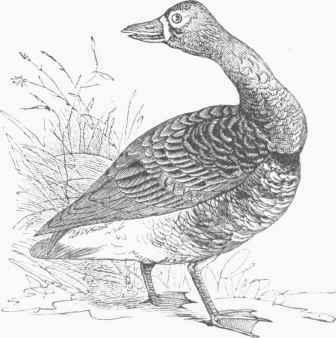
Laughing Goose (Anser Gambelii).
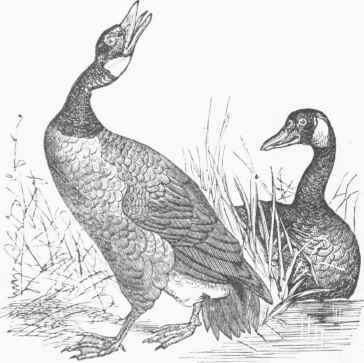
Canada Goose (Bernicla Canadensis).
Asia, and America, where they spend the summer, to the more southern parts in winter, especially South America; they feed chiefly on marine grasses and algoe, though some live far from water, eating seeds, berries, etc. The Canada goose (B. Canadensis, Linn.) is about 3 ft. long, with an extent of wings of 65 in., and a weight of 7 lbs. The head, neck, bill, feet, and tail are black; a large, triangular patch of white on the cheeks behind the eyes, confluent below; upper parts grayish brown, with paler edges; lower lid white; below grayish white, passing into pure white near the anal region; upper tail coverts white; primaries and rump dark brown. It is found throughout North America, and accidentally in Europe; the spring migration northward begins with the melting of the snow, from March 20 to April 30, and the return commences in the first half of September, the birds passing along the coast, but most numerous in the interior; their flight is very high, their "honk" often being heard when the bird cannot be seen, and very regular unless interrupted by fogs, storms, or unexpected accidents. The food consists of the seeds of grasses and aquatic plants, slugs and snails, worms, insects, tender blades of corn, and Crustacea, shell fish, and marine plants on the seashore.
They are not often found in company with other species; the senses of sight and hearing are very acute, and their stratagems for avoiding their enemies evince great cunning; they rarely dive, unless when attempting to escape, at which times both old and young quickly disappear. The males are very pugnacious during their courtship, and defend their mates against all enemies; the nest is built on the ground in some retired spot near the water, of dried plants; the eggs of the wild bird are usually about six, though the domesticated birds lay a few more; they average 3 1/2 by 2 1/2 in., are smooth, thick-shelled, and of a dull yellowish green color; the period of incubation is 28 days, and they have only one brood in a season; the young are able to follow their parents to the water in a day or two, but many are destroyed in spite of the watchfulness of the mother by snapping turtles, gar fish, pickerel, and birds and beasts of prey. They are shot from ambush at their feeding places, and may be attracted by living or artificial decoys; the flesh of such as have lived in the interior is very agreeable, but rather strong and fishy in the shore-fed birds. Besides man and the animals just mentioned, their worst enemies are alligators, the couguar, lynx, and raccoon, and the white-headed eagle.
They are readily domesticated, and when tame are advantageously crossed with the common goose, the resulting brood being larger and more easily raised and fattened than the originals. The flesh and eggs are valuable as food, the feathers for beds, the quills for writing purposes, and their oil in domestic medicine. Hutchins's goose (B. Hutchinsii, Rich.), called by the gunners winter or flight goose, is 25 in.
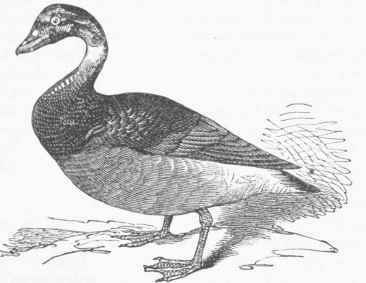
Brant Goose (Bernicla brenta).
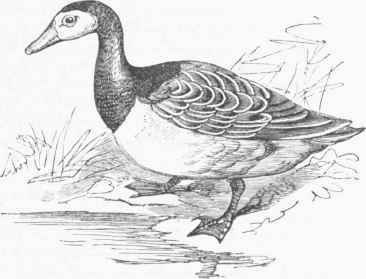
Barnacle Goose (Bernicla leucopsis).
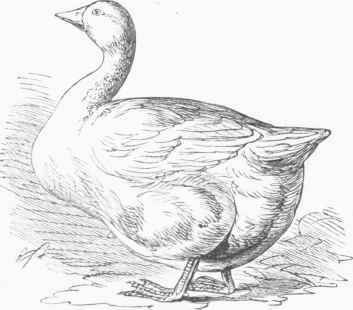
Bremen Goose.
Continue to:


My Books

