


Goose Fish
Description
This section is from "The American Cyclopaedia", by George Ripley And Charles A. Dana. Also available from Amazon: The New American Cyclopædia. 16 volumes complete..
Goose Fish
Goose Fish , an acanthopterous fish of the lophioid family, which contains some of the most hideous and voracious of the class. It belongs to the genus lophius (Artedi), characterized by a head enormously large, broad, and flat; the body slender, smooth, with two separate dorsal fins; the mouth very wide, the lower jaw the longer, armed with numerous movable, sharp, conical, recurved teeth on the jaws, palate, vomer, and pharyngeal bones; tongue smooth; branchial rays six, and branchial arches three. Numerous fleshy appendages or cirrhi are arranged along the edge of the lower jaw, the pectoral fins, and to the base of the tail; there are several spines upon the head, two just behind the snout, others over the eyes and at the back part of the skull; the anterior rays of the dorsal, situated on the head, are separated as two slender tentacles, the first generally with a fleshy appendage, joined to the skull by bony rings, and capable of free motion at the will of the animal. The pectorals are elongated into a kind of arm, the rays representing fingers, by which some members of the family are enabled to move as upon legs; hence Cuvier's name of pectorales pediculati; these fins are large and digitate at the end, and behind and beneath them are the large branchial apertures; the ventrals are stout and fleshy, considerably in front of the pectorals; the tail is stout and digitate at the end.
The eyes are large and oval; the nostrils are peculiar in being placed at the end of an erectile tube, the summit of which expands like the cup of a flower, and which is directed toward any odorous object. The skeleton is fibrous rather than bony; the stomach is very large and muscular, and the intestine short; the spinal cord is as long as in other fishes, but is remarkably reduced in size below its anterior third, while the nerves which arise from it form a large bundle within the spinal canal, completely concealing the cord. There are five species described, of which the L. Ameri-canus (Cuv.) and L. piscatorius (Linn.) are the best known. The American goose fish grows to a length of 4 or 5 ft., varying in weight from 15 to 70 lbs. Its appetite is most voracious, and it feeds upon all kinds of fish; entire sea fowl, such as gulls and ducks, have been found in its stomach; it is occasionally taken by the hook and in nets, but is good for nothing, not even its liver containing much oil. Being a poor swimmer from the feebleness of its pectoral fins, it remains hidden in the mud or sand, waving its fleshy appendages, which fishes mistake in the turbid water for food, and are thus drawn within the reach of its capacious gape.
From this habit of fishing, it has been called angler and fishing frog, and from its hideous appearance and immense mouth, sea devil, wide gab, and devil fish. The color of the L. Americanusis dark brown, sometimes in blotches, and dirty white below.
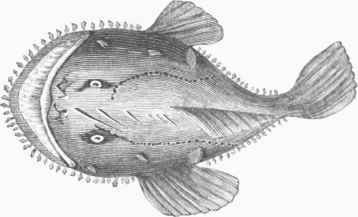
Goose Fish (Lophius Americanus).
The L. piscatorius is not uncommon in the seas of Europe, where it grows to the length of from 3 to 5 ft.; the color is brown above, the fins darker, with the under surface white.
Continue to:


My Books

