


Haeriem Haarlem, Or Hariem
Description
This section is from "The American Cyclopaedia", by George Ripley And Charles A. Dana. Also available from Amazon: The New American Cyclopædia. 16 volumes complete..
Haeriem Haarlem, Or Hariem
Haeriem Haarlem, Or Hariem, a city of the Netherlands, in the province of North Holland, on the navigable river Spaarne, 3 m. from the sea, 10 m. W. of Amsterdam, and 17 m. N. N. E. of Leyden, with both which cities it communicates by canals and railways; pop. in 1872, 32,156. The city is well built, clean, and intersected by canals. A picturesque gateway on the high road to Amsterdam is a part of the old fortifications; the ramparts have been converted into public promenades. Most of the public edifices are built around a handsome square, in the centre of which is a bronze statue to Laurens Coster, whom the Dutch regard as the inventor of printing. The principal buildings are the town hall, formerly the residence of the counts of Holland, the palace of the states general containing a gallery of paintings, 12 Protestant and three Roman Catholic churches, and one Old Catholic (Jansenist) church. It is the seat of a Catholic and an Old Catholic bishop. St. Bavon's church, erected in the 15th century, is the largest ecclesiastical edifice in Holland, and is celebrated as containing the great organ constructed in 1738, and which until lately was the largest in the world.
The city has a botanical garden, numerous public schools, a gymnasium, an academy of arts founded in 1752, and the Teyler institute; and in the S. outskirts are many nursery gardens, renowned for tulips, hyacinths, and other bulbous plants, in which an extensive trade is carried on. It possesses manufactories of cotton, silk, linens, velvets, ribbons, damasks, lace, jewelry, sail cloth, and soap, and has refineries of salt, tanneries, and dye works. Prior to the discovery of the art of bleaching by chlorine, Haarlem enjoyed celebrity for its bleacheries. Large quantities of linen were supplied to England, and hence came to be called hollands. - Haarlem was a flourishing town in the middle of the 12th century, and figured in the wars between the Dutch and West Frisians. The revolted peasants seized it in 1492, but lost it the same year. Having joined the revolt of the Netherlands against the Spaniards it was besieged by the troops of Alva in 1572-3. The citizens made one of the most heroic defences on record. After seven months' siege, during which the Spaniards lost 10,000 men, and twice breached the walls, but were unable to obtain entrance, they turned the siege into a blockade, and placed a fleet on the lake to cut off supplies.
The defenders, who originally numbered 4,000, including some German auxiliaries and a corps of 300 women, being reduced to 1,800, and the last mouthful of food eaten, proposed to place the women and children in their centre, fire the city, and cut their way through the besiegers. The Spaniards now offered terms if they would surrender. The proposal was accepted. Alva's troops marched in, disarmed the inhabitants, and the 57 hostages were put to death; and four executioners were kept constantly busy until they ceased from fatigue after 2,000 persons had been butchered, when 300 remaining victims were tied in twos, back to back, and cast into the lake. William of Orange retook the city in 1577.
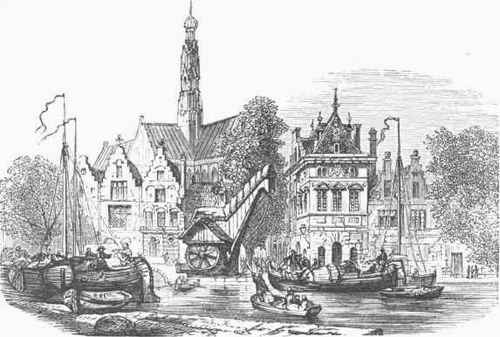
Quay of the Grain Market, with St. Bavon's Church.
Continue to:


My Books

