


Phcenicia
Description
This section is from "The American Cyclopaedia", by George Ripley And Charles A. Dana. Also available from Amazon: The New American Cyclopædia. 16 volumes complete..
Phcenicia
Phcenicia (Gr.  from
from  a palm tree, or from the same word as signifying red), the name given by the Greek and Roman writers to the narrow region between the hills of northern Palestine and the Lebanon mountains of Syria on the east and the Mediterranean on the west. By the Phoenicians themselves their country was called K'na'an (Canaan), lowland. Its northern boundary in a political sense was near Aradus in lat. 34° 52' N, and its southern S. of Mt. Oarmel, about lat. 32° 30'; its length was about 180 m., and its general breadth from 10 to 12 m. including the mountain slopes; area, less than 2,000 sq. m. From Aradus (the Arvad of the Scriptures) to Tripolis the coast forms a bay into which several rivers fall having a short course from the mountains; the principal of them is the Nahr el-Kebir (the ancient Eleutherus). Tripolis (now Tarablus) stands on a promontory half a mile broad and extending a mile into the sea. A chain of seven small islands running out N. W. protects its harbor from the prevalent winds. S. of Tripolis a low range of chalk hills borders so closely on the sea that there is no room for a road between them.
Further S. they recede a little from the sea, and on a narrow strip stands Batrun, the ancient Botrys; and still further S., on a hill by the shore, stood the city called Byblus by the Greeks (the Gebal of the Hebrews, now Jebail). A little S. of Byblus is the river Ibrim, the ancient Adonis, which was said to be annually changed into blood, and which still assumes in summer a red color derived perhaps from the ferruginous sands of the mountains from which it flows. A few miles further S. stood Bery-tus (now Beyrqut), in a plain extending southward 12 m. to the mouth of the river Damur (the ancient Tamyras), beyond which the hills again press closely on the sea for several miles. There, on the slope of a small promontory, is seen the site of Sidon (now Saida), the oldest and one of the most famous of the cities of Phoenicia. The plain is prolonged as far as Sarepta (the Zarephath of the Old Testament), 8 m. to the south, whence it again widens and continues as far as Tyre, with an average width of about 2 m.; near that city it widens to 5 m.; 8 m. S. of Tyre (Sur) it terminates in the White promontory (Ras el-Abiad), rising perpendicularly from the sea to the height of 300 ft.
The road here, which in some places hangs over the water, was cut through the rock, it is said, by Alexander the Great. Originally it appears to have been ascended by steps, and was therefore called the Tyrian climax, or staircase. Eighteen m. further S. Acre or Ac-ca (the Accho of the Hebrews and the Ptole-mais of the Greeks) stands on the N. projection of a bay which is about 8 m. across and is terminated on the south by the promontory of Carmel. A few miles southward was Dor, a town of considerable magnitude, next to which at no great distance the important city of Caesarea was built by Herod the Great. Near this place, N. or S. of it according to different views, the Phoenician territory terminated. The vicinity of the Nile affects the coast of Phoenicia even as far N. as Tyre and Sidon. The set of the currents carries regularly to the eastward the alluvial matter which the river pours into the sea, and deposits it on the coast, so that towns formerly maritime have become inland, and harbors are filled up. (See Lebanon, Palestine, and Syeia.) - Though the Phoenicians appear to have dwelt on the coast of Syria at the earliest dawn of history, they always considered themselves as colonists.
Herodotus says they came from the Erythrasan sea, that is, that part of the Indian ocean which washes the shores of Arabia and Persia, to the Mediterranean, "and having settled in the country which they now occupy, immediately undertook distant voyages; and, carrying cargoes both of Egyptian and Assyrian goods, visited, among other places, Argos." In his essay " On the Early Migrations of the Phoenicians," in his edition of Herodotus, George Rawlinson says: " The migration of the Phoenicians, at a very early time, from the shores of the southern sea to the coast of the Mediterranean, has been contemptuously ridiculed by some writers, while by others it has been regarded as a fact scarcely admitting of question. The authority of Herodotus, of Strabo, of Trogus Pompeius, of Pliny, of Dionysius Pe-riegetes, of Solinus, and of Stephen, is quoted in favor of the movement; while against it can only be urged the difficulty of the removal, and the small value of half a dozen Greek and Roman authorities in respect of a fact admitted to be of so very remote an antiquity." Bochart, Heeren, and Movers decide against the notion of a migration, while Ken-rick, Lenormant, and Schrader maintain it.
The last named, in an essay on the presumptive cradle of the Semitic races (Zeitschrift der Morgenldndischen Gesellschqft, 1873), supposes that the Phoenicians once occupied the coasts of Arabia and Persia, and, trafficking with the principal cities of Babylonia, followed the course of the Euphrates and Tigris, and crossed over to the Mediterranean coast by the usual road across Palmyra. Rawlinson says: "On the whole it may be concluded that the Canaanites and Phoenicians were two distinct races, the former being the original occupants of the country, and the latter being immigrants at a comparatively recent date." Yet the Sidonians, Arvadites, and other Ca-naanites of Scripture were undoubtedly the Phoenicians of classical writers. Eusebius says the Phoenicians called their country Cna, and St. Augustine says the Carthaginians spoke of themselves as Chanani, though ancient Egyptian inscriptions show that Phoenicia was also called Keft or Kaft. The original inhabitants of Phoenicia were probably Hamites, as stated in Genesis, but on being surrounded by Semitic races, by Aramaeans to the north and east, and by Hebrews to the south, or overpowered by Semitic immigrants from the shores of Arabia, they gradually adopted the Semitic tongue, and forgot their own Hamitic language. - Like all ancient seafaring peoples, the Phoenicians in the early stages of their commerce committed piracy and engaged in the slave trade.
But though Europe suffered from their piracy, it is certain that from their visits she received the rudiments of her civilization. The use of alphabetical characters was clearly derived from Phoenicia by all ancient European and by several oriental nations. The choicest works of art known to the earlier Greeks came from Sidon; the produce of its looms furnished the most costly offering to the gods; and its trinkets adorned the persons of the Grecian women. The Phoenicians traded where trade was profitable, and concealed from others the course they pursued to reach the distant countries to which their traffic extended. Thus, though they had supplied tin and amber for several centuries to the Greeks, Herodotus, who had visited Tyre itself, could obtain only very vague accounts of the countries in which they were produced. The master of a Phoenician merchantman bound for the land which produced tin, perceiving himself followed by a Koman ship which had been sent to learn the way, ran his vessel on the rocks to lead the rival craft to destruction; and on his return home the government remunerated him for the loss. In the Mediterranean sea they had taken possession of Cyprus, and made Paphos and Amathus their chief settlements.
They occupied Rhodes until the arrival of the Dorians, and the islands of Thera, Melos, Paros, Oliarus, and Cythera, whence the whole of Greece derived the cult of Aphrodite. From the island of Thasos, where they had valuable gold mines, and from Samothrace, which from them received its peculiar worship, they carried on a large trade with Thrace. In Crete they established the colonies of Itanus and Lampe. Their settlements on the Bosporus and Pontus, however, they relinquished very early to the Greeks. They had seized all the promontories of Sicily, in which they founded Eryx and Panormus (Palermo), and the adjacent islands. Malta, Gozo, and Comi-no were also in their possession, and on Cos-syra (now Pantellaria) was developed an independent Phoenician state of considerable maritime power. The coasts of Sardinia were dotted with Phoenician settlements, and they were in mercantile connection with the towns of Etruria. Corsica, the Baleares, and other islands served as stations for the trade with Spain, of which they occupied the S. W. portion, including Tartessus (Tarshish) and Gades (Gadira, Cadiz), and which in the beginning of the 6th century B. C. was controlled by the Carthaginians. The Phoenician factories on the banks of the rivers Garonne and Rhone, in Gaul, grew into important cities, the foundation of which, like that of Massilia, was subsequently ascribed to Hellenic colonists.
The shores of north Africa were early visited and peopled by the Phoenicians. Though Carthage seems to have been founded only in the beginning of the 9th century B. C, long before that time they had in Africa the trading posts Leptis Magna, (Ea, Sabrata, Gichthis, Tacape, Macomades, Capsa, Thala, Sufetula, Thebeste, Almedera, Sicca Veneria, Cirta, Utica, Hippo, and Auzea. In fact, from the Syrtis Major to the island of Cerne (now Arguin, W. of Morocco), the land was full of Phoenician factories, and on the Atlantic coast a series of towns extended down to the Lixus. The intercourse and intermixture with the Libyans gave rise to the Libyo-Phoenician race. It is not known how far they penetrated into the interior of Africa, but there are good reasons for supposing that they reached Timbuctoo and the Niger, and possibly Lake Tchad. Dan, Hamath, Myriandrus, Tarsus, and Laodicea to the north, and Joppa, Ascalon, Casium, Elath, and Ezion-geber to the south of their own territory, were also stations of Phoenician trade. The Phoenicians occupied the Bahrein islands in the Persian gulf. The situation of Ophir has not been determined. (See Ophie.) Commerce with eastern Asia was carried on principally by caravans, which passed to and through the Tigris and Euphrates valley by three main routes.
One of them touched Dan and Hamath, another Palmyra, and a third crossed directly the Syrian desert to the mouths of the rivers. By way of the Red sea the Phoenicians visited the eastern coasts of Africa. There is little doubt that they traded also with far eastern Asia and even with China. They visited also the lands bordering on the Caucasus, the Black sea, and the sea of Azov. It is a disputed point whether they went by sea-to the British islands and other parts of northern Europe, or obtained tin, amber, and other products of those regions from the trading posts established in the interior and the south of Europe. The commerce of Phoenicia appears to have reached its height about the 8th century B. C. Ezekiel (chap, xxvii.) draws a vivid picture of the commercial splendor of Tyre at the end of the 7th century, at which period its trade directly or indirectly embraced the whole known world. For their shipping Lebanon afforded inexhaustible supplies of timber, and from Cyprus they obtained everything else that was necessary for fitting out a vessel. Sidon and Byblus among their cities appear to bave enjoyed the highest reputation for naval skill.
Of their vessels nothing is known, except that they were equipped for war as well as for trade; and their discipline was so good that even in Athens, the first maritime state of Greece, Xenophon cites a Phoenician ship as the best example of order and skilful arrangement that could be found. The Phoenicians were the first to apply astronomy practically to navigation, and they had noticed the connection of the moon with the tides, with which they had become acquainted in their Atlantic voyages. Of their manufactures, the most famous was that of the purple dye, which they prepared from a shell fish. As Tyre was celebrated for its purple, so Sidon was noted for its glass, the invention of which was attributed by the ancients to the Phoenicians, though they had probably learned its use from the Egyptians. The Sidonians used the blowpipe, the lathe, and the graver, and cast mirrors of glass. Hiram the Phoenician king sent to Solomon, to aid in building the temple, an artist "skilful to work in gold and in silver, in brass, in iron, in stone, and in timber, in purple, in blue, and in fine linen, and in crimson; also to grave any manner of graving." (2 Ohron. ii. 13, 14.) The Phoenicians were celebrated also for the manufacture of perfumes.
Their skill in mining and metallurgy was great, and their, mining operations in Spain, Thasos, and elsewhere were carried on upon a stupendous scale and by very scientific methods. They carriecl to Egypt principally wine, oil, wool, and timber, taking in return glass wares and fine spun garments of byssus (either cotton or linen). They imported from Arabia myrrh, fur, and gold. They had extensive pearl fisheries in the Persian gulf. They obtained from India and China fine silks, ointments, pearls, and precious stones; from Armenia, mules and horses; from Georgia, pottery and handsome men and women; from Syria, wine and cotton; and from Palestine, wheat, barley, oil, and balm. They furnished the Hebrews with every variety of objects of industry and luxury, and the Greeks with fur, ointments, aromatic herbs, spices, and rare fishes. The coast and the interior of Africa supplied them with fruit, vegetables, timber for house and ship building, ivory, various kinds of animals, and slaves. - From the earliest period of which we have any knowledge the cities of Phoenicia were governed each by a king. Such was the condition of Canaan when invaded by the Israelites. Every town with its adjacent territory constituted a sovereignty.
The monarchy was hereditary wherever we can trace its descent, but the sanction of the people was necessary to the succession, and to them the right of election reverted in case of a vacancy of the throne. In Tyre, and probably also in Sidon and the other principal cities, a powerful aristocracy existed along with the monarchy. The chief nobles seem to have held to some extent the functions of a senate. At Tyre, when the throne was vacant, the place of the sovereign was occupied by elective magistrates called 8offets or judges. A large part of the population of Phoenicia was composed of slaves, who were brought from all parts of the ancient world, and whose numbers were such in Tyre that on one occasion they rose in insurrection and expelled the free population. The cities of Phoenicia were never united under a single monarch, but generally the superior power of some city, at first Sidon and afterward Tyre, enabled it to exercise that controlling power over the others which the Greeks termed hegemony. The three principal cities, Sidon, Tyre, and Aradus, had a place of joint meeting, the town of Tripolis, where measures of the highest importance were decided by a representative assembly. The chief defence of the Phoenicians was their naval power.
When threatened by land they employed mercenary troops, for the narrow extent and limited population of their own land made it impossible to raise native armies able to cope with the Assyrians and Babylonians, or later with the Persians and Macedonians. - The principal Phoenician cities, Tyre and Sidon, were founded, according to the statement of Herodotus, about 2700 or 2800 B. C, but it is not until the time of Solomon (1000 B. C.)- that we have any certain historical knowledge of their affairs. Hiram, king of Tyre, and his predecessor Abibal, are historical personages, and from them we have a regular succession of kings with dates of their reigns. The friendship and alliance of Hiram and Solomon, and the voyages of their fleets to Ophir, are recorded in Scripture. It appears from the cuneiform inscriptions that before this time Tiglath-pileser I. had marched to the Phoenician coasts, but without effecting a permanent conquest. About 915 B. C. Eth-baal, a priest, founded a new dynasty in Tyre. One of his successors left the throne to his two children Pygmalion and Elissa conjointly; but, according to the legend, Pygmalion's tyranny drove Elissa (or Dido) into exile with a large body of followers, by whom Carthage was founded. (See Dido.) About this time, that is, about the middle of the 9th century B. C, Phoenicia was compelled to acknowledge the suzerainty of Assyria. The foreign commerce and naval power of the Phoenicians does not seem to have suffered greatly from internal feuds and invasions.
The migrations of the Ionians and Dorians compelled them to relinquish some of their settlements in Grecian territory; but no serious rivalry could have existed between the Greeks and the Phoenicians before the second half of the 8th century. In the latter part of this period all the Phoenician cities except Tyre, which had regained their independence, again became tributary to Assyria. Tyre alone successfully resisted Sargon, and sustained a siege lasting five years; but about 700 it was conquered by the Assyrians, and Sennacherib placed on the Tyrian throne a creature of his own. With the exception of an effort to shake off the Assyrian yoke, made about 30 years later, Phoenicia quietly continued in vassalage until the destruction of the Assyrian monarchy, and the arrival of Pharaoh Necho, whom it acknowledged as suzerain (about 606). Nebuchadnezzar's defeat of Necho brought the Phoenicians under the rule of Babylon. They rebelled shortly after, but were again subjugated, though Tyre withstood a siege of 13 years.
Soon afterward the Phoenicians went out in the service of the Babylonians to resist an Egyptian fleet, but were defeated, and their country was plundered by the Egyptians. From a recently discovered inscription, it appears that in the reign of the Sidonian king Esmunazar the Phoenicians had obtained possession of the towns of Dor and Joppa, at the extremities of the plain of Sharon. The fall of Babylon before the arms of the Persians was soon followed by the submission of the whole of Phoenicia to Cyrus or his successor Cambyses. Under the Persian monarchy the Phoenician navy was a regular and very important element of the imperial power; but the internal constitution of the cities does not seem to have been disturbed, and the native line of kings continued to reign under the protection of the Persian sovereigns. The commerce of the cities flourished by the rich traffic of Arabia and the East which passed through their hands, and their manufactures of purple and glass were in full activity. Throughout the long struggle between Greece and Persia the Phoenicians contributed the chief naval forces of the Persian monarchs.
During the reign of Artaxerxes Ochus, Sidon, which had now taken the lead among the Phoenician cities, revolted, and after a desperate struggle was betrayed by Tennes its king to the Persians in 350, and was utterly destroyed with all its inhabitants, except a few who were absent, and by whom the city was rebuilt. When Alexander invaded the Persian empire, the Sidonians submitted to him readily, but Tyre resisted, and after a siege of seven months was taken by treachery and reduced to ashes, part of the inhabitants being slain and the rest sold as slaves. Alexander rebuilt the city, but it never regained its former importance. Phoenicia was incorporated into a Macedonian province with Syria and Cilicia, and its commerce again flourished as in former ages. It afterward fell under the dominion of the Seleucidse. In 64 B. 0. the Eomans conquered the country, and from that time till now Phoenicia has shared the fate of Syria. During the crusades Tyre was a port of consequence, but under the rule of the Turks, and especially after the commercial changes consequent upon the discovery of the passage to India by the way of the cape of Good Hope, it became what it remains to this day, " a rock for fishermen to spread their nets upon." - The religious and mythological conceptions of the Phoenicians have been treated at length in the article Mythology. Their language bore a very close affinity to the Hebrew, with which most names and words preserved as Phoenician or Carthaginian by the Hebrew, Greek, and Latin writers correspond very nearly; and the only satisfactory results in interpreting the Phoenician monuments and coins have been obtained by making the Hebrew the key to their explanation.
But as the ancient writers merely represented the sound of the Phoenician words, and not their orthography, one must be cautious in using them for linguistic purposes. It sometimes happens also that words are given as Phoenician which are not such. More important than the isolated words scattered through the writings of the ancients are the connected Punic texts found in the first three scenes of the fifth act of Plautus's .Pcenulus, which are the only specimens we possess of the colloquial language of the people. No remains of Phoenician literature proper have come down to us. There is no doubt that the people had religious books, written laws, and archives and records. A court poet is mentioned on the Egyptian monuments as having been among the retinue of a Hittite (presumably Phoenician) king, and Debir, a Canaanitish (probably Phoenician) town in Palestine, was called Kirjath Sepher, "the city of the book." The Greek writers Theodotus, Hypsicrates, and Mochus are said to have translated some Phoenician books, but none of their works have been preserved.
Dius and Menander of Ephesus made some extracts from the annals of Tyre which are still extant, and Eusebius gives a fragment of a translation, made by Philo of By bios, of a cosmogony by Sanchuniathon of Berytus, but its authenticity is questioned. (See Sanchuniathon.) The monuments of the language which we have received directly from the Phoenicians are all inscriptions, engraved either in stone or in metal. It is to be observed, however, that only five of these inscriptions have been found in Phoenicia proper; the others come from Carthage, Numidia, Mauritania, Cyprus, Sicily, Sardinia, Marseilles, Malta, Athens, and Egypt. They are written in an alphabet which, like all Semitic alphabets, is composed wholly of consonants. This Phoenician alphabet forms the basis of all the Semitic and Indo-European graphic systems, yet to all appearance the Phoenicians based their own on the Egyptian hieratic writing. The alphabet consists of 22 signs, the forms of which vary with every age and district. The words are written from right to left, and are rarely disconnected. One may distinguish three main .styles or periods of writing.
The first, the archaic Phoenician, was employed from an unknown time to the 7th or 6th century B. C, not only by the Ca-naanites but by the Aramaeans; its characteristic is great angularity in some letters, and a certain undulation in others. The second is the proper Phoenician alphabet, employed from a period subsequent to the 7th or 6th century down to the beginning of our era. The formerry angular letters received a rounder shape, and the straight strokes were made thicker in the middle than at the ends. The Carthaginian writing of this period, as well as that of Marseilles and Sardinia, gives these strokes with a certain graceful curvature, and many letters have ornamental appendages. The third or Neo-Punic alphabet belongs to the period subsequent to the Roman conquest of northern Africa, and must be a derivative of the Carthaginian cursive writing rather than of the style found on the monuments. The letters are simplified, and some are given with a single stroke; but h and kh form exceptions, being more complicated than before. Gesenius fell into the error of considering the Neo-Pu-nic inscriptions of Numidian origin, but it has since been established that Nu-midian and Punic are in no manner related to each other.
The grammatical structure of the Phoenician language cannot be made out from the small number of literary monuments, and hence it is impossible to define wherein it differed from the Hebrew. But it is certain that many words and forms of words used only in the poetical and archaic portions of the Bible, or only in isolated instances, are quite common in Phoenician; that some words were employed by the Phoenicians with a wider or narrower meaning than the Hebrews gave them; and that certain relatives, pronominal suffixes, and other grammatical forms are peculiar to Phoenician. As in Hebrew, it is customary to explain many peculiar forms in Phoenician as Aramaean, but it is probably more correct to regard many of them as remains of a primitive Semitic language, the parent alike of Phoenician, Hebrew, and Aramaean. The newly discovered monuments have shown the opinion formerly held, that Phoenician was a sort of mixed dialect, midway between Hebrew and Aramaean, to be erroneous. There are traces of Aramaean influence due to the movements of later times, for the whole of Palestine became Aramaic during the 7th and 6th centuries B. C. As at this time the emigration to northern Africa was strongest, it explains also the presence of Aramaean forms in the Carthaginian monuments.
Punic' inscriptions differ very little if at all from those of the eastern Phoenicians, and no essential differences appear in the so-called Neo-Punic monuments till after the destruction of Carthage. The commercial intercourse which the western Phoenicians maintained with the parent country, especially while the Phoenicians ruled the Mediterranean, contributed greatly to the maintenance of the mother tongue in its original condition, even in the most distant and isolated colonies. "What the ancients called Libyo-Phoenician, and what was its relation to Punic, is entirely unknown; but as a matter of conjecture it seems more probable that it was Libyan infused with Phoenician, than Phoenician with Libyan, as Gesenius holds. The inscriptions published by Gesenius in 1837 hardly represent one fourth part of the number of Phoenician monuments now collected, the most important texts having been discovered since. These are the inscription on the sarcophagus of the Sidonian king Eshmunazar, two on the sacrificial tablets of Marseilles and Carthage, several of Umm el-Awamid, various trilingual ones found in Sardinia, some from Cyprus, and numerous votive and funeral inscriptions of Carthage and Numidia. At Dhiban in Moab was discovered in 1868 a monument with 34 lines of Hebrew-Phoenician. (See Moab.) - The principal works on Phoenicia and the Phoenician language are: Heeren, " Historical Eesearches into the Politics, Intercourse, and Trade of the principal Nations of Antiquity" (English translation, Oxford, 1833); Gesenius, Scriptures Linguaique Phoenicia Monuraenta (Leipsic, 1837); Movers, Die Phdnizier (Bonn, 1841); Ewald, Erlcla-rung der grossen phonizischen Insclirift von Si-don (Gottingen, 1856); A. Levy, Phonizische Studien (Breslau, 1857-64), and Phonizisches Wbrterbuch (1864); Kenan, Memoire sur Vori-gine et le caractire veritable de Fhistoire phe-nicienne qui porte le nom de Sanclioniaihon (Paris, I860), and Mission de Phenicie (1874); De Vogue, Inscriptions pheniciennes de Vile de Ghypre; Lenormant and Chevallier, Manuel oVhistoire ancienne de l'Orient (3 vols., Paris, 1868-'9; English ed., 2 vols., 1869-'70), and Les premieres civilisations (1874); Schroder, Die plibnizische Sprache (Breslau, 1869); Hell-wald, Culturgeschichte (Augsburg, 1874); and Duncker, Geschichte des Alterthums (4th ed., Leipsic, 1874 et seq.).
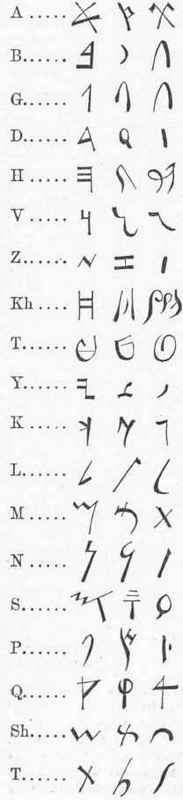
Phoenician Alphabet.
Continue to:


My Books

