


Aberration
Description
This section is from "The American Cyclopaedia", by George Ripley And Charles A. Dana. Also available from Amazon: The New American Cyclopædia. 16 volumes complete..
Aberration
I. Aberration of Light, the alteration of apparent position in a heavenly body, due to the fact that the observer is carried along by the earth's motion, the velocity of which is a measurable quantity in relation to the velocity of light. The aberration of light is therefore due to the combined effect of the transmission of light and of the earth's motion. The solution of all problems to which it gives rise is due to the astronomers of the last century; their calculations are in perfect accord with the minutest practical observations, made with the most elaborate and largest astronomical instruments constructed in some observatories chiefly for the purpose of measuring this amount of aberration. If, at a time when rain drops were falling in a perfect calm perpendicular to the earth's surface, we were standing on a platform car on a railroad track, and rapidly moving forward or backward, the drops would strike us under an angle deviating from the perpendicular in proportion to the swiftness of our motion. The direction of this deviation would in either case be toward the side we are moving to, and this is exactly the case with the light coming to us from the heavenly bodies.
This is evident when we compare the direction of the rain drops with that of the light, and that of the car with the motion of the earth in its yearly orbit. If now the direction in which light reaches us be changed, the apparent position of the body from which the light proceeds must be changed also. Let A B represent a small portion of the earth's orbit, and S M the ray of light from a fixed star S; the motion of the earth from B toward A will cause the light to come in the direction S' A, and the star will appear to stand in S'. If C D represents a small portion of the earth's orbit half a year later, thus moving in an opposite direction, the star T will for the same reason appear to stand in T'. If the velocity of our earth was so much slower as to be for our most delicate instruments incomparable to the velocity of light, no apparent influence would be exerted on the apparent direction, and there would be no appreciable aberration; but the relation happens to be within the pale of actual measurement.
Taking the length of the earth's yearly orbit in round numbers at 600,000,000 miles and the length of the year at 81,556,931 seconds, the velocity of our earth is nearly 19'2 miles per second; and light being transmitted at the rate of 192,000 miles per second, it is clear that it travels about 10,000 times faster than the earth. If now we consider that an equal velocity would change the direction of the perpendicular, or 90°, into its half, or 45°, we see that a velocity of only 1/10,000 would deviate the angle approximately 1/10,000 of 45°, or about 16 seconds. This, however, is a rough estimate; trigonometrically calculated, we obtain more, namely, 20 seconds. This now must be the maximum aberration produced by the yearly motion of the earth on the position of all stars observed at right angles to the direction of that motion. They must all appear displaced to an amount of 20" forward, and this is in fact observed in all heavenly bodies at right angles to the plane of the ecliptic.
As after six months the earth moves in an opposite direction at the other side of the sun, this displacement must be observed in an opposite direction after the lapse of every half year, making a total displacement of 40" in the position of all the stars situated near the poles of the ecliptic; therefore they appear to have a yearly movement in small ellipses of 40" mean diameter, or about one fortieth the diameter of the moon.
II. Aberration in Optical Instruments. As white light is composed of colored rays of different refrangibility, any kind of refraction must split it up into rays of different colors. This is called dispersion. As the convex lenses used in telescopes, microscopes, and other optical instruments refract the light to focal points, this dispersion causes an infinite number of foci. Those consisting of the most refrangible rays, the violet, are the nearest to the lens, and they follow in the order of their refrangibility - blue, green, yellow, orange, and red; the focus of the last is the furthest distant from the lens. This grand defect, called chromatic aberration, is corrected by the construction of achromatic lenses.
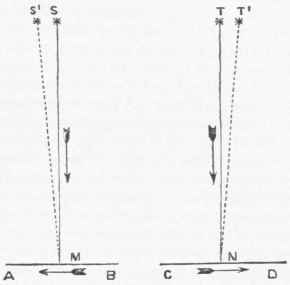
Aberration of Light.
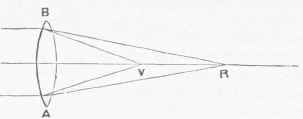
Chromatic Aberration.
(See Achromatic Lens.) The course of the rays producing chromatic aberration is represented in the adjoined figure, in which A B is the lens, V the focus of the most refrangible or violet, and R that of the least refrangible or red rays. - Another defect, called spherical aberration, arises from the nature of the curve used in making lenses and reflectors. Geometry proves that parallel rays can only be refracted and reflected to a single focus by a parabolic curve; however, lenses and reflectors are ordinarily ground as parts of a sphere, which differs from a parabola in the fact that in the latter the amount of curvature increases toward the centre or axis. The consequence is that a section of a sphere, not having curvature enough toward this point, has an infinite number of foci at different distances; those formed by parts nearest to the axis will be the furthest off, while those formed by the refractions or reflections near the circumference of the lens or mirror will be the nearest. The two figures given here represent the case of this aberration by refraction and reflection: C D is the lens, of which the rays passing near the centre P are united in F, while the rays passing near the circumference D C unite nearer to the lens in E. G H is the curved mirror or reflector which reflects the rays U I and W K falling on it near its centre in N, while the rays S G and T H, falling on it near the circumference, are brought together much nearer in M. When the aperture of the lens or mirror is small, for instance only 5° or about 1/70 part of the circumference, these differences are practically inappreciable; but when the aperture must be large, as is the case with astronomical telescopes, peculiar arrangements are contrived, so that in making the lenses or reflectors a curve is obtained as nearly as possible of the parabolic form.
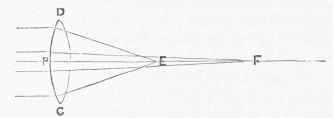
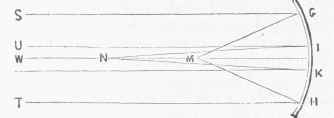
Spherical Aberration.
Continue to:


My Books

