


Albany City, New York. Continued
Description
This section is from "The American Cyclopaedia", by George Ripley And Charles A. Dana. Also available from Amazon: The New American Cyclopædia. 16 volumes complete..
Albany City, New York. Continued
It gives exact time by telegraph to the city and to various railroads. The young men's association, formed in 1833, supports a lecture course during the winter, and has a library of above 12,000 volumes, and a reading room supplied with 75 papers and 30 other periodicals. It is the oldest institution of the kind in the United States, and has about 1,100 members. There are 54 churches: Baptist, 5; Congregational, 2; Protestant Episcopal, 6; Evangelical, 2; Friends', 1; Jewish, 3; Evangelican Lutheran, 4; Methodist Episcopal, 8; Presbyterian, 6; Performed Protestant Dutch, 6; Roman Catholic, 10; and United Presbyterian, 1. A Reformed Protestant Dutch church was formed in 1640, and a quaint edifice of this order stood in State street at Broadway till 1806. A Lutheran church was formed in 1680, a Protestant Episcopal in 1715, and a Roman Catholic society in 1796. The communion plate of St. Peter's church was presented by Queen Anne for the Onondaga Indians. The number of public schools is 16, of which one is for colored children; there is also a free academy with 8 teachers and 214 pupils. The penitentiary, situated on the west of the city, about a mile from the capitol, was built in 1845-'6, and has 600 cells.
At the close of 1871 there were about 500 convicts, a large number of whom were prisoners of the United States. The contract system of labor is adopted, the men being employed in shoemaking and the women in chair-seating. The income exceeds the expenditure by a sum varying from $10,000 to $20,-000 a year, while in all the other penitentiaries of the state there is an annual deficiency of from $50,000 to $125,000. There are no punishments for refractory prisoners except confinement in a solitary cell. School is kept for those who choose to attend on two evenings of the week, and there is a library of 1,400 volumes. In 1869 the old burial grounds, penitentiary grounds, almshouse farm, and Washington parade ground, in the western part of the city, were set apart for a public park, to be known as "Washington Park." - For 30 years after the revolution, Albany was the seat of the entire trade of the western part of the state, the produce being brought in by sleighs in winter; but the growth of the city was not rapid. The first great impulse to its commercial prosperity was given by the successful trip of the Clermont, the first steamboat of Fulton, in 1807, and the improvements in steam navigation which immediately followed.
The steamboats now upon the Hudson river are among the largest that navigate any inland waters. The Erie canal, completed in 1825, and the various lines of railroad constructed since that time, have each essentially added to the growth and prosperity of the city. The total amount of property reaching tide water at Albany by the Erie and Champlain canals for the year 1871 was 848,829 tons, valued at $15,806,-259; the total cleared from Albany the same year by both canals was 82,079 tons, valued at $4,753,971; and the amount of canal tolls collected at this place was $2,837,077. The total number of cars of grain inspected at Albany in 1871 was 2,595; the sales of grain at the corn exchange here the same year aggregated 3,947,-000 bushels. The lumber market of Albany is the largest in the state; the value of the boards, shingles, timber, etc, received here in 1870 was nearly $10,000,000. There are 32 slips from the river for receiving boats, and a river dock more than a mile long for loading boats and barges. There is also in the river a pier, not connected with the shore, about 1,100 feet long. The Albany board of lumber dealers was incorporated in 1869, and in 1871 there were 57 firms engaged in this trade.
The city is the seat of very important and extensive' manufactories, of which the most numerous are 9 boiler and steam engine works, 13 boot and shoe factories, 18 breweries, 17 carriage builders, 10 flouring mills, 18 harness factories, 4 piano factories, 18 iron founderies, 17 machine shops, 8 sawing and planing mills, 12 stove founderies, and 11 soap and candle factories, besides extensile factories of car wheels, saws, oilcloth, agricultural implements, jewelry, silver ware, cabinet furniture, etc. The city has 9 banks, 6 savings banks, 6 insurance companies, and 7 daily, 1 tri-weekly, 2 semi-weekly, 5 weekly, and 2 monthly periodicals. - Albany is the oldest settlement in the original 13 colonies except Jamestown, Va. Henry Hudson, in the yacht Half Moon, moored in September, 1609, at a point which is now in Broadway, Albany. Several Dutch navigators ascended the river to the same place during the next three or four years, and in 1614 the Dutch built the first fort on an island below the present city, which is hence called Castle island.
In 1617 a fort was built at the mouth of the Normanskill; and in 1628 another was erected near the present steamboat landing in the south part of the city and named Fort Orange. A quadrangular fort called Fort Frederick was afterward built on the high ground, now State street, between St. Peter's church and the geological hall, with lines of palisades extending down Steuben and Hudson streets to the river. These fortifications were demolished soon after the revolution, and the only evidence of their existence now remaining is the curved outlines which they have given to the streets in the older parts of the city. The place was called by the Dutch New Orange, and retained that name until the whole province passed into possession of the English in 1664, when New Orange was changed to Albany, in honor of the duke of York and Albany, afterward James II. In 1686 Albany city was incorporated by patent. Peter Schuyler was the first mayor. The Schuyler family possessed the good will of the Indians to such a degree that while other settlements were desolated by Indian forays, Albany was never attacked by them. Besides its ancient importance as a centre of the Indian trade, Albany afterward became the point where the great military expeditions against Canada were fitted out.
It was fortified at an early period, and although often threatened with invasion, no hostile army ever reached the city. Here assembled the first convention for the union of the colonies. It was held in 1754, and Benjamin Franklin was its leading member. The ostensible object of this convention was the defence of the colonies against the savages, but the plan of union then drawn up and adopted was the first recorded in the history of the country. Albany became the state capital in 1797. It has been visited by several disastrous fires, of which those in 1797 and 1848 were most destructive. The lower part of the town has often been inundated.
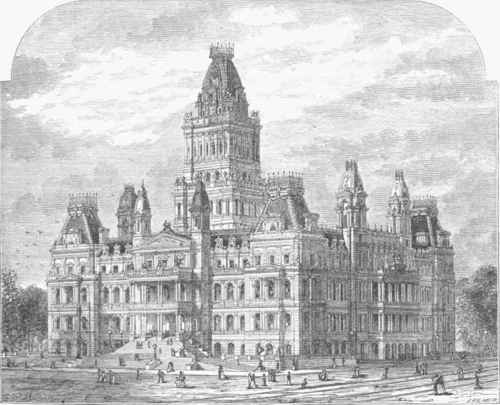
The New Capitol at Albany, N. Y.
Continue to:


My Books

