


American Antiquities. Part 3
Description
This section is from "The American Cyclopaedia", by George Ripley And Charles A. Dana. Also available from Amazon: The New American Cyclopædia. 16 volumes complete..
American Antiquities. Part 3
Those of undoubtedly high antiquity are most massive in character, and display remarkable evidences of taste and skill. It would seem that during the aboriginal rule the bulk of the inhabitants dwelt in rude structures of thatch and cane, which after a few years of abandonment would decay and leave no trace of their existence, except perhaps in the fragments of broken pottery which might surround them. Whatever of architectural skill the people possessed was dedicated to the construction of their temples and the residences of their chiefs, which were often included the one within the other. These temples were in nearly all cases pyramidal in form, terraced and truncated, and ascended by flights of steps usually built on an inclined plane running up the centre of one of the sides, generally that opposed to the rising sun. These structures perhaps better deserved the name of altars, or the Scriptural name of "high places," than of temples; an ediflce built on the level summit in reality constituting the naos, or temple proper.
The great temple of Mexico, which is described by all the early writers as nearly identical in form and structure with all the temples of Anahuac, consisted of an immense square area, "surrounded by a wall of stone and lime eight feet thick, with battlements ornamented with many stone figures in the form of serpents." The extent of this enclosure, which occupied the centre of the ancient city, may be inferred from the assertion of Cortes that it might contain a town of 500 houses. It was paved with polished stones, so smooth, says Bernal Diaz, that "the horses of the Spaniards could not move over without slipping." The four walls of this enclosure corresponded with the cardinal points, and gateways opened midway upon each side, from which, according to Gomera, led off broad and elevated avenues or roads. In the centre of this grand area arose the great temple, an immense pyramidal structure of five stages, faced with stone, 300 feet square at the base and 120 feet high, truncated, with a level summit, upon which were situated two towers, the shrines of the divinities to whom it was consecrated. It was here that the sacrifices were performed and the eternal tire was maintained.
One of these shrines was dedicated to Tezcatlipoca, the other to Huitzlipoehtli; which divinities sustained the same relation to each other in the Mexican mythology as Brahma and Siva in that of the Hindoos. Besides this great pyramid, according to Clavigero, there were 40 similar structures, of smaller size, consecrated to separate divinities; one was called Tezcacalli, which was covered with brilliant materials, and sacred to Tezcatlipoca, the god of light, the soul of the world, the vivifier, the spiritual sun; another to Tla-loc, the god of water, the fertilizer; another to Quetzalcoatl, said to have been the god of the air, whose shrine was distinguished by being circular, "even," says Gomera, "as the winds go round about the heavens; for that consideration made they his temple round." Besides these, there were the dwellings of the priests (amounting, according to Zarate, to 5,000) and of the attendants in the temples, seminaries for the instruction of youth, and, if we are to credit some accounts, houses of reception for strangers who came to visit the temple and see the grandeur of the court; also ponds and fountains, groves and gardens, in which flowers and "sweet-smelling herbs" were cultivated for use in certain sacred rites, and for the decoration of the altars. "And all this," says Solis, " without retracting so much from that vast square, but that 8,000 or 10,000 persons had sufficient room to dance in it, upon their solemn festivals." The area of this temple was consecrated ground; and it is related of Montezuma that he only ventured to introduce Cortes within its sacred limits after having consulted with the priests and received their permission, and then only on the condition, in the words of Solis, that the conquerors "should behave themselves with respect." The Spaniards having exhibited, in the estimation of Montezuma, a want of due reverence and ceremony, he hastily withdrew them from the temple, while he himself remained to ask the pardon of his gods for having permitted the impious intrusion.
There is a general concurrence in the accounts of this great temple given by the early authorities, among whom are Cortes, Diaz, and others, who witnessed what they described. They all unite in presenting it as a type of the multitude of similar structures which existed in Anahuac. Their glowing descriptions, making due allowance for the circumstances under which they wrote, are clearly sustained by the imposing ruins of Pa-pantla, Xoxachalco, Misantla, Quemada, and the thousand other monuments which are yet unrecorded by the antiquary. Solis speaks'of eight temples in the city of Mexico of nearly equal grandeur with that above described, and estimates those of smaller size to amount to 2,000 in number, "dedicated to as many idols of different names, forms, and attributes."
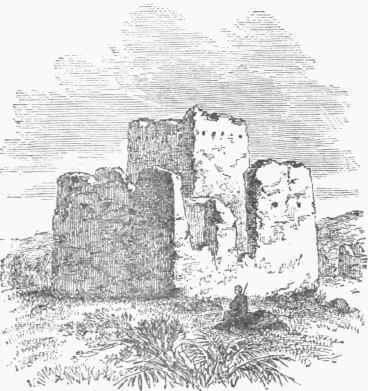
Casa Grande, New Mexico.
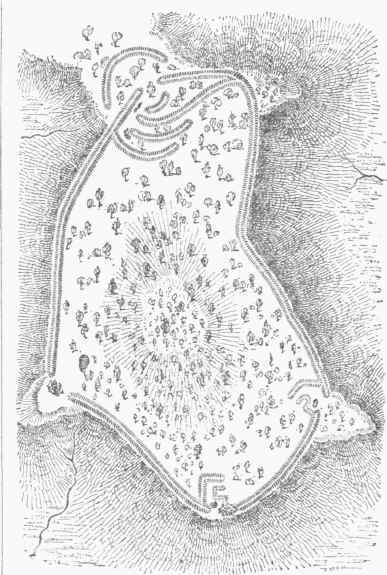
Fortified Hill, Butler County, Ohio.
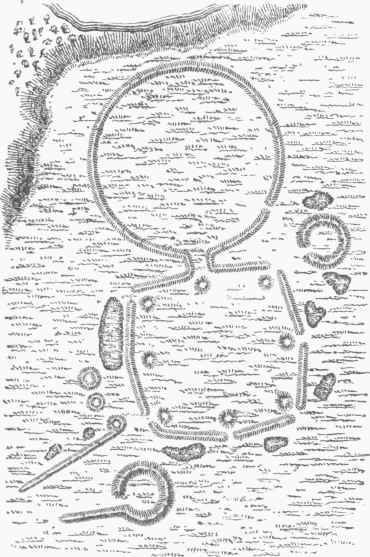
Ancient Works near Chillicothe, Ohio.
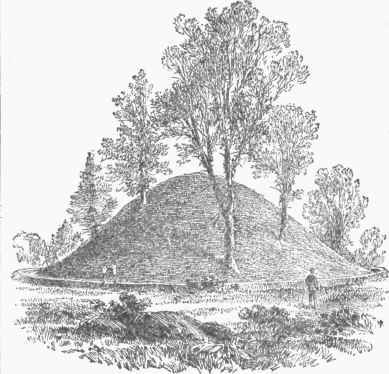
Conical Mound, Marietta, Ohio.

Animal-shaped Mounds, Wisconsin.
Continue to:


My Books

