


American Antiquities. Part 4
Description
This section is from "The American Cyclopaedia", by George Ripley And Charles A. Dana. Also available from Amazon: The New American Cyclopædia. 16 volumes complete..
American Antiquities. Part 4
Serpent-shaped Mound, Adams County, Ohio.
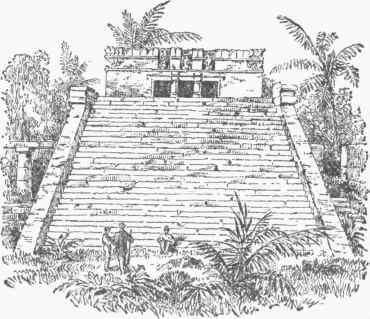
Mexican Teocalli.
Torquemada estimates the number of temples in the Mexican empire at 40,000, and Clavigero places the number far higher. " The architecture," he adds, "of the great temples was for the most part the same with that of the great temple of Mexico; but there were many likewise of a different structure, composed of a single body in the form of a pyramid, with a staircase, etc." Gomera says, " They were almost all of the same form; so that what we shall say of the principal temple, will suffice to explain all the others." Cortes, in a letter to Charles V., states that he counted 400 of these pyramidal temples at Cholula. From all sources we gather that the principal temples, or rather sacred places, of Mexico consisted of large square areas, surrounded by walls, with passages midway at their sides, from which ave-nues or roads sometimes led off; and that within these enclosures were pyramidal struc-tures of various sizes, dedicated to different ! divinities, as also the residences of the priests, I with groves, walks, and fountains.
It has al-ready been said that the pyramids of Teotihua-can, which are found within eight leagues of the city of Mexico, on the plain of Otumba, are probably among the most ancient raonu-ments of Mexico. There are two principal ones, dedicated, according to tradition, to the sun and moon respectively; each built of cut stone, square, with four stages and a level area at its summit. Humboldt says the larger is 150 feet and the smaller 145 feet high. Mr. Brantz Mayer, however, affirms that the larger is 171 feet high; Mr. Glennie, 221 feet. It is 680 feet square at the base, covering an area of 11 acres, or nearly equal to that of the great pyramid of Cheops in Egypt. The pyramid of Cholula also has four stages, and when measured by Humboldt was 160 feet high by 1,400 feet square at the base, covering an area of 45 acres. - The temples of Central America, of which so many ruins still exist, although possessing a general correspondence with those of Mexico, had nevertheless many features peculiar to themselves. The artificial terraces or pyramidal elevations seem to have been usually less in size, but crowned with more extensive buildings, upon which aboriginal art exhausted its utmost capabilities. These structures were marked by broad stairways, leading directly to their principal entrances.
Upon some of these terraces a single building was erected, but upon the larger ones several (usually four) were arranged so as to form a court or area. They were massively built, the walls being in all cases of great thickness. The larger number were one story high; but there were many of two, and some of three or more stories. In these cases, each successive story was usually smaller than that below it, giv-ing the structure the appearance of a pyramid of several stages. The fronts of these build-ings, though sometimes stuccoed, were usual-ly of stone, and covered with elaborately carved figures and ornaments, many of them without doubt symbolical. The interiors of some corresponded with the imposing character of their exteriors. They were divided into narrow corridors and dark chambers. These were arched, or rather the roofs were supported by overlapping courses of stones - constituting a pointed arch, corresponding in type to the eariie t monuments of the old world. The walls of these corridors were often stuccoed, and covered with paintings and figures in bass-relief. Within some of the chambers, as at Palenque, have been discovered tablets clearly of a mythological character, covered with elaborate and artistic sculptures and hieroglyphics.
In these chambers are still found the remains of idols and altars, and evidences of ancient sacrifices. The works of Stephens, Catherwood, Squier, Brasseur de Bourbourg, and Charney contain full accounts of these monuments. - In Honduras, at Copan, the remains of edifices are found, corresponding generally with the preceding description, but associated with grand monoliths, intricately carved, such as have been discovered nowhere else except at Quirigua, in the vicinity of Copan, and on the islands of Lake Nicaragua. They seem to have been planted in the areas, perhaps also on the steps and summits, of the ancient structures. Whether designed as statues of the gods of ancient worship, or to commemorate distinguished priests, warriors, or statesmen, can probably only be determined when the hieroglyphical inscriptions which some of them bear shall have been deciphered. To Copan we may safely assign an antiquity higher than to any of the other monuments of Central America with which we are acquainted, except those rude works of earth and uncut stone which also exist there, and which seem to have been the early types after which, as civilization and the arts advanced, the more imposing monuments of which we have spoken were modelled.
It is certain that Copan was a ruin, concerning which only the vaguest traditions existed, at the period of the Spanish conquest. - In New Granada, among many minor relics of antiquity, such as figures of divinities and objects worked in gold and stone, are found a few considerable monuments, consisting of structures which seem to have been supported by columns of large size and just proportions. - In Peru we find a very large number of aboriginal monuments, consisting not alone of ruined temples, but of great works of public utility - aqueducts, bridges, and paved roads hundreds of miles in length. The remains of the great temple of the sun at Cuzco are still imposing. In describing it as it existed at the time of the conquest, the early Spaniards expended every superlative of their language. It consisted of a principal building and several chapels and inferior edifices, covering a large extent of ground, in the heart of the city. Aqueducts opened within this sacred enclosure; and it contained gardens, and walks among shrubs and flowers of gold and silver, made in imitation of the productions of nature.
Continue to:


My Books

