


Anaconda
Description
This section is from "The American Cyclopaedia", by George Ripley And Charles A. Dana. Also available from Amazon: The New American Cyclopædia. 16 volumes complete..
Anaconda
Anaconda (eunectes murinus, Wagler), a large serpent of the boa family, found in most parts of intertropical America. The genus boa, which contains the large American serpents, has been made to include many species which do not belong to it, among others the anaconda; and we find accordingly this species named boa scytate, boa murina, boa gigas, and boa, aquatka, by various authors. The genus eunectes may be distinguished from all others of the boa family by the nostrils opening at the upper part of the end of the muzzle, and looking directly upward; this peculiarity, added to their very small size, the little space between them, and their crescentic form, which allows them to be completely shut, indicates the aquatic habits which we know characterize the anaconda. Other generic characters are the three plates which surround the nostrils, the plates which cover the anterior half of the top of the head and the scales which cover it posteriorly, the flat and smooth scales of the body, and the undivided plates on the under surface of the tail. The head is comparatively small, conical, very flat below, and truncated in front; the body is considerably larger in the middle than at either extremity; the tail, less prehensile than in the boas, forms about one sixth of the total length.
The eyes, which are small, are so placed that the animal can see at the same time objects above and before it, a provision common to all water serpents. The mouth is perfectly straight, and armed with strong teeth gradually diminishing in size in the four series; the number is 16 on each side in each jaw, 5 on the palate, and 10 on the pterygoid bones. The scales of the body are lozenge-shaped, and nearly of the same size, except those of the sides, which are two or three times larger than the rest; on the trunk there are about 60 longitudinal and 375 transverse rows; on the tail there are over 80 transverse and about 36 longitudinal rows. The plates or scutellae of the abdominal region are very narrow, and about 250 in number, and of the tail from 60 to 73. The colors are simpler than in the boas, being blackish green above in the adults, and olive brown in the young; on the temples, between two lines of pure black, is a wide yellow band extending obliquely from the eye to behind the angle of the mouth; the back and tail present large oval disks of deep black, disposed in two series alternating with each other, and occasionally coalescing; along each side is a single or double row of black rings contrasting finely with the yellow ground color; the color beneath is ochre yellow with black quadrangular spots, isolated or confluent.
The anaconda is the largest serpent of America, and is only equalled in size by some of the pythons of the old world; it is occasionally seen in museums 20 feet long, and it probably attains a considerably larger size, though the accounts of travellers are generally much exaggerated in this respect. The Guianas and Brazil are the favorite and perhaps the exclusive resorts of the anaconda. It lives mostly in the water, and is fond of shallow places, where it remains with all but the head submerged watching for its prey; it swims rapidly, in an eel-like manner, and can pass a long time beneath the surface; it is occasionally seen floating lazily with the current; it is also in the habit of stretching itself on the sand or on the rocks, on a river's bank, or along the trunk of a fallen tree, where it lies in wait for animals which come to drink. Its ordinary food consists of agoutis, small rodents, iguanas, fish, and occasionally a monkey, sloth, or ant-eater; it crushes its prey in its strong folds, and, seizing it with its teeth, swallows it very slowly, head first. The time of impregnation is the winter months, when the natives attack it with guns, arrows, and even clubs; it is sluggish in its motions on land, and timid, and not at all feared; it is very tenacious of life.
The natives use the skin for shoes and hags, the fat for the purposes of oil, and the flesh for food. It is ovoviviparous. Only one species of the genus is described.
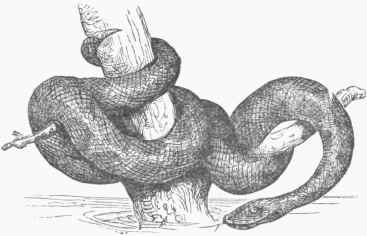
Anaeonda (Euneetes murinus).
Continue to:


My Books

