


Ant-Eater
Description
This section is from "The American Cyclopaedia", by George Ripley And Charles A. Dana. Also available from Amazon: The New American Cyclopædia. 16 volumes complete..
Ant-Eater
Ant-Eater, the popular name of the South American species of the old genus myrmeco-phaga, of the edentate order of mammals, from the principal food of these animals. The ordinal characters are given under Edentata. The South American ant-eaters are covered with hair; the scaly ant-eaters of the old world are described under Pangolin. None of them have any teeth, and the plantigrade anterior feet are armed with enormous claws, bent downward and inward toward the palm, so that the animal walks on the outer edge of the foot. In this way the points are kept unbroken, serving as admirable instruments for tearing down ant hills, though they render the gait of the creature very slow and awkward. The bones of the jaws and nose are elongated into a kind of tube, nearly cylindrical, at the end of which is the small circular mouth, from which is protruded the long tongue covered with a glutinous saliva by which its food is captured. The great ant-eater or ant bear (myrmecophaga jubata), the tamanoir of the Portuguese, is about 4 feet long, with a bushy tail of 2 1/2 feet more, the head being more than a foot long; the height at the shoulder is about 3 1/4 feet, and at the croup 5 inches less.
The claws are 2 1/2 inches long, sharp-pointed, with cutting edges, but so directed that they are comparatively useless as weapons of defence or offence, and applicable only to the motions of tearing down ant hills; there are 4 on the fore feet and 5 on the hind. The tongue may be protruded to the length of 18 inches. The hair is long and coarse, brown mixed with gray at the head, and with white on the body and tail; the throat is black, with a broad stripe of this color, bordered with a narrower white one, running over the shoulders to the rump; arms and thighs silvery white, and hind legs black; breast and under parts brown. The claws when not in use are folded against a callous pad in the palms and soles. Though large and powerful, it is very stupid and inoffensive, and allows itself to be overpowered by the meanest enemies, which it could easily hug and tear to death, did it know enough to exert its great strength. It is wholly terrestrial, unable to climb trees from the structure of the claws and the absence of prehensile power in its uncommonly plumy tail; it makes no burrow, covering its body when at rest by the tail, which, with its long-mane, makes the creature resemble a bundle of coarse loose hay.
The female has a single young one, which she carries on her back long after it can provide for itself. Its food consists exclusively of ants; it obtains them by tearing open the hills, and drawing its glutinous tongue over the insects, at the rate, it is said, of two protrusions in a second. The flesh of the ant bear is black and of a musky flavor, but it is eaten by the Indians and negroes, and at times even by the European colonists. It is a native of South America, from Colombia to Paraguay, and from the shores of the Atlantic to the foot of the Andes; but it is nowhere a numerous species, being rarely seen even in its native regions. Like all animals using a purely insect diet, it is capable of enduring a total deprivation of food for almost incredible periods. - The tamandua, M. tamandua, docs not exceed the size of a large cat. Its head is less disproportionately long, but is of the same cylindrical form with that of the larger animal, with which also correspond the formation of its anterior and posterior extremities, the construction and number of its toes, and the shape and form of its claws.
The most remarkable difference between the two animals lies in their tails, that of the tamandua, which is a purely sylvan animal, living exclusively in trees and never found on the ground, being bare on the inferior side and of singular prehensile power. The hair over the whole body of the tamandua is uniform, short, crisp, and shining, a sort of silky wool standing out from the body; and it varies much in color in different individuals. The female has but two pectoral mamma), and bears but one young one at a birth, which is of a light straw color and very ugly. The tamandua feeds on termites, ants, honey, and even bees, which in those countries make their hives in the topmost branches of the forest trees, and are stingless. It is a native of tropical America. - The little or two-toed ant-eater, cycto-thurus didactylus, is not larger than the common squirrel. It has but four toes on its hind feet, and two on the fore feet. Its whole length, from the snout to the insertion of the tail, is but 6 inches; the length of the head is not quite 2 inches, while that of the tail is about 9. In general form it resembles the tamandua, but its muzzle is shorter and less tapering. Its ears are short and drooping, and are nearly concealed among the fur, which is long on the head and cheeks.
The hair on the body and sides is long, soft, and glossy, much shorter on the tail, of a uniform light straw color, tinged with maroon along the back, where it has a strongly marked line. The tail is bare of fur at the under surface toward the end, and is very prehensile. The ribs are very broad and flat, overlapping each other. It lives in trees, having many of the habits of squirrels; it feeds on the larva? of wasps and other insects, which it picks out of their nests with great dexterity. Like other ant-eaters, if is nocturnal in its habits, being fond of sleeping by day with its tail securely twisted around a branch. It has four mamma}, two pectoral and two abdominal, and bears but one offspring at a birth. Its native countries are Guiana and Brazil; further south it is unknown.
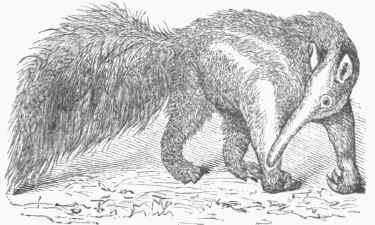
Great Ant-Eater (Myrmecophaga jubata).
Continue to:


My Books

