


Armadillo
Description
This section is from "The American Cyclopaedia", by George Ripley And Charles A. Dana. Also available from Amazon: The New American Cyclopædia. 16 volumes complete..
Armadillo
Armadillo (dasypus, Linn.), a genus of the class mammalia and order edentata, forming a small family, intermediate between the sloths and ant-eaters, and having an affinity to the families chlamyphorus and oricteropus. They are distinguished by the possession of molar teeth only. The armadillos have a singular coat armor covering their whole body and head. It consists of three bony bucklers, composed of small polygonal plates set in juxtaposition to one another, but neither connected by joints nor separately movable. The bucklers which cover the rump and shoulders of the animal, each forming as it were a single solid piece, are capable of little pliancy or motion save what is allowed during the life of the animal by the partial elasticity of the thin shell or crust lubricated by the animal oils which penetrate it. These bucklers, however, are connected by a number of transverse movable bands, composed of similar plates with the principal bucklers, which are themselves connected by the soft and pliant inner skin of the animal, and thus admit of the most rapid motions, being situated immediately above the loins.
The buckler or helmet which defends the head has no connection of any sort with the armor of the shoulders, so that the neck is left perfectly free, while it is at the same time completely protected by the projection of the skull-piece. The legs of the armadillos are extremely short and stout, covered with scaly plates, furnished with powerful claws for burrowing in the ground, and guarded as far as the knees by the defending bucklers; these descend so low as to make a complete defence to the belly of the animal, which is covered only with a rough skin, from which originat3 a few long coarse hairs, and a partial one to the thighs and knees. Except in one species, the armadillos are devoid of hair, save that above mentioned, and a few straggling bristles, which proceed from the inner skin, between the jointed plates of the lumbar region. The tails of all the species but one are armed with annular bands similar to those connecting the bucklers, and in all are adapted to a notch cut out of the posterior buckler in order to receive them. The teeth of the armadillos are of simple cylindrical form, varying from 7 or 8 to 17 or 18.in number, on each side of each jaw, and when the mouth is closed shut one into another.
The different species have 4 or 5 toes on their fore feet, and invariably 5 on their hind feet. Their eyes are small, their ears erect and pointed, and they have elongated snouts. They are mostly nocturnal in their habits, though a few of the species go abroad by day; perfectly inoffensive; are never known to bite, or attempt any defence; but when pur-sued immediately commence burrowing, which they do with such power and rapidity that they easily evade their pursuers. The ordina-ry food of armadillos consists of fallen fruits, roots, worms, ants, and carrion. Their grinding teeth enable them to feed only on soft substances, and therefore they can devour flesh only when putrid. Abundance of tins food they find at all seasons on the pampas of South America, where cattle are slaughtered for the sake of their hides alone. On this food the armadillos become immensely fat, when they are esteemed a great delicacy and are served up roasted whole in their shells. - The armadillos are arranged by Cuvier in five small groups, according to the arrangement of their teeth, toes, and other structural differences: 1. The cachicames, with 4 anterior toes, 7 teeth on a side, above and below, a pointed muzzle, and a long, annulated tail. 2. The aparas, with toes and tail as the last species, but with 9 or 10 teeth on each side, above and below.
This animal has also the power of rolling itself into a ball like a hedgehog. 3. The encouberts, with 5 anterior toes and 9 or 10 teeth, throughout. In addition, however, they have 2 teeth on the intermaxillary bones of the upper jaw resembling incisors, in which they differ not only from all armadillos, but from all the order edentata. 4. The kabas-sous, which have 5 toes both before and behind, but the claws obliquely arranged, so as to give them unusual power in burrowing and clinging to the soil when seized. They have 9 or 10 teeth, throughout; and their tails are undefended by armor, as in the other species. 5. The priodontes, or last subdivision of the armadillos, in addition to the unequal toes and enormous claws of the kabassous, have from 22 to 24 small teeth, throughout, on each side of both jaws. Of the cachicames, or first division, there are three species, of which the commonest is the dasypus peba, or black tatu of Paraguay. It is about 1G inches long, and was originally known under the appellations of the 7, 8, and 9-banded armadillo, three species being made out of one.
The other species of this group are the mule tatu, so called from the length of its ears, and the tatu verda- \ duro, hardly distinguishable from the last, except by the breadth of the movable bands and the size of the croup buckler. Of the aparas, there is but one species, the mataco, which has in general but 3 bands and a short, blunt tail, covered by a single horny crust. The en-couberts have three species: the poyou, or \ yellow-footed armadillo, which has usually but 7 or 8 movable bands, and is easily known by its triangular snout, flat body, and short legs; the hairy armadillo, remarkable for its more copious growth of bristles from between the movable bands, and for its practice of burrow- ing into the bodies of dead horses, and remain- ing within them until all the flesh is consumed, and nothing left but the skeleton and hide; and lastly the pichiy, which is the smallest of all the armadillos. The kabassous have but one species, the tatouay, or wounded armadillo, so called by the Indians from an idea that the scaly covering of its tail, which is naked and looks raw, has been torn off by violence.
The last subdivision of armadillos, the prio-dontes, has likewise but one species, the dasypus gigas, or great armadillo of Cuvier. It is remarkable for its size, being 3 feet 3 inches long; for its movable bands, 12 or 13 in number, composed of rectangular plates; for the thickness of its tail at the base; and for the spiral lines of the scales by which it is defended. All the armadillos are inhabitants of Central and South America, being found dispersed from Mexico, over the pampas of Buenos Ayres, and south as far as Paraguay. The armadillo runs with remarkable speed, easily outstripping a man. Although the females in no species have more than 4 mammae, and in some but 2, they invariably produce 6, 8, or 10 young at a birth, hearing hut once in a season.
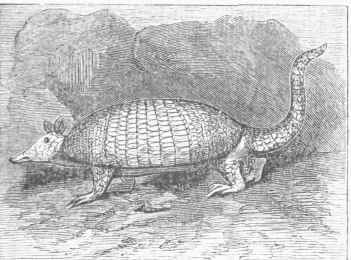
Armadillo (Dasypns sexcinctus or D. encoubert).
Continue to:


My Books

