


Flatheads
Description
This section is from "The American Cyclopaedia", by George Ripley And Charles A. Dana. Also available from Amazon: The New American Cyclopædia. 16 volumes complete..
Flatheads
Flatheads. I. A term applied at different times to tribes of Indians in widely distant parts of America, and incorrectly to the Selish, the tribe now known officially as Flatheads. The name is derived from the practice of flattening the skulls of their infants by various mechanical contrivances; the model of the deformity is the same in all the tribes, and much like that observed in the ancient Peruvian crania. The forehead is depressed and indented; the upper and middle parts of the face are pushed back so that the orbits are directed a little upward; the head is so elongated that in extreme cases the top becomes nearly a horizontal plane; the parietals are bent so as to form an acute angle, and instead of the occiput constitute the posterior portion of the head; the breadth of the skull and face is much increased, and the two sides are in most cases unsymmetrical. The best known tribes which flatten the heads of their children are the Chinooks, Calapuyas, Clickitats, Clatsops, Cowalitsk, and Clatstani. Among the Chinooks the child is placed in a wooden cradle, and a pad of grass is tightly bandaged over the forehead and eyes, so that it is impossible for him to see or move; and when bandaged and suspended in the usual way, the head is lower than the feet.
A more cruel way is practised in other tribes by binding a flat board obliquely on the forehead. These processes continued for several months produce the deformity, which, according to Dr. Pickering, disappears with age, so that most adults present no trace of it. This shape of the head is so highly prized among the Chinooks that their slaves are not allowed to practise artificial flattening. The internal capacity of the skull is not diminished by the flatness, and the intellect is not affected, as all travellers agree that these nations are remarkably shrewd and intelligent; but it is said that they are particularly subject to apoplexy. The Chinooks are the best known of the Flatheads; they inhabit the S. shore of the straits of Fuca, and the deeply indented territory as far as the tide waters of the Columbia river. They are commonly diminutive, with ill-shaped limbs and unprepossessing features; the oblique eye and arched nose are occasionally seen among them; their complexion is darker than that of the more northern tribes who do not flatten the head.
They have the filthy habits and the usual vices of the N. W. Indians, but are said to be superior to the hunting tribes of America in the useful and ornamental arts; their climate is comparatively mild and moist from the prevalence of westerly winds, and they are a fishing and maritime people. They differ from the northern tribes in language as well as in physical characters. Dr. Morton, in plates 42 to 50 of the Crania Americana, gives descriptive illustrations of several skulls of the Columbia river tribes.-The custom of flattening the head is very ancient, but the modern Indians, except those of the N. W. coast, do not generally practise it; it was a custom in Peru before the arrival of the Incas, and was practised also by the Inca Peruvians to a comparatively recent date. It seems to have been principally employed by the Toltecan branch of the American nations, including the semi-civilized race of Mexico, Peru, and-Central America, and the ancient mound builders of the Ohio and Mississippi valleys; the Natchez tribe of Florida and the southern states, the Choctaws, and the Caribs (both insular and continental) flattened the skulls of their children by various devices, either in a vertical direction (as in the Natchez) or longitudinal one (as in the ancient Peruvians).
II. Properly Selish, a small tribe of Indians, the most important and civilized branch of the Selish family. The origin of the name Flat-heads as applied to them is unknown, as they do not flatten the head. They were visited by Lewis and Clarke in 1806-'7, and are mentioned by the name of Hopilpo. They resided on the Bitter Root or St. Mary's river, the largest tributary of Clarke's river, and numbered about 600. In 1830 they, with other Oregon tribes, were greatly reduced by pestilential fevers. Although a peaceful, industrious tribe, they became warriors to defend themselves against the Bannacks, Crows, and Blackfeet, but have never made war upon the whites. Hearing of Christianity from an Iroquois of one of the Canada missions, they sent three deputations to the Jesuits in St. Louis to obtain a missionary. Father P. J. De Smet went to the tribe in 1840, and began a mission which soon made the whole tribe Christians. They were poor, miserable, half starved, and nearly nakedT living on fish and roots, and having no means of crossing rivers except their lodge skins; but they were willing to work, made rapid progress in agriculture, and have adopted the habits and dress of whites. They are remarkably sober and honest, and good warriors, although preferring peace.
They were long governed by an excellent chief, Victor, regarded also as chief of the Pend d'Oreilles and Kootenays. The missionaries introduced agricultural implements, horses, and cattle, and the tribe prospered, being long without agents or traders. The treaty of Hellgate, July 16,1855, approved by the senate on March 8, 1859, ceded all their lands without any consideration paid by government; and though it seemed to secure them their lands on the Bitter Root, yet under an order issued by President Grant on Nov. 14, 1871, they were removed to the Jocko reservation, which comprises 1,433,600 acres in the N. W. part of Montana. Of this tract the portion assigned to them is the worst. Any head of a family who would renounce tribal relations was permitted to take up 160 acres in the Bitter Root valley, and congress appropriated (June 5, 1872) $50,000 to pay for their houses and improvements there. It was also stipulated that 60 houses should be built for them, but only 11 were begun. Chariot, the chief who succeeded Victor, refused to sign the contract for the removal to the Jocko reservation. They have recently been attacked by the Sioux and lost many warriors.
In 1872 they were reported at 460, which is evidently too low, with a school directed by missionaries and sisters of charity, and containing 29 pupils; they raised wheat, corn, oats, potatoes, and hay to the value of more than $7,000; had 1,200 horses, 800 cattle, and 250 swine. Their language is remarkably difficult. Its grammar has been published by Mengarini (New York, 1861). It is spoken with some dialectic differences by the Kalispels or Pend d'Oreilles, the Spokans, Coeurs d'Alenes, Kettlefall Indians, Okanagans, Clallams, Lummi, and Shewhapmuck.
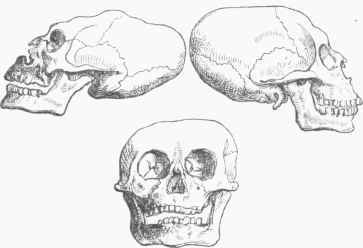
Skulls of Flathead Indians.
Continue to:


My Books

