


Geneva
Description
This section is from "The American Cyclopaedia", by George Ripley And Charles A. Dana. Also available from Amazon: The New American Cyclopædia. 16 volumes complete..
Geneva
Geneva (Fr. Geneve; Ger. Genf; Ital. Gine-vra), I. A canton of Switzerland, bounded N. by Vaud and the lake of Geneva, and on all other sides by France; area, 109 sq. m.; pop. in 1870, 93,239, of whom 47,868 were Catholics, 43,639 Protestants, 771 Christians of other denominations, and 901 Jews and other non-Christians; 20,209 families were French, 978 German, 121 Italian, and 7 Romaic. The peasantry speak a patois which resembles somewhat that spoken in the neighboring districts of France and Vaud. The canton is without mountains, and its highest hills rise only about 500 ft. above the lake. The soil is hilly and stony, and therefore not fertile; but in consequence of the excellent cultivation, the canton resembles a garden. The Rhone, which flows southwesterly from the lake of Geneva, receives the Arve, Nante de Vernier, Avril, London, and Laire. The canton is divided into three districts and contains 48 communes; in 31 of them the Catholics are a majority, and in 17 the Protestants. The canton has 5 gymnasia or secondary schools and about 75 primary schools with 5,000 pupils. The receipts and expenditures are about 3,000,000 francs annually, the public debt about 16,000,000 francs. The legislature, called the grand council, consists of one representative for every 000 inhabitants.
Geneva was the first Swiss state to introduce trial by jury (1844), and exerted a liberal influence upon the national councils in the promulgation of the federal constitution in 1848. The canton sends four delegates to the lower house of the Swiss diet, and furnishes a contingent to the army of about 4,000 men. The Protestant churches are governed by a consistory, which is elected for four years, appoints an executive committee of 5, and is composed of 25 lay members and 6 clergymen. The compagnie des pasteurs, which comprises all clergymen and professors of theology, presides over the religious instruction of the Protestant population, and controls ecclesiastical appointments. The Catholics of the canton, who are divided into 23 parishes, formerly belonged to the diocese of Lausanne. In 1872 the pope erected it into a diocese, a measure which the government of the canton denounced as contrary to the law, insisting that a new diocese could be erected only with the consent of the government. The free "Evangelical Church," which is unconnected with the state, has a theological school in the city of Geneva, and had in 1872 eight clergymen.
The administration of education is in the hands of the government, but the parishes are called upon to contribute toward its support.
II. A city, capital of the canton, at the W. extremity of the lake of Geneva, where the Rhone issues from it, and 3 m. above the continence of the Arve; pop. in 1870, 46,774, of whom 25,397 were Protestants, 20,284 Catholics, 519 members of other Christian denominations, and 574 Jews and other non-Christians. Including the suburbs, the population in 1870 was 57,697. The old city, on the left bank of the Rhone, is hilly and narrow. It was enlarged in 1850 by the conversion of the fortifications into promenades and quays. On the right bank is the more modern part, where the streets are mostly straight and wide. The two parts are connected by six bridges. The Mont Blanc bridge, near the lake, is magnificent. The cathedral, dedicated to St. Peter, erected in the beginning of the 12th century, in the Byzantine style, is believed to occupy the site of an ancient ternpie of Apollo. The hotel de ville formerly had a number of inclined planes without steps, enabling the aged senators to ride up to the highest story in their litters or even on horseback. The public library contains about 60,000 volumes and 000 MSS. The Musee Rath is named after its founder and devoted to the fine arts.
On a small island of the Rhone, below the Mont Blanc bridge, stands a monument to Rousseau, who was born in Geneva in 1712. Of the churches in Geneva, the Reformed have seven, the Catholics three; there are also one English and one Greek church, and a synagogue. In 1873 all the Catholic churches passed into the hands of the Old Catholics, as they alone took part in the election of pastors ordered by the new church law of the canton. Geneva has celebrated private schools, which attract many pupils from abroad, and commercial, industrial, artistic, and musical schools. The university of Geneva was founded in 1368, and was reorganized by Calvin and Beza. The college attached to it resembles the English Eton and Westminster schools, and is conducted by masters (regentes), under the direction of a rector, a principal, and the professors of the university. The studies at the university embrace belles-lettres, philosophy and science, divinity, and law. The environs of Geneva are dotted with villas. The suburb Plainpa-lais is regularly built, and has about 8,000 inhabitants.
Les Eaux Vives, a suburb on the road to Chamouni, has a population of about 0,000. In the vicinity is a celebrated lunatic asylum in a magnificent edifice.-Geneva has long been celebrated for its manufacture of watches, jewelry, and musical boxes, employing about 3,000 persons, who make more than 100,000 watches a year, and work up annually about 75,000 ounces of gold, 5,000 marks of silver, and $200,000 worth of precious stones. There are also manufactories of velvet, silk goods, India stuffs, hats, leather, cutlery, firearms, chronometers, and mathematical, musical, and surgical instruments. Geneva became a free port in 1854. The transit trade is considerable, and the neighborhood of France and Italy gives rise to active smuggling. The forwarding, commission, and banking business, especially the latter, are of great magnitude. Geneva is also the principal telegraph station and the focus of the railways of Switzerland, and the central point of the federal postal and customs union.-Calvin lived in Geneva, and Servetus was burned at the stake in the champ du bourreau, the ancient place of execution, outside the walls.
John Knox was made a citizen of Geneva in 1558. Among the distinguished persons born in the city are Jean Jacques Rousseau, Necker, the naturalists De Saussure, Deluc, Bonnet, Huber, and De Can-dolle; Dumont, the friend of Mirabeau and of Jeremy Bentham; Sismondi the historian; and Albert Gallatin, the American statesman. Sir Humphry Davy died and was buried in Geneva. Guizot the French statesman, whose mother found an asylum in Geneva, received his early education there.-Geneva is supposed to have formed part of the territory of the Al-lobroges. It was subjected to the Romans about 122 B. C. The city was burned during the reign of Heliogabalus, and rebuilt by Aurelian, who gave it many privileges and called it Aurelianum Allobrogum. In the 5th century it was annexed to the possessions of the Burgundians, and in the 6th to the Frank-ish kingdom. The republic of Geneva originated in the municipal institutions of the town, to which Charlemagne granted certain privileges, subordinate to the bishop, who was called prince of Geneva, and was an immediate feudatory of the German empire. Dissensions occurred on many occasions between the citizens and the bishops on one side, and the counts of Genevois, who ruled the adjoining province of Savoy and claimed jurisdiction over Geneva, on the other.
After the extinction of the line of the counts of Genevois, the dukes of Savoy were appointed their successors by the German emperor Sigismund (1422). Hence the claim of Savoy upon Geneva, from which the Genevans could only free themselves after several centuries by alliances with other Swiss states, and by the aid of the reformation. The bishop of Geneva was expelled in 1534. Through the zeal of William Farel, the new service of the reformed religion was established in August, 1535. But the old parties, the partisans of Savoy and the national party, reappeared under new forms and fomented discord. Farel prevailed upon Calvin, who came to Geneva in August, 1536, to remain there, and eventually made himself the temporal as well as spiritual ruler of the town. Geneva became the leader of religion and the model of morals in Europe, the home of literature and learning, and the metropolis of Calvinism. An attack of Charles Emanuel of Savoy upon Geneva (December, 1602) was gallantly repelled, and the victory then achieved is still commemorated.
The independence of Geneva was solemnly recognized by the house of Savoy in 1754. The government of the city fell into the hands of patrician families, as everywhere else in Switzerland, and the history of this century becomes a list of fierce and often bloody struggles to regain the old rights and privileges belonging to the people. In 1782 the administration party obtained the interference of France, Sardinia, and Bern, who sent troops into Geneva and oppressed the democrats. In consequence, about 1,000 Genevese applied for permission to settle in Ireland, and the Irish parliament voted £50,000 to defray the expense of their journey, and gave them lands near Waterford; but they soon abandoned the settlement. Other fugitives stirred up the French republicans to unite Geneva to France, and in 1798 the town was occupied by French troops and incorporated with France as a part of the department of Leman. After the overthrow of Napoleon it joined the renewed Swiss confederacy (March 20, 1815), and several places which had formerly belonged to France and Savoy were added to its territory.
A new and more liberal constitution was adopted in May, 1847. The Geneva convention of 1864 brought about an agreement among the European powers to consider the edifices and members of medical departments strictly neutral in time of war. In 1868 naval wars were specially included in this treaty. The United States, however, did not join in it. In December, 1871, the court of arbitration on the Alabama question, consisting of five members appointed by the governments of the United States, Great Britain, Italy, Switzerland, and Brazil, met here. The deposed duke of Brunswick died in Geneva, Aug. 19, 1873, and left to the city his entire fortune, about 100,000,000 francs.
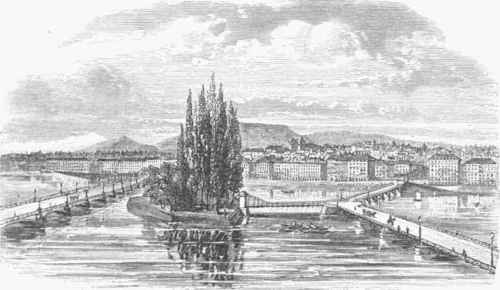
Geneva.
Continue to:


My Books

