


Chapter X. The Field And Its Zones Of Play - Shifts And The Sliding Defense Against Them - The Kicking Game - The Forward Pass - Generalship
Description
This section is from the book "Football For Public And Player", by Herbert Reed. Also available from Amazon: Football for Public and Player.
Chapter X. The Field And Its Zones Of Play - Shifts And The Sliding Defense Against Them - The Kicking Game - The Forward Pass - Generalship
Time was when the football field meant to the average eleven merely a battle ground on which to make more consecutive yards than its opponent, never releasing the ball to the adversary until it was evident that no further advance could be made with the running game, and then kicking the leather as far down the field as possible. Each team began to run the ball as soon as in possession and without regard to the position on the field in which the team found itself. Kicking on first down was almost unheard of, and was resorted to only when the opposing eleven was fumbling badly or when there was half a gale behind the kicker. Happily all that is changed and to-day there are as many strategic positions on the field as if it were not flat but abounded in advantages of conformation.
In the diagram (Fig. 1) the field is shown with two teams about to start the game, the Black team kicking off, the White team receiving. The White team has chosen the goal favored by the wind, and as soon as the kick-off is received will therefore be considered the attacking eleven. The "zones" indicated in the diagram are laid out from the viewpoint of the White captain, who (presuming that in this case he has a really strong wind at his back) will use a fairly liberal form of generalship in the endeavor to score as fast as possible and hold this advantage in the second and third periods, starting the attack once more in the last period. If the White team can get in a long run-back on the kickoff the eleven will be in position to begin the running attack almost at once, but should the run-back be short, it would be an obvious waste to use up time in the running game, when any exchange of kicks is bound to be to the heavy disadvantage of the Black eleven. Once up to his own forty-yard line the White captain may safely use the ball as indicated by the "zone of attack" in the diagram, with such modifications as are suggested in the fuller consideration of generalship at the close of this chapter.
Fig.1. The FIELD of PLAY and its ZONES.
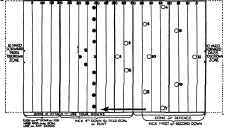
The positions of the White team follow the custom of most elevens in recent years in forming to receive the kickoff. The men are excellently situated for the purpose of converging on the man with the ball in order to get a flying interference under way before the members of the opposing team can get far down the field. The Black team is arranged with three men back of the ball so that the White eleven will not know which man is to kick it and in which direction it is likely to go. It is well for the team kicking off to send the ball as high as possible to allow the men time in which to get down the field, and as a rule to get it into the corner of the field so that the side line will act as a protection against a run-back on one side. The exception to this side kick is when the strongest running half of the opposing eleven is in one of these corners. The ball should go, if possible, to the weakest man. The high kick into the corner is best when the receiving backs are of about even ability. Of course, in kicking off against a very strong wind the ball should be sent much lower, as hard as possible, and in the hope of getting it to bound before it reaches the receiving half. A fumbled kickoff, even though recovered, is a great boon to the team playing against the wind.
So much for the kickoff. Let us turn now to the various advanced plays of recent years, the shifts, the kicking attack and the forward pass. The basic principle of both line and back shifts is to catch the defense in lateral motion at the instant the ball is snapped. A second principle is to bring two strong forwards together to make an opening no matter to which side of the center the play goes, and the third principle is to bring the stronger forwards into action with greater frequency than the weaker. When the first and second principles are followed the result is a "lopsided " line (i.e, more men on one side of the center than the other), while when following the third principle only the result may be either a lop-sided line or a balanced formation - this last the formation that many good coaches still believe to be the strongest. Glenn Warner's shift of years ago consisted in simply having the line side-step to the right or left a certain number of places, and for some time it was very effective, for it spread the defense, a defense at that time loath to shift at all, and when so doing shifting slowly.
That shift still has its uses, but the sensation of recent years has been the Minnesota shift, invented by Dr. H. L. Williams, head coach at the University of Minnesota. The old shift was what might be called a one-position shift, since the men moved from their regular station to another and then started with the snap of the ball. The Minnesota play may be called a two-position shift in that it requires the men in it to take two positions other than their regular stations before the ball is snapped. Hence the common term, "jump" shift, the men practically jumping from the first position into the second. Now while the old shift settled the nature of the line at once, the new shift keeps the nature of the line in doubt to the defense until almost the instant of the snapping of the ball. Whereas the old shift meant a move at once on the part of the defensive line right or left, the new shift makes it impossible for the defensive line to shift until almost the instant of the snapping of the ball. Further, the defensive line cannot tell until that instant upon which side the shift is to be made.
Photo, by Paul Thomoson.
Continue to:


My Books

