


The Kicking Game
Description
This section is from the book "Football For Public And Player", by Herbert Reed. Also available from Amazon: Football for Public and Player.
The Kicking Game
The fullback, indicated by the cross (X) mark, has just managed to get his punt away in safety, and his forwards are seen, at the left of the picture, in full cry down the field.
Thus the Minnesota, or jump shift, has the added advantage of a double lateral threat.
The original Minnesota method is shown in the diagram (Fig. 2), the tackles in this case remaining on the line and the guards dropping into the second, or middle rank of the formation. Sometimes the guards are left on the line and the tackles dropped back in this first position. This for variety and to alternate the heavy work of leading the shift at the snap of the ball. When the shift was taken to Yale late in the season only the two tackles were brought back. Other teams that took up the shift dropped back only the two guards, while still others occasionally dropped back the entire line. Yale continued the shift another season, dropping back the two tackles and using a guard in the interference, while when Princeton took up the Minnesota method the Tigers came closer to the original formation.
The second position of the Minnesota is shown in the diagram (Fig. 3) with only one man on one side of centre and five on the other side, in this case with the two guards "paired." One of the great difficulties of the shift is to time the second position and the snap of the ball accurately, to vary the intervals between the two for the further bewilderment of the defense, and a third difficulty is to get the backs to find their places with sufficient dispatch. The Minnesota shift slowly made is practically useless, but accurately timed is still a potent factor in football. If in the course of the shift one of the backs remains five yards behind the line there is always the threat of a forward pass, and, by accurate timing, it is easy to swing the second position of the maneuver into a regular kick formation behind a lop-sided line.
Now the natural tendency of the defensive player in the old days was to follow his man around in the course of a shift in the line, the end sometimes swinging clear around to the other side. Against the shift it is obvious that this will not do, for the shift can be jumped against the unprotected side, or against the newly arranged side, the defense being unable to run around as fast as the opponents can jump. The principle of the shift, therefore, must be met by as sound a principle of defense. This principle is that the defense can "slide" faster than the attack can side-step (as in the old shift), not, like the attack, being obliged to have a man come over the ball in order to pass it, and can slide quite a little faster than the attack can jump. In the diagrams (Figs. 2 and 3) the two positions of the defensive line are shown - in the first its normal position, and in the second its position after the slide has been made. The attack, jumping to the right, finds itself facing a line that has slid to the left, and that, having been able to move faster a shorter distance is not in motion. The positions of the two lines, therefore, are about as they would be in normal formation - but not quite, since the presumably two strongest forwards of the attack are brought against the non-reinforced side of the defensive line.
Fig. 2. MINNESOTA SHIFT. (FIRST POSITION) Attack.
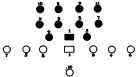
Line Defence. Fig. 3. (SECOND POSITION THE SHIFT MADE). Attack.
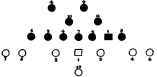
Line Defence (THE SLIDE COMPLETED).
It has been shown that because of the neutral zone (the length of the ball) between the two lines the defensive forwards have a slight advantage, and this is just enough in many cases to offset the advantage gained for the attack in pairing two strong men against a non-reinforced side of the defensive line. Experience has shown that in evenly matched teams, on which every line man is doing his duty on defense, the Minnesota shift can generally be stopped short of a first down, but a perfectly executed shift will work against a defensive line that has one weak spot or is in the least degree sluggish. Tacticians have been working for some time on a plan of defense against the shift that will retain the slide principle at full value and at the same time permit of a reinforced line on the side where the attacking line has been reinforced. It is a fascinating problem. Before passing to variations of this jump shift I might add that of course the defensive backs slide with the sliding line, so that their second position combined with the second position of the line results in what I have called the normal, or standard defense.
Fig.4. "JUMP" SHIFT, IDAHO STYLE. (FIRST POSITION).
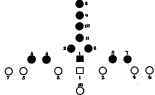
Line Defence.
Fig. 5. Attack (second position the shift made). Attack.
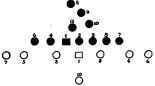
Line Defence (THE SLIDE COMPLETED).
One of the most interesting variations of the shift, and much more alarming to the partisan in the stand than the well coached team in the field, is shown in the diagrams (Figs. 4 and 5). It has been called the "Idaho Divide," but its principle is much the same as that of the Minnesota, and I consider the Minnesota more effective. Dartmouth used the formation against Princeton in 1912, but made much more headway with the old-fashioned formations. The two positions of the shift and the two positions of the sliding fine are shown in the diagrams.
The " Wheel," used with considerable success by Harvard, is one of the most interesting forms of the shift. It can be used to bring about a lop-sided line or a balanced line, the two sides simply changing positions as shown in the diagram (Fig. 6). When first used this shift was rather bewildering to the defense, since one set of men swung around behind centre, the other set through the neutral zone, with somewhat the effect of a pinwheel. This passing through the neutral zone at first thoroughly upset the defense. Later the centre was obliged by the referee to step back and allow one side of the pin wheel to pass in front of him but not in front of the ball. This robbed the shift of considerable of its bewilderment, but it is still useful upon occasion for changing the positions of the forwards, although many coaches believe the men might as well take up their new positions when the teams line up.
Continue to:


My Books

