


Athens. Part 6
Description
This section is from the book "Athens - John L. Stoddard's Lectures", by John L. Stoddard. Also available from Amazon: John L. Stoddard's Lectures 13 Volume Set.
Athens. Part 6
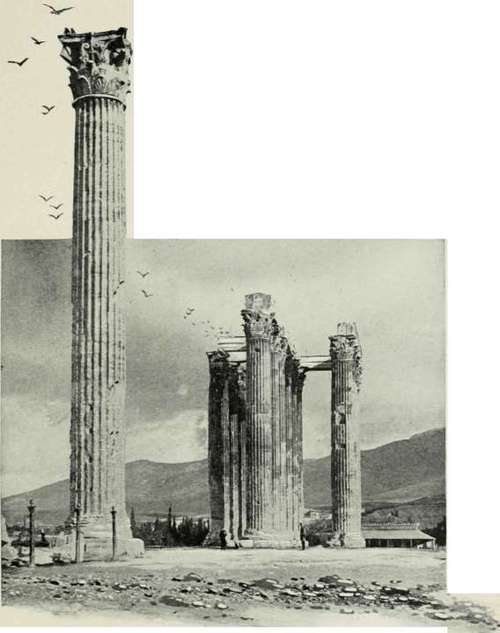
Temple Of Olympian Jove.
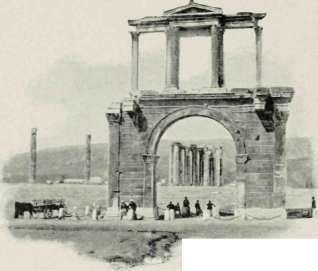
The Arch Of Hadrian.
A flight of rough-hewn steps leads to the summit, where the judges sat. They are the ancient steps. By them St. Paul ascended to address the Athenian audience which gathered before him. Above him, as he spoke, rose the whole glory of the Acropolis, with its magnificent temples and bewildering array of statues. And yet this stranger dared to utter the impressive words, "God dwelleth not in temples made with hands." This in the shadow of the Parthenon! "We ought not to think that the Godhead is like unto gold or silver, or stone graven by art and man's device." This in the presence of the works of Phidias!
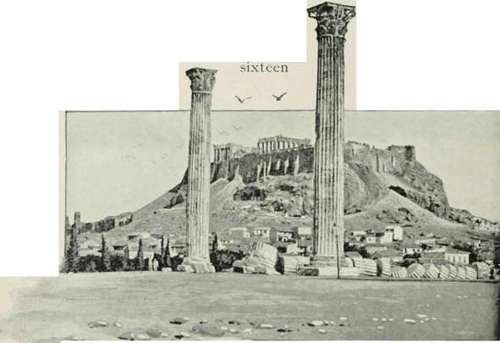
The Sentinels.

The Elgin Marbles In The British Museum.
When we remember how the Acropolis must then have looked, we cannot wonder that the Athenians who heard these words spoken within its shadow smiled, and ironically answered, "We will hear thee again of this matter!" Well, Athens has heard him again, and so has the entire world. Paul discoursed here for possibly an hour, but what he said has ever since been echoing down the ages. None knew him then; but in a few short years, to the church founded by him in the Greek town of Corinth, he wrote his two epistles to the Corinthians, which may be read in every language of the civilized world; and now there is hardly a city in all Christendom that has not a cathedral or church bearing the great Apostle's name.
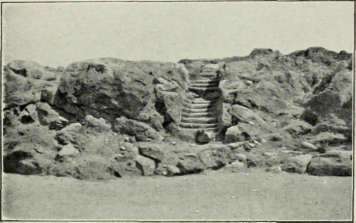
Mars Hill.
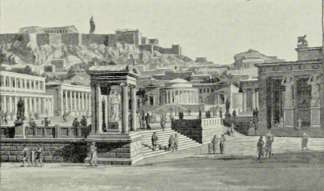
In The Time Of Paul.
Not far from this historic spot is another ledge of great antiquity. Here dungeons have been excavated in the solid rock, one of them being called the "Prison of Socrates".

Prison Ok Socrates.
Opinions differ as to its authenticity; just as men still dispute about the exact locality where Jesus hung upon the Cross. But of the general situation in each case there is no doubt. In Athens, as in Jerusalem, one stands in close proximity to where the purest souls this earth has ever known were put to death by those who hated them; and somewhere on this hill, four hundred years before the scene of Calvary, Socrates drank the poisoned cup forced upon him by his enemies, and in that draught found immortality.
The lineaments of Christ's face are not surely known to us, but those of Socrates have been preserved in marble. His was a plain and homely visage. The playwright, Aristophanes, caricatured him on the stage, and moved the audience to shouts of laughter; but, with the exception of the Nazarene, no man ever spoke like Socrates. He was a natural teacher of men. He walked daily among the temples or in the marketplace, talking with every one who cared to listen to him. His method was unique. It was, by asking searching questions, to force men to think, - to know themselves. If he could make an astonished man give utterance to an original thought, he was contented for that day. He had sown the seed; it would bear fruit. He had no notes, nor did he ever write a line; yet his incomparable thoughts, expressed in purest speech, were faithfully recorded by his pupils, Xenophon and Plato, and will be treasured to the end of time.

Socrates.
Another memorial of Athens which well repays a visit is the Temple of Theseus, - that legendary hero of old Greece, half-man, half-god, whose exploits glimmer through the dawn of history, much as a mountain partially reveals itself through morning mists. Fortune has treated this old temple kindly. There is hardly an ancient structure extant that has so perfectly resisted the disintegrating touch of time or the destroying hand of man. For the Theseum was built nearly five hundred years before the birth of Christ, in commemoration of the glorious battle of Marathon, where Theseus was believed to have appeared to aid the Greeks in driving from their shores the invading Persians.
Continue to:


My Books

