


Athens. Part 9
Description
This section is from the book "Athens - John L. Stoddard's Lectures", by John L. Stoddard. Also available from Amazon: John L. Stoddard's Lectures 13 Volume Set.
Athens. Part 9

The Stadium.
It is hard to single out for special notice any one individual among these heroes; but no American gained more popularity on the historic race-course, than the man who for swift running carried off so many prizes in Old Athens, - that lithe citizen of the "Athens of America," Thomas Burke. Over his speed and skill the Greeks were wildly enthusiastic. Some of them showed him proofs of personal affection. One asked him, through an interpreter, on what food he had been trained. Burke, like a true Bostonian, replied, "Beans!" After one of his brilliant victories, when the Americans had gained in swift succession four first prizes, one old Athenian stood up in the Stadium, and raising his hands in mock despair, exclaimed: "O, why did Columbus ever discover that country!"
Finally, on the last day, there came a contest which the Greeks had been awaiting with alternating hope and fear. It was the long run from the battlefield of Marathon to Athens, - a distance of twenty-five miles.
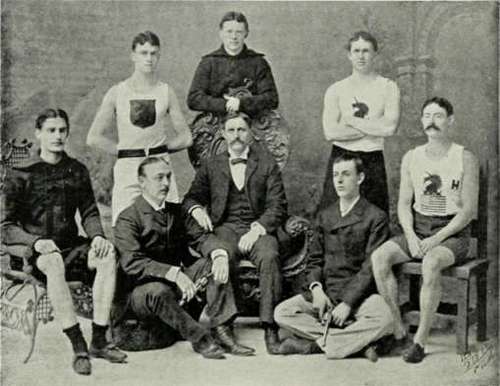
Some Of The American Athletes.
Besides the Greeks, there entered for this race Americans, Australians, Frenchmen, Germans, and Hungarians. Secretly, however, almost every one of the spectators hoped that a Greek would win. History and sentiment alike seemed to demand that the coveted honor should be gained by a descendant of the men of Marathon, for this was the same road traversed by the historic Greek, who ran to announce to the Athenians the triumph of the Greeks over the Persians at Marathon, and as he entered the Arena, dropped dead, gasping the word, "Victory!"
Instinctively that scene rises before the reader's imagination, as it must have done before the minds of the thousands gathered on the course to witness the issue of the race. It was half-past four in the afternoon when a cannon-shot announced that the leading runner was in sight. Two or three minutes passed in breathless silence. No one moved or spoke. Suddenly, a far-off cry was heard, "It is a Greek - a Greek!" These words were taken up and ran the whole length of the Stadium as electricity leaps from point to point. A moment more, and a hundred thousand voices rent the air with cheers and acclamations. The king himself almost tore the visor from his cap, waving it frantically round his head; for, in truth, the victor was a Greek, - a young peasant named Loues, twenty-four years of age. Before entering the contest, he had partaken of the sacrament and had invoked the aid of Heaven; and apparently the gods had come to his assistance, for he had made the run of twenty-five miles over a hard, rough country in two hours and forty-five minutes! To show the feeling the victor entertained for the American athletes, it may be said that when Loues crossed the line, notwithstanding the tremendous excitement and enthusiasm that prevailed, he ran to Tom Burke, and, throwing his arms around him, kissed the American flag which the Bostonian was holding in his hand.
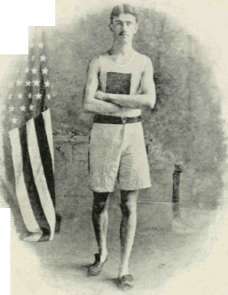
Thomas Burke.

The Soldier Of Marathon.

Loues.
At the king's palace, Loues and the other competing athletes were entertained in royal style by the crowned head of the kingdom. The joy and pride of the young peasant's father, as he saw him universally feted and admired, is said to have been extremely beautiful and touching; for Loues was treated almost as a demigod by his delighted countrymen.
The strangest gifts were showered upon him. A cafe, for example, offered him carte blanche at its hospitable table for the rest of his life; a barber-shop promised him free shaves so long as he lived; and even a boot-black coveted the honor of polishing his shoes for an indefinite period, expecting nothing in return.
Large sums of money also were offered him; but these, with the true spirit of the athlete, Loues declined. "The only reward I crave," he exclaimed, "is the wreath of laurel from Olympia, such as my ancestors received two thousand years ago. I am poor, but I ran, not for money, but for the glory of my native land".

The "Lantern Of Demosthenes".
Continue to:


My Books

