


Lake Como. Part 12
Description
This section is from the book "Lake Como - John L. Stoddard's Lectures", by John L. Stoddard. Also available from Amazon: John L. Stoddard's Lectures 13 Volume Set.
Lake Como. Part 12
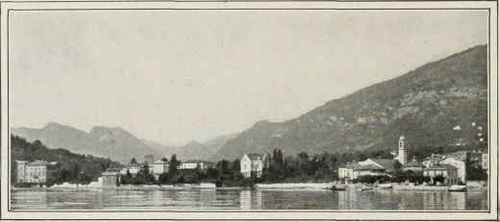
Lenno, Residence Of Pliny The Younger.
Nor is this lovely Tremezzina bay without the charm of biographical associations. One of the villas owned by Pliny the Younger on the lake is thought to have been located at Lenno, and another at Bellaggio. In one of his letters (Book IX. 7) he writes :
"I am pleased to find by your letter that you are engaged in building. . . . Your buildings are carried on upon the sea-coast; mine are rising on the side of the Larian lake. I have several villas upon the borders of this lake, but there are two particularly in which, as I take most delight, so they give me most employment. . . . One of them stands upon a rock and overlooks the lake; the other actually touches it. The first, supported as it were by the lofty buskin, I call my tragic; the other, as resting upon the humble sock, my comic villa. Each has its own peculiar charm. . . . The former commands a wider, the latter enjoys a nearer view of the lake. One by a gentle curve embraces a little bay; the other being built upon a greater height, forms two. The former does not feel the force of the waves; the latter breaks them. From that you see the fishing vessels; from this you may yourself fish, and throw your line out of your room, and almost from your bed, as from a boat".
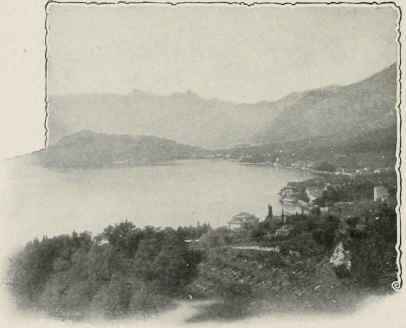
The Tremezzina Bay, Looking South Toward Bai.Bianello.
How dearly he loved his native city and its adjoining waters, is evidenced by the following passages from a letter to Caninius Rufus (Book I. 3):
"How is that sweet Comum of ours? What about that most enticing of villas; the portico where it is one perpetual spring : that shadiest of plane-tree walks; the crystal canal, so agreeably winding along its flowery banks, together with the lake lying below, that so charmingly yields itself to the view? . . . If the scene of your enjoyments lies wholly there, you are one of the happiest of beings; if not, why then you are no better than the rest of men. Why not leave, my friend, . . . degrading cares to others, and devote yourself in this snug and secluded retreat entirely to pleasures of the studious kind? Make these your business and your recreation, your labor and your rest, the subjects of your waking and even of your sleeping thoughts. Compose, and bring out something that shall always belong to you.
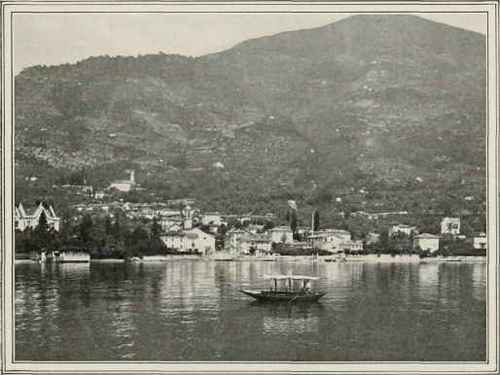
The Bay Of Lenno.
All your other possessions will pass from one master to another; this alone, once yours, will remain yours forever".
Seated within my garden, in full view of both localities of which Pliny wrote, I turn the pages of his letters with the deepest interest and profit.
One thousand, eight hundred years have passed since they were written, yet they make vastly better reading now than the average daily paper or the ten - cent magazine. Among them are his two long letters to the historian Tacitus, describing faithfully the circumstances of his uncle's death at the eruption of Vesuvius, in 79 a.d., when Herculaneum and Pompeii were destroyed. Here, too, are biographical allusions to that uncle, popularly known as Pliny the Elder, recording the fact that at the time of his death, though only fifty-six years old, he had left behind him a veritable encyclopedia of Natural History in thirty-seven books, a history of the Roman wars in twenty books, and other historical writings in thirty-seven more, besides no less than one hundred and sixty note-books of observations and reflections! Still more remarkable, however, is the nephew's correspondence with the emperor Trajan in reference to the growing sect of Christians. These letters form, in fact, - together with the emperor's replies, - a precious contribution to ecclesiastical history, since they were written only about forty years after the death of Saint Paul, and have been quoted by the Christian church for eighteen centuries.

Statue Of Pliny, On The Como Cathedral.

A Walk Which Would Have Suited Pliny. Villa Giulia.
Trajan, who evidently entertained for Pliny a genuine affection, had sent him, in the year 103 a.d., as his special representative to the province of Bithynia in Asia Minor.
Continue to:


My Books

