


Lake Como. Part 13
Description
This section is from the book "Lake Como - John L. Stoddard's Lectures", by John L. Stoddard. Also available from Amazon: John L. Stoddard's Lectures 13 Volume Set.
Lake Como. Part 13
There Pliny seems to have doubted the fidelity to the emperor of those who, on the plea of being Christians, refused to show respect for Church and State by making the customary religious offerings to the imperial statue. His letter to Trajan, asking for instructions on this point, is much too long to be inserted here; but the concise response of the emperor may well be given as indicating his magnanimous character. It runs as follows :
"You have adopted the right course, my dearest Secundus, in investigating the charges against the Christians who were brought before you. It is not possible to lay down any general rule for all such cases. Do not go out of your way to look for them. If indeed they should be brought before you, and the crime is proved, they must be punished; with the restriction, however, that where the party denies that he is a Christian, and shall make it evident that he is not one, by invoking our gods, let him (notwithstanding any former suspicion) be pardoned upon his repentance. Anonymous informations ought not to be received in any sort of prosecution. It is introducing a very dangerous precedent, and is quite foreign to the spirit of our age.'"
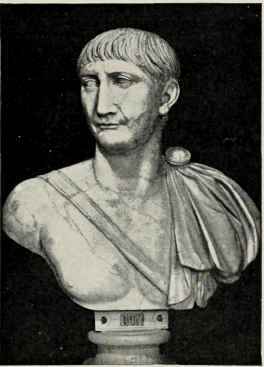
The Emperor Trajan.
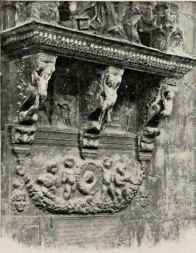
Pedestal Of Pliny's Statue.
To me the most enjoyable of all the letters of Pliny are those addressed to his intimate friends. They give us the most perfect literary picture extant of a cultivated Roman gentleman at the commencement of the second century. Written in elegant Latin, much in the style of Cicero, they show us what the Roman Empire could produce in culture and refinement, as well as in the sterling qualities of justice, kindness, and benevolence, in contrast to the usually mentioned vice and horrible excesses of some of the wearers of the imperial purple and their satellites. Charming indeed are the glimpses these afford of a sincere and unaffected character. Thus, to Fundanus (Book I. 9), he writes in praise of country life:
"Here I neither hear nor speak anything I have occasion to be sorry for. No one talks scandal to me, and I find fault with nobody, unless it be myself, when I am dissatisfied with my compositions. Here 1 live . . . conversing only with myself and my books. True and genuine life! Sweet and honorable repose! Thou solemn sea and solitary shore, true and most retired school of art and poetry, with how many noble thoughts do you inspire me! Snatch then, my friend, as 1 have done, the first opportunity of leaving the town with its din, its empty bustle, and laborious trirles, and devote your days to study or repose; for. as my friend Attilius happily observed, - It is better to have nothing to do than to do nothing. Farewell".

In An Azzano Garden.

Near The Supposed Site Of One OF pliny's villas.
One is inclined to quote too much from these delightful letters, but one more brief citation cannot be omitted :
"The most perfect of all characters.
in my estimation, is his who is as ready to forgive the errors of mankind, as if he were every clay guilty of some himself: and at the same time is as cautious of committing a fault, as if he never pardoned one".
It is a pleasure to learn that the life of Pliny J did not contradict his principles. He seems to have been always gracious, generous, and just. He is known to have sent an invalid slave to Egypt for his health; he bought for his old nurse a farm worth several thousand dollars; he presented the daughter of his tutor with a handsome marriage portion; he founded and endowed in Como an almshouse for the poor of both sexes; and, in addition, gave to that city for public baths and educational purposes sixty-five thousand dollars, and left a still larger amount-to be divided at his death among his servants. Tender and chivalrous also are the epistles to his wife, and his domestic life was evidently a happy one. What most impressed me, as I closed this volume of old Roman letters, was a feeling of astonishment and sadness at the possibility of such a fate as overtook this region after Rome's decline. Who could have dreamed in Pliny's time, when this delightful correspondence was indited, - showing a life of literary, philosophical, and artistic intercourse with numbers of congenial friends in villas filled with precious manuscripts and lovely works of art, - that in a few short generations almost every trace of learning and refinement here would have been swept away, and that a day so intellectually brilliant, could be succeeded by a night of darkness, lasting practically for a thousand years! In fact, these shores, like those of the Mediterranean in general, have never seen a restoration of that culture. In the slow, intermittent progress of humanity it is unfortunately true that Ground, once lost, is not recovered; Greece and Rome are not replaced; And the sites of Pagan learning-Still lie desolate and waste.
Continue to:


My Books

