


Around Lake Garda. Part 15
Description
This section is from the book "Lake Garda - John L. Stoddard's Lectures", by John L. Stoddard. Also available from Amazon: John L. Stoddard's Lectures 13 Volume Set.
Around Lake Garda. Part 15

The Tower Of San Martino.

Ossuary Of Solferino, Interior.
It has been usually supposed that the appalling scenes of suffering witnessed by Louis Napoleon here, and at the still more sanguinary battle of Magenta, twenty days before, induced him to conclude the war sooner and much less advantageously than any one in Europe had expected. For although victor in this, - the fourth pitched battle won by the allies within eight weeks from the opening of the campaign, - Napoleon now amazed the world by offering his adversary terms of peace. But there were other reasons for his conduct besides his naturally tender heart. The four great fortresses of northern Italy known as the "Quadrilateral," which Austria had been building for so many years, and into which the army of Franz Joseph had retired, were still untaken, and it was thought their capture could not be effected at a smaller sacrifice than fifty thousand lives. Moreover, Germany had taken advantage of the situation to mass her troops upon her western frontier, and threatened to attack France in the absence of her emperor and army, if he went still farther. Hence Louis Napoleon made the peace of Villafranca, which so shocked and disappointed the Italians; for, though it rescued Lombardy from Austrian dominion, it still left Venice to endure for seven years more the fetters of the foreigner, before the doubleheaded eagle of the Hapsburgs took its departure from the Doges' Palace, never to return; while - since the dream of Italian unity became a reality only by degrees - eleven years had yet to pass ere Victor Emmanuel's army made its entry into Rome, and gave again to Italy the Eternal City.

Ossuary Of San Martino, Interior.
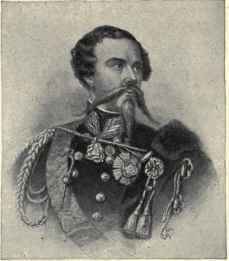
Victor Emmanuel.
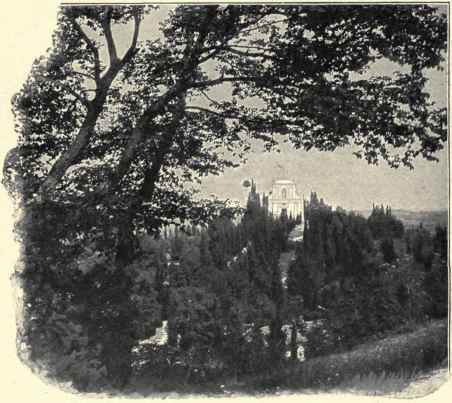
Ossuary Of Solferino.
But interesting and instructive as a visit to this battlefield must always be, if I were asked which feature of my tour on and around Lake Garda gave me the greatest amount of pleasure and inspiration, I should unhesitat-ingly answer, - the site of the Villa of Catullus at Sirmione. Sirmione - or, as the Romans called it, Sirmio - is an extremely narrow but beautifully wooded peninsula, which leaves the land abruptly in the very centre of the southern shore, and like a long pier stretches out into the lake for about a mile and a half in the direction of Riva. The form of this tongue of land might be compared to that of a recumbent sea monster, whose raised head, facing northward, rises far above the water, while its long, slender tail sinks gradually until hardly visible above the waves.

Franz Joseph.

Ossuary Of San Marti NO.

Meissonier.
Battle Of Solfer1no.
As one approaches Sirmione in the steamer, the most conspicuous object in its little town is an enormous castle, dating from the thirteenth century, and built by one of the famous Scaliger family, which for so many years controlled the fortunes of Verona, and whose elaborate tombs still constitute the principal architectural ornaments of that city. This mediaeval edifice is at present utilized merely for the government post and telegraph offices, yet its great courtyard well repays a visit, and its gigantic tower commands a view rivaling that of San Martino in extent and beauty.

Landing Pier And Hotel, Sirmione.
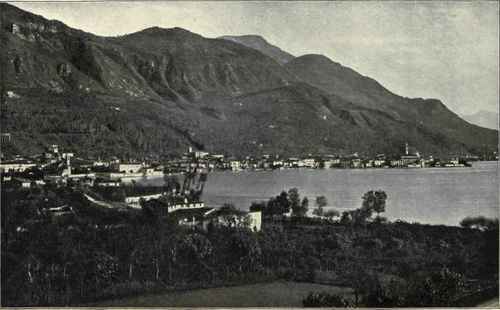
The Bay Of Salo.
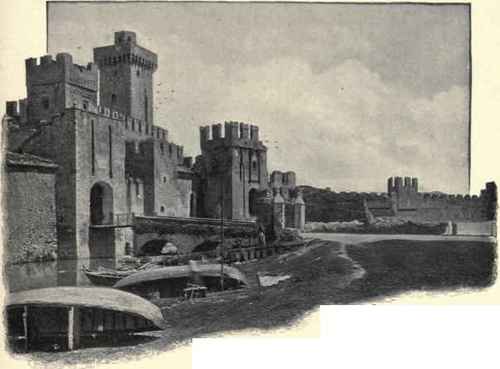
The Castle, Sirmione.
But neither this nor any other building in the town compares in interest with the ruins of the Roman villa at the northern end of the peninsula. From the small hotel garden, where we had lunched, al fresco, in a vine-embowered pavilion rising from the water's edge, an easy walk of fifteen minutes brought us to a stately olive grove, which forms an appropriate antechamber to the classic spot. For the soft shade and venerable air of these old trees attune one's spirit to the influences of the place, partly because their gnarled and twisted trunks assure us that they, too, have outlived many generations of humanity, partly because these ancient guardians of the poet's home are shrouded with that atmosphere of mystery which characterizes any living object that can number centuries of existence.
Continue to:


My Books

