


Around Lake Garda. Part 7
Description
This section is from the book "Lake Garda - John L. Stoddard's Lectures", by John L. Stoddard. Also available from Amazon: John L. Stoddard's Lectures 13 Volume Set.
Around Lake Garda. Part 7

Promenade At Arco.

The Eyrie Of The Counts Of Arco.

Arco is not, however, the terminus of the railway; and the toy train, which glided down the mountain side from Loppio more nimbly than it climbed from the plain of Mori, brings us in fifteen minutes more to the extremity of the alluvial delta, where we alight at a romantically situated town, within whose streets we hear the throbbing chords of the guitar and whose soft name of Riva assures us we have reached at last The Shore. I am seated in the picturesque old town of Riva, at the northern limit of Lake Garda - that glorious expanse of blue-green water, uniting the Tyrol with Italy. It is the first of June. The "season " is over. The villas look deserted, and most of the hotels along the lake are closed. A few of the latter, however, remain open to receive travelers who, like myself, enjoy by preference their cool and silent corridors in the absence of a crowd. "It is too hot for the Italian Lakes," is what the followers of fashion always say when one proposes to visit them as late as this; just as Meran is called unbearable in summer, and Egypt unendurable in November - all of which statements I have long since found to be incorrect. At all events, I who have always wilted in New York's humid heat, find such a temperature as this delightful; nor would I hesitate to spend an entire summer at several points upon these charming shores. It is high noon, and I am writing, literally, in a bower of roses in the garden of the Hotel Lido, pausing occasionally to look out from beneath a fragrant dome of Jacqueminots and Maréchal Niels, through a long vista of green foliage to the multicolored lake. The mercury stands at seventy-five degrees, Fahrenheit, but a refreshing breeze steals inland from the water, conferring a delicious sense of coolness without the slightest apprehension of a chill. For here, as in most southern countries, all that is needed to be comfortable is to avoid the solar rays and court the shade, even if it be only that of a sun umbrella. Though this part of Lake Garda is Tyrolean territory, I feel already that I am in another land. The flow of language that I hear no longer breaks irregularly on Teutonic consonants, but ripples musically over the euphonious vowels of the tongue of Dante. Even when no words are spoken, the gestures are Italian. "A beautiful day," I said an hour ago, in his own language, to a fellow-idler on the shore. He gave a backward sweep of his wrist toward lake and mountains, half closed his eyes, and held his hand aloft in silent ecstasy. Nothing more was necessary. I understood that he was no less happy than myself amid such scenery, and I could have staked my life that, had he spoken, he would have answered me in Italian. Around me rise imposing mountains, sparkling here and there with the last vestiges of winter's snow; while at their feet, and partly in their shadow, lies the classic, southward-pointing lake, thirty-six miles in length, and varying in breadth from one and a half to nearly a dozen miles.
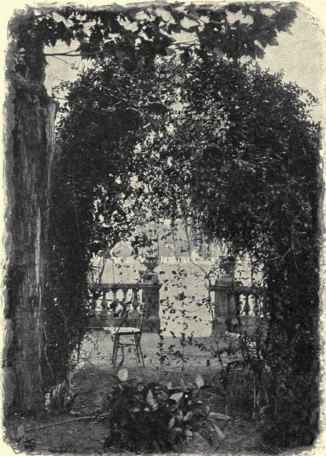
From The Bovver Of Roses By The Lake.
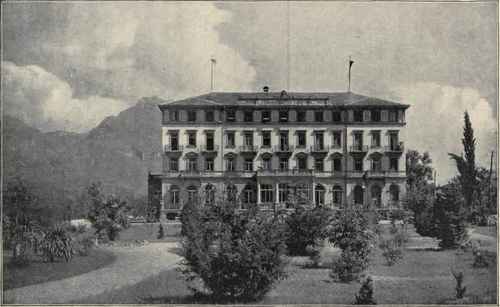
Hotel Lido At Riva.
Lake Garda - as we call it - has borne various titles during the two millenniums of its authentic history. Called by the Romans, La-cus Benacus, from the now-vanished city of Benacum on its western shore, its Gothic masters in the Middle Ages named it - from its great fertility and floral beauty - - the Garden Sea; while the old town of Garda, near the "Garden " of mediaeval legend, has given to the lake its present German appellation, Gardasee, as well as its Italian title, Lago di Garda. Of all the different names it has received, however, perhaps the most appropriate is that of the "Poets' Lake"; so many are the famous bards who have adorned its olive-silvered shores with wreaths of deathless song. Thus Virgil, who was born not far from its southern boundary, and spent his youth in its vicinity, mentions its magnitude and the fierce storms which sometimes lash its surface into waves well worthy of the sea. Of Dante's reference to the savage scenery near Lake Loppio, we have already taken note; and of this beautiful expanse itself he also sings:
Continue to:


My Books

