


Around Lake Garda. Part 6
Description
This section is from the book "Lake Garda - John L. Stoddard's Lectures", by John L. Stoddard. Also available from Amazon: John L. Stoddard's Lectures 13 Volume Set.
Around Lake Garda. Part 6
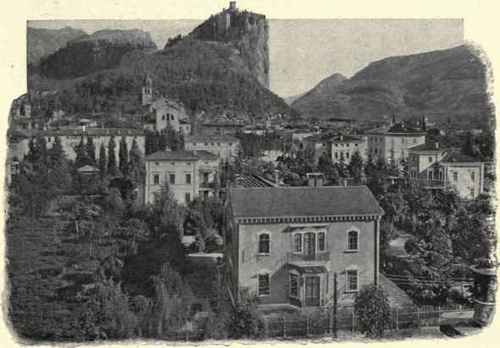
Arco, And Its Cliffs.
Yet even these colossal streams are but the shrunken rivulets of those which once ground slowly through the yielding gorges to the sea. The valleys of Tyrol and of the Bernese Oberland were filled then to the brim with solid ice which, through the pressure of the monster snow-fields of the upper world, were driven downward with a slow but irresistible momentum. Like glittering plowshares, often miles in breadth and thousands of feet thick, these mighty agents furrowed out the valleys to still greater depths, and carved the Alpine pyramids to something like their present shape, surmounting easily the lesser mountains in their path, as rivers rise and ripple over rocks. Embedded in these viscous floods lay thousands of huge boulders, which, wrenched away from the adjoining cliffs, were borne like driftwood far from their original homes; and these, when the great glaciers melted or retreated, were left like stranded exiles where they chanced to be, completing thus a journey that had lasted possibly a thousand years. Thus, high up on the mountain sides above Lake Garda, rocks are found which could have had no other origin than the Engadine. One of these frigid monsters of the Ice Age, creeping down the Vintschgau valley, met in the neighborhood of Botzen an ally which had been stealing southward down the Brenner, and these, uniting, filled the valley of the Adige. Meanwhile, a third of equal size was grooving out the channel of the Sarca from the Ortler Alps, and all of them reached such a height that, overflowing the pass between the Mori and the Riva of to-day, they met, and ultimately left a large proportion of the blocks that form the present stony desert round Lake Loppio. At that time, too, Lake Garda was a long fjord of the Adriatic, through which these glaciers made their exit oceanward.

Mountain Peaks Emerging From A Sea Of Clouds.
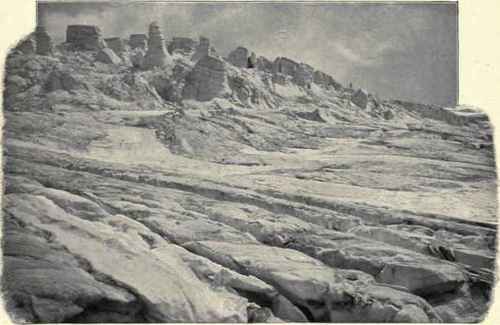
A Tyrolese Glacier Of To-Day.
Fearful, indeed, must the huge mass of ice have been which plowed its pathway sunward through this narrow estuary. Tyndall has estimated that a glacier only one thousand feet in depth exerts on every square yard of its bed a pressure of four hundred and eighty-six thousand pounds. The monster that moved through this valley had, however, twice this thickness; and such was its enormous weight and force that it dug out the bed of the fjord to a depth of more than a thousand feet below the level of the sea.
Naturally, therefore, when the ice subsided, it needed only a little accumulation of detritus at the southern end to separate this body of water from the Adriatic, and thus to change the fjord into a lake. Accordingly, this actually happened, and now the surface of Lake Garda is only about two hundred feet above the sea, to which it sends its overflow by the river Mincio. Most of the salt-water fish remaining here after the separation naturally perished as the water freshened; but some varieties, having adapted themselves to their new environment, still exist here, thus furnishing additional zoological proof of the former union of the lake and sea.

An Alpine Plowshare In Tyrol.

A Stranded Exile.
Such thoughts give special interest to one's excursions about Arco, the charming little health resort which occupies the centre of the plain. Sunny and sheltered, near to the lake, yet far enough away to have a somewhat milder climate than is known at R i v a, this pretty settlement of villas and hotels has visitors, and even permanent residents, during three quarters of the year. It may be called a miniature Meran, for it can boast of a casino, daily concerts, lovely walks, and other attractions similar, though on a smaller scale, to those described in connection with the former capital of the Tyr5l.
Excursions, too, abound in its vicinity, not the least interesting of which leads to its ruined castle, surmounting the extraordinary rock that dominates the town. This natural acropolis was, as we might expect, originally fortified by the Romans; and subsequently the great Theodoric, ablest of all the Gothic kings whose power flourished on the ruins of imperial Rome, built here a stronghold whose foundations are still visible. Here, too, for more than six hundred years lived the redoubtable Counts of Arco, who played distinguished roles in nearly all the conflicts and crusades which characterized the Middle Ages and the times of chivalry. Destroyed by the French in 1703, the sternness of this ancient castle has been softened by the well-kept garden that surrounds it, until its massive walls and towers, garlanded with vines and flowers, appear to be themselves a product of the soil. Standing amid these shattered battlements, and looking over the luxuriant plain toward the sweet, silvery silence of Lake Garda, the lonely rock suggested a colossal milestone in the passage of those prehistoric centuries, whose slow march saw the gradual evolution in this valley of an ice-filled fjord into the tranquil lake, which even now seems dreaming of that mother sea which it is destined nevermore to join.
Continue to:


My Books

