


Drones
Description
This section is from the book "The Busy Little Honeybee", by Josephine Morse True. Also available from Amazon: The Busy Little Honeybee.
Drones
The workers' brothers, the gentlemen bees or drones, do not have any share in the work of the hive. Once in a while they fly outside to get up an appetite, but usually they just hang around inside the hive, eating the honey which their sisters, the workers, have gathered.
They really have a very good excuse for being lazy, though, for nature has not given them the right equipment to be either workers or fighters. A drone has no sting on the end of his body with which to defend himself or his home; neither has he a long tongue for sucking up nectar, or a honey sac in which to store it. Drones are striped like their sisters, but they are larger, though not so large as the queen.
These handsome fellows have only one use. One of them will be the drone which will catch up with the queen on her mating flight. If there were not such a drone the queen could not lay any eggs and the colony would soon die out. So the workers put up with their lazy brothers because the queen must have a mate in order to carry on her work.
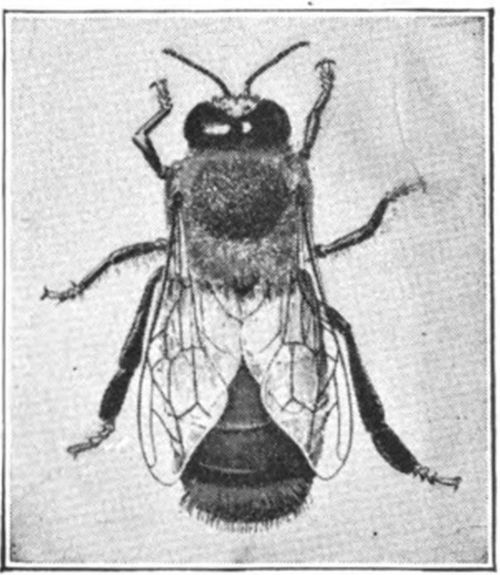
In spring and early summer, when honeybees are most apt to swarm, the workers build new drone cells, or make some of the worker cells larger. The queen lays drone eggs in these cells. A bee colony raises four or five hundred drones in the swarming season so there will surely be one that can fly fast enough to join the new young queen on her mating flight, after the old queen has gone away with the swarm.
During the summer the workers allow the drones to live in the hive because there is plenty of honey for all, but when cold weather comes they drive the drones out and do not allow them to come in again. Since drones are delicate and feel the cold, they soon die outside in the night air.
It may seem strange that these gentlemen bees do not stand up for their rights and refuse to let the workers turn them out, but although drones are larger than workers there are only four or five hundred of them in a hive while there are perhaps seventy thousand workers. So they have no chance. If a drone refuses to leave, five or six workers will set on him and pull off a wing or a leg until he hurries out of the hive to escape from his tormentors. Although this seems cruel, it is done for the good of the hive. The bees know that the drones would eat too much honey during the winter, and that no drones are needed until spring. Then other drones will be raised. This may not be according to human beings' ideas, but bees have their own way of doing things.
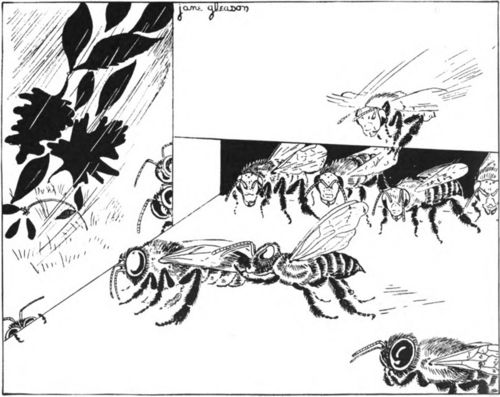
In the Fall the Workers Drive the Drones out of the Hive
Everything that bees do is for the good of the whole colony. There would be fighting in the hive all the time if each bee tried to please herself alone. Instead of that, they all work together happily, doing whatever is best for the colony, which is their family.
Continue to:


My Books

