


The Queen Bee
Description
This section is from the book "The Busy Little Honeybee", by Josephine Morse True. Also available from Amazon: The Busy Little Honeybee.
The Queen Bee
In every hive there is one bee whom the others all treat with great respect. She is the queen bee, and is very dignified in her movements. She is larger than the others and of one solid color instead of being striped. The workers may often be seen forming a circle around her, cleaning and combing her with their front legs and feeding her with their tongues. The precious queen must be cared for and carefully guarded, since she is the only mother bee in the hive among thousands of lady bees.

And yet the queen bee is raised from an ordinary worker egg. The reason that she grows to be so much larger and handsomer than the workers is that she receives special food and care while she is still a worm or "larva. "
To allow for this extra growth the worker bees build extra large cells. The eggs in these cells will develop in sixteen days into queen bees. In an ordinary cell, the egg takes twenty-one days to develop into a worker bee. When an egg in one of these extra large queen cells (which look very much like large peanut shells) hatches into a small white worm, the workers feed it for five and a half days a rich, milky-looking food called "royal jelly. " Ordinary bees are fed this food for only three days. Royal jelly is made by glands in the heads of the young nurse bees.
When the nurses have fed a great deal of royal jelly to the queen "larva" they pack the cell full with still more royal jelly, and cover the open end of the cell with a thin cap of wax. Then they leave the future queen in the dark to spin her cocoon and to change from a big shiny white worm into a young queen bee.
When it is time for her to hatch, the queen bee gnaws the thin wax around the edges of the cell cap. With the nurse bees' help she is at last able to push open the cap, which works like a little lid on a hinge, and into the world she comes, a beautiful golden brown queen bee, much larger than any of the workers.
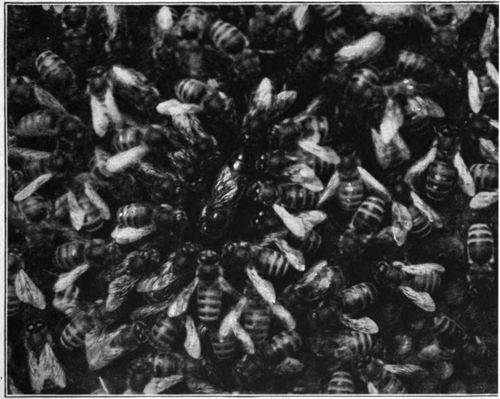
The Workers Form a Circle Around the Queen
Since there can be only one queen in the hive, the newly hatched queen at once goes around to the unhatched queen cells to sting and kill the unhatched queens. If two queens hatch out at the same time, they have a battle royal, fighting until one has killed the other.
For a few days the new queen bee roams around through the hive, traveling over the combs and growing strong. Then one day she goes out on the doorstep and tries out her wings. What an adventure it is! She does not fall down as a young bird often does while it is learning to fly, for her wings are strong and she seems to know how to fly without being taught. She takes a few flights in the air above the hive, noticing different things near by so that she will be able to find her way home when she flies farther away, later on.
Soon, on a bright warm day, the queen bee takes a long flight. Three or four "gentlemen" bees, or drones, fly after her. Others join them, and the one who flies the fastest and catches up with her becomes her mate. Then the queen flies back to the hive and soon begins to lay eggs.
From now on she will spend her time indoors, laying eggs. Before her flight the workers did not pay much attention to her, but now that she is the mother bee of the hive they treat her very differently. As long as she lays eggs they will take good care of her: feeding her, stroking and cleaning her with their legs and feelers, guarding her from harm.
The queen bee has no wax pockets, no pollen baskets, no brushes on her legs. She never goes honey gathering. She does not even take care of the baby bees. Her one duty is to lay eggs. No other bee lays eggs, but the queen does nothing else. She curves the end of her long body into an empty cell and lays an egg as big as the head of a pin. She lays mostly worker eggs, although she can lay either worker or drone eggs. She lays the drone eggs in cells a little larger than the other egg cells, for the drones - the gentlemen bees who do no work - are larger than their sisters, the workers.

Queen

Drone
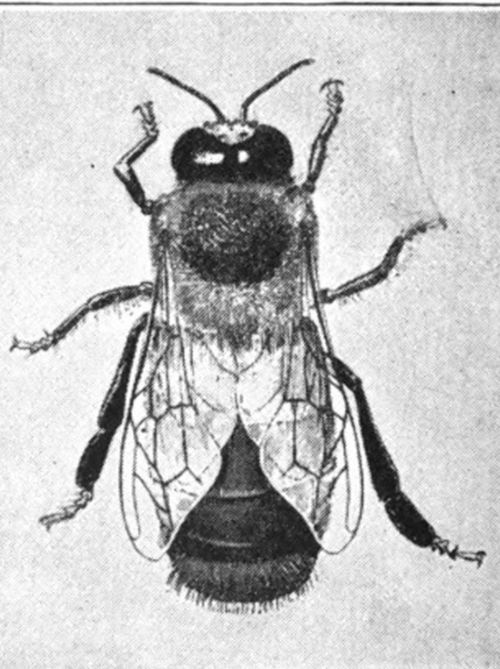
Worker
When flowers are in full bloom and bees are working their hardest, the queen lays as many as a thousand eggs a day. Sometimes a very fine queen will lay fifteen hundred eggs in one day. Egg laying is very important, for there must always be enough bees to carry on the work of the hive. But when the weather grows cool and the flowers stop blooming, there is no nectar to gather. Then the queen does not lay so many eggs as she does in the working season. When the weather becomes really cold, she stops laying altogether until it grows warm again.
A queen bee often lives two or three years, but she lays best during the first two years of her life. During this time she is given the best of care, but if she should stop laying, the bees would form themselves into a thick ball around her to keep her from getting enough air to breathe. When she died they would raise another queen from one of her eggs. If a strange queen from another hive should make a mistake and try to come in, the bees would kill her in the same way. The queen's sting is smooth - not barbed like the worker's sting - so she does not die after stinging. But a queen bee does not use her sting except once in a long while, and then only against another queen bee.
Continue to:


My Books

