


Stellated Geringore
Description
This section is from the book "Parrots", by Prideaux John Selby. See also: Alex & Me: How a Scientist and a Parrot Uncovered a Hidden World of Animal Intelligence.
Stellated Geringore
Calyptorynchus stellatus. - Wagler.
Calyptorynchus stellatus, Wagler, Mono. Psitt. in Abhand. etc., p. 685, sp. 3 - Banksian Cockatoo, Lath. Syn. Sup. ii. var. ii. p. 92.
This species, which appears to bear a near affinity to the Calyptorynchus Solandri of Vigors and Horsf. [Psittacus Solandri, Temm.), and with which it seems to have been confounded, is described as a distinct species by Wagler, in his monograph of the family. The specific characters, as contrasted with those of the Solander's Gerinpore, consist in the whiter colour of the bill, the greater proportion of yellow upon the head and cheeks, and the spots of that colour upon the lesser wing-coverts, with some deviation in the colour and markings of the lateral tail-feathers. It is also somewhat inferior in size; in other respects the resemblance is remarkably close, hut as specific distinction is well known to exist in other instances where the characters are not more prominently marked, we are justified in considering it as a separate species, and it ought to be retained as such, unless extended observation and well authenticated facts prove it a mere variety, or some particular state of plumage, of another species, arising from age or sex. In it the typical form of the bill is prominently marked, the outline or perspective contour forming nearly a semicircle, the depth at the base, as may be seen in the figure, is very great, and considerably exceeding the length, measured from the rictus or gape to the tip. The under mandible is wider than the upper, and toothed, with the front deeply emarginate. The upper is thick at the base, compressed or cestiform towards the culmen, the tip bending inwards, and not projecting far beyond the under mandible. Its colour is greyish-white. The forehead is scarcely crested, but the feathers upon the vertex are a little elongated. The mass of the plumage is of a greenish-black, deepest upon the back and wings, where it assumes a purplish tinge. The cheeks are yellow, with some markings of the same colour on the sides of the head, and the lesser wing-coverts are speckled with paler yellow. The tail is of mean length, the two middle feathers entirely black, the ateral with their bases and tips black, the intermediate space being vermilion, with from five to seven narrow bars of black, the interior webs are margined with yellow. The shafts of the tail feathers project in the form of a bristle beyond the barbules, which appear worn down by attrition. It is a native of Australia, but unfortunately little attention has hitherto been paid to the natural habits of these curious birds. They are said to feed upon bulbous roots, as well as other fruits, or rather the seeds of fruits. They are seldom seen in flocks of any magnitude, but keep more in family parties. In disposition they are wild and fierce, and do not ex-hibit that docility and aptness for imitation so conspicuous in other members of the family.
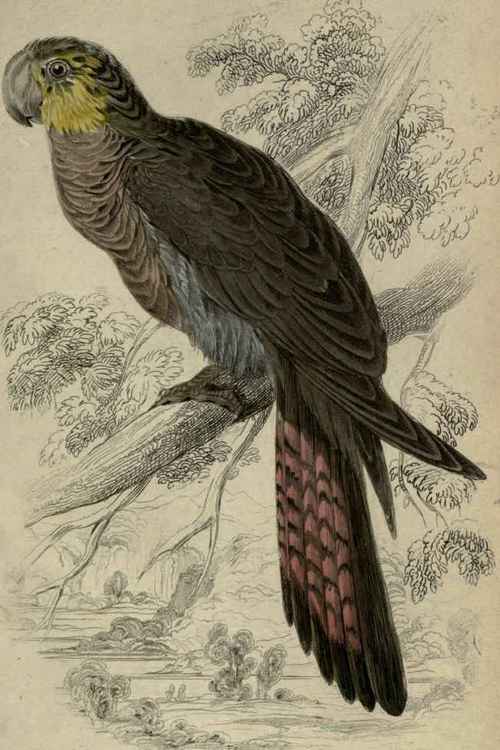
Plate 15.Calyptorynchus Stellatus.
E. Lear del.
Lizars.
Stellated Geringore. Native of Australia.
The subject of our next illustration, though bearing in many respects a strong resemblance to the preceding genus, is distinguished from it by the peculiar form of its tongue, which is tubular and extensile, and by the form and contour of its bill. The upper mandible is of great size, and considerably impressed, the tomia or cutting edges being bidentate or doubly sinuated. The under mandible is small in proportion, with a single emargination. The orbits and cheeks are naked, and the head is adorned with a long crest, generally pendent, but which can be erected, and is composed of long narrow acuminate feathers. The legs are naked a little way above the tarsal joint, the tarsi themselves are short. The tail is of mean length and even. It constitutes the type of Geoffroy's genus Microglossus, which is retained by Wagler in his Monographia Psittacorum. In Kuhl's Conspectus, it is the representative of his section Probosciger, and he considers it as a form intermediate between the Maccaws and Cockatoo, but our present ignorance of the natural habits of this singular bird, renders it difficult to trace its true affinities, and we even feel doubtful whether the station now assigned it, is that to which it will be entitled upon a further investigation and more correct knowledge of its natural history. We propose for it the name of the Microglossia aterrimus.
Continue to:


My Books

