


March - First And Second Weeks. Flowers. Part 2
Description
This section is from the book "The Garden Week By Week Throughout The Year", by Walter P. Wright. Also available from Amazon: The Garden Week by Week Throughout the Year.
March - First And Second Weeks. Flowers. Part 2
Colour Schones With Hardy Plants
Let me give a few examples of colour groups, and show the plants which can be used for forming them. We can have neighbouring groups of mauve, red, and white. You may think that there are not sufficient mauve flowers? Have you forgotten, among tall plants, Phloxes and Michaelmas Daisies and Erigeron Speciosum; and among dwarfer ones Verbena Venosa, annual Asters and Stocks (which can be bought in separate colours), Primroses, and Aubrietias?
Red flowers are, of course, abundant, and comprise both annuals and perennials. Here are a few, all good: Gladiolus Brenchleyensis is a really magnificent grouping plant, graceful in growth, and full of vivid colour. Dry roots can be got from the bulb dealers for three or four shillings per hundred. Lobelia Cardinalis and L. Fulgens are both handsome plants, growing about the same height as the Gladiolus (two to two and a half feet), and very bright. They had better be bought as young plants. Lychnis Chalce-donica is a very bright and cheap plant, reminding one of the Campion. If sown early it will flower the same year from seed, but plants can be bought cheaply. The Bergamot (Monarda Didyma) has crimson, tasselly, perfumed flowers, and is an old favourite. Plants of it cost very little. Montbretias are free and graceful. There is also a red Delphinium - a dwarfish plant which has been rather overshadowed by its tall, blue sisters, that are now so much petted by hardy plantsmen. Its name is Nudicaule, and it can be flowered from seed sown early under glass, or bought as plants. The Poppies, both annual and perennial, are glorious. The great Papaver Orientale and its varieties are among the brighest of the latter class, and when their bloom is over, it is succeeded by that of the annuals, sown in April or May, and rigorously thinned by stages until the plants stand a full eighteen inches apart. Be sure, however, to choose double annual Poppies; the singles are very brilliant, but they are soon over. Dwarf scarlet Nasturtiums, sown where they bloom, will come in admirably for the front.
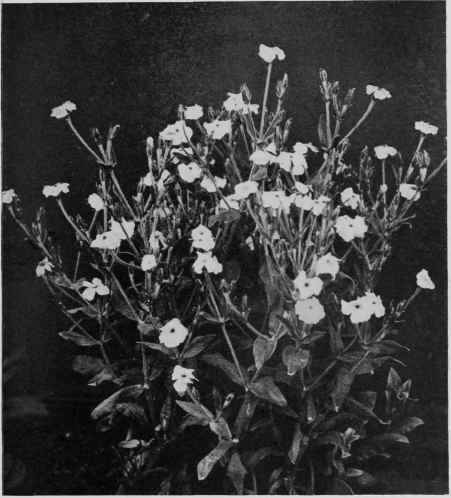
The Rose Campion, Agrostemma coronaria.
Our next group, white, will give us no more trouble; or, to put it in a better and truer way, not less pleasurable work. We have a splendid plant in the fine Ox-eye Daisy, Chrysanthemum Maximum King Edward VII., which we can buy cheaply, and we shall find will soon establish itself securely. Behind it we may set, if we like, white Hollyhocks. We must remember the white Phloxes, such as the splendid variety Tapis Blanc, and we must certainly also recall the white Canterbury Bell, procurable as seedling plants in spring, or to be raised by sowing out of doors in June. It is branching and free-flowered to a degree when thinly grown from the first, and will be perpetual if the fading flowers are picked off. The white Rose Mallow (Lavatera Alba) is somewhat less compact than the Canterbury Bell; in fact, it is of somewhat straggly growth, but it is a plant which blooms long, late, and abundantly. Moreover, it can be had in the flowering stage in a few weeks from seed sown out of doors. Other good annuals are the white Godetia and white Candytuft, both of which flower freely, and hold their bloom well. White Stocks and Asters are the best of the half-hardy annuals, and these are raised from seed sown under glass this month. The white Tobacco (Nicotiana Affinis), should not be forgotten, as it flowers profusely; it can be raised like the Stocks and Asters.

Fig. 31. - Grouping Herbaceous Plants.
a. Positions for dwarf plants at the front.
b- Positions for plants of medium height.
c. Where to plant the tallest subjects.
d. Grass or path, as the case may be.
Is the reader interested in this idea of arranging colour groups in his herbaceous borders? If so, and he would like to carry it a little further, he can put a block of pink next to his white one, and follow with blue and yellow. We have several good pink flowers available. To begin with, pink is a colour fairly common in Hollyhocks, so that we can at once secure something tall for the back. But almost more desirable still is the Sweet Pea. Countess Spencer is a brilliant pink, and the more freely the flowers are cut the longer the plants will bloom. The Rose Mallow is a medium height plant that has the great merit of large flowers and continuous blooming; these tend to compensate for its rather straggly habit. The pink Canterbury Bell will be splendid in early summer, and a sister biennial that is somewhat dwarfer, but equally beautiful in colour, is the salmon-pink Sweet William. Pyrethrums and Paeonies give us some beautiful pink varieties, and both are early bloomers; but the Pyrethrums are perpetual when cut over after the first blooming. Two very fine annuals are available in dwarf pink Godetia and Clarkia Elegans, both of which last well. Silene Pendula Com-pacta is a good dwarf pink annual. The pink Snapdragon is magnificent, and can be grown from seed like an annual. It can be got tall, medium, or dwarf. The medium is the best.
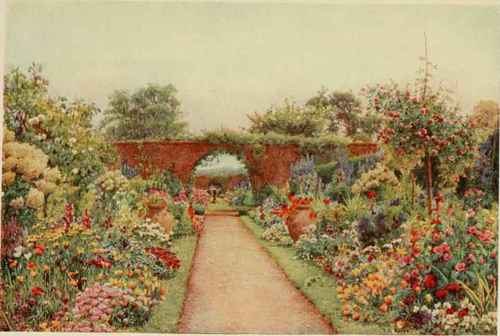
Herbaceous Borders, with Roses, at Harleyford Manor, Marlow.
From a Water Colour Drawing by E. A. Rowe.
When we get to blue we think inevitably of Delphiniums, grandest of all the blue flowered perennials. Their tall spikes are invaluable. There are many good blue Sweet Peas - none better, perhaps, than Frank Dolby as a garden variety. Helen Pierce is a good veined blue - a variety, too, of nice garden habit. One of the very best of blue-flowered plants is Nigella Miss Jekyll, an annual which may be raised from seed out of doors, and flowered in a few weeks. It is neither more nor less than a glorified variety of the blue Love-in-a-mist. The colour is delightful, the flowers are large, and the blooming is continuous till the autumn. This is a plant in a thousand. We can get deeper blue in Anchusa Italica,Dropmore variety, which is a favourite with hardy plantsmen. Of quite dwarf plants we may take Forget-me-nots, Nemophila Insignis, and Phacelia Campanularia, all of which can be raised from seed, the first in late spring for blooming the following year, the other two in early spring for flowering the same year.
We do not get yellow in abundance among tall plants, but a Hollyhock of this colour can be got, and several of the Sweet Peas come near it, notably James Grieve, which is a good garden sort. The best early-blooming plants are the Leopard's Bane (Doronicum), the Globe Flower (Trollius), and the Wallflower Belvoir Castle or some other selected yellow. The yellow Columbine (Aquilegia Chrysantha) follows them closely. Among summer flowers of dwarf to medium height there are Snapdragon Yellow King, or some other selection of the same colour; Coreopsis Grandiflora, Iceland Poppies, Calceolaria Golden Glory, and Carnation Daffodil, or some other good yellow. If a low plant is wanted for the front, Viola Royal Sovereign, or another good yellow sort, should be chosen. Hollyhock, Carnation, Viola, Leopard's Bane and Globe Flower can be bought as young plants in spring. All the rest can be raised from seed. To make sure of having the Snapdragon in bloom by mid-summer, the seed should be sown under glass in winter.
Continue to:


My Books

