


Tables. Part 3
Description
This section is from the book "Furniture", by Esther Singleton. Also available from Amazon: Furniture.
Tables. Part 3
In the Seventeenth Century, lightness was carried farther, and the table was simply supported by four turned legs with heavy bulb feet, connected with straining-rails close to the floor. These legs swelled out into the form of acorns (often curved) or globes, sometimes stained black, or picked out with black threads.
The peculiarity of the slab gave this special kind of table the descriptive name of "drawing-table." The drawing-table was, therefore, composed of extra leaves superimposed on lower ones that could be drawn forward so that the top leaves could fall into the space the lower ones made, and form with the leaves, thus lengthened, one continuous surface. The mechanism by which these leaves were lengthened and dropped was both intricate and ingenious.
Greater lightness being required, the legs were soon turned in plain spirals or with beading. A typical form now appears, which was either round or oval, and consisted of a frame with spirally turned legs and flaps, or falling leaves, that were supported by legs. These legs could be pulled forward when required; and, when not in use, folded back into the frame. These are called "gate-legged," or "thousand-legged tables," for they had six, eight, twelve, sixteen, or even twenty legs. The table could be shut up into about one-third of its extended length. (See Plates CV. and CVI.)
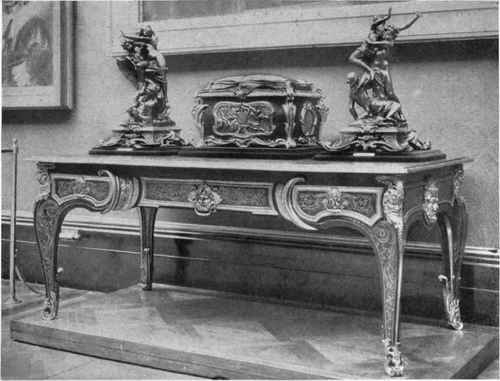
Plate CVII - Boulle Table - Wallace Gallery
This spiral kind of table was made in all sizes and of all kinds of wood. It even lasted until mahogany came into general use among the wealthy, for a fine example, owned by Sir William Johnson, is preserved in the Albany Institute and Historical and Art Society. It is of rich red mahogany, 29 5/8 inches high, 6 feet, 6 inches long and 5 feet, 11 inches across the shortest diameter. The leaves drop or are supported by legs that fold into the frame. This table was confiscated in 1776.
The Flemings of the Seventeenth Century were particularly skilful in the production of tables and chairs. They made tables of all forms: dining-tables, writing-tables, card-tables, chair-tables, bureau-tables, round, square and oval tables, tables that stand on one foot, tables that stand on three feet, folding-tables and tables a banc (or bench tables). They were made of oak, maple, walnut, cedar, cypress, marble and sometimes of silver, of mosaic and of marquetry; and they were beautifully carved and embellished with gold.
In the time of Louis XIV. tables were ornate and handsome. The finest were of carved and gilded wood with term-shaped legs connected by straining-rails. Some had the hind's foot (pied de biche). Tables were also made of violet-wood, walnut, pine, cherry, or other woods with simple turned feet; and these were covered with a cloth that matched the hangings of the room. Marquetry was also a favorite ornamentation for tables at this period.
The gueridon, or small tripod table, consisting of a column ending in three feet and supporting a small, round top, seems to have made its advent at this time. It was much used for cards. Other card-tables were three-cornered, or cut into five faces.
Console-tables often stood with their backs against a pier-glass. Their slabs were of handsome marble, or mosaic, and their frames very elaborate and heavy.
Boulle's tables are superb.
A handsome table from the Wallace Gallery appears on Plate CVII. This shows how the Boulles kept up with the fashion. Here we have a graceful sweeping line for the legs, and the two smaller drawers are separated from the larger one in the centre by a graceful sweeping crescent in gilt bronze. The mascarons at the corners and that decorate the handles of the drawers are or moulu as are also the leaf-shoes of the feet.
Moliere, who died in 1673, had among his effects "two small carved loo tables of gilded wood with three eaglet's claws for feet, painted bronze color, top hexagonal (80 livres); a little table with pillars of turned wood; a wooden table with parquet top representing flowers (30 livres), and two small tables of similar wood (18 livres)"; also a "Turkish table cover," valued at 15 livres.
Marot's tables differ a little from those in use in France. Of course, they have the characteristic Marot ornamentation. As the Eighteenth Century progresses, marquetry is more and more used as a decoration for table tops and even the legs are inlaid with floral ornaments. The legs grow slimmer and the term-shaped leg with flat ball feet, connected by stretchers, gives place to the cabriole that first ends in the simple hoof and later in the ball-and-claw foot.
The console-table, with gilded frame and marble slab, is greatly used in the Louis XV. period. In fact, it occurs in almost every room. In the bedroom, it stands between the two principal windows, opposite the bed. There are usually two consoles in the salon. (See Plate CIX.)
The frames are ornate and exhibit a bewildering combination of scrolls, flowers, leaves, twisting dragons and shells. In the days of the Regency the favorite monkey is sometimes climbing and peering through the foliage.
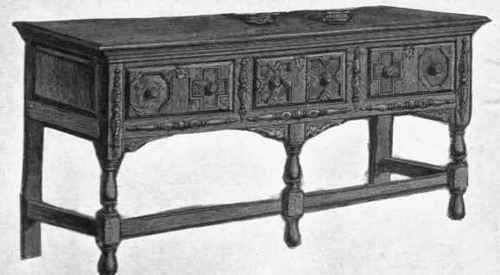
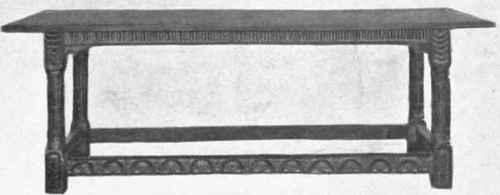
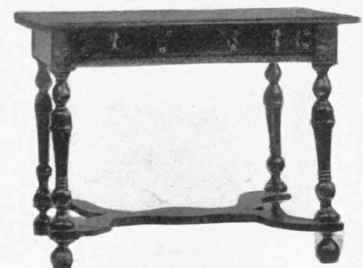
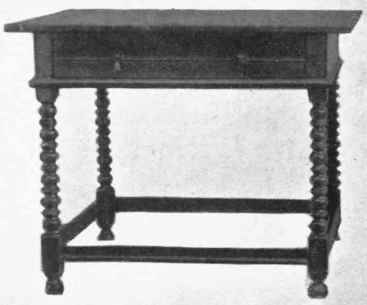
Plate CVIII - Sideboard-Table, William and Mary Period; Oak Dining-Table; Seventeenth Century English Dressing-Tables
The taste of Louis XV. for small rooms, and, more particularly, for little suppers, banished rigid etiquette and ceremony. Ingenious mechanics now invented tables and buffets for informal service, - pieces in which shelves could be made to rise and fall, and which contained various contrivances to raise dumb-waiters. The cabinetmakers, too, were skilful, and, therefore, the tables of Choisy, Versailles and Trianon are classed among the most sumptuous and ingenious works of the day. Many persons were engaged upon the famous "moving table" of Choisy. Sulpice, the cabinet-maker, designed it; Guerin made the mechanism for the model; the table itself was made by Lechaude; Loret, the goldsmith, furnished the copper and silver mounts; and Loriau supplied the cables. A movable buffet was made for similar apartments in Versailles.
Continue to:


My Books

