


IV. The Living Room
Description
This section is from the book "Home Furnishing, Practical And Artistic", by Alice M. Kellogg. Also available from Amazon: Home Furnishings, Practical And Artistic.
IV. The Living Room
A strong plea for the living room is made in these words of an English architect of reputation :
"Let us have in our houses a room where there shall be space to carry on the business of life freely and with pleasure, with furniture made for use."
In much the same spirit is the ideal fixed by R. de Maulde la Claviere of "a living and well-ordered place, where the accessory does not take precedence of the essential, where every object has its own place and its specific character," and where there is "a sentiment of unity, spaciousness and comfort."
Individual occupations may claim the library, studio or study; the little children and older people the nursery and sitting room; but the living room is distinctively for general service, unique in usefulness, its realisation a continuous source of delight.
In homes where a living room has always existed, life without it seems impossible. Unlike other rooms that may be completely furnished from the outset, the living room is a thing of growth. It may begin in a very unpretentious way and assume importance with time and the development of family interests, but it is never at a standstill in suggestiveness as to its treatment.
In reconstructing an old house there is often an opportunity for throwing together rooms that are too small for use by themselves, and forming one large living room. Windows may be added and doorways enlarged, with careful attention paid to the architectural details. In one such attempt the discovery of an oak-beamed ceiling made a delightful starting point for a return to an earlier, simpler period of interior work.
In another house a dark end of a long room was lightened by inserting three windows in a row and opening them in casement fashion. Underneath the windows a set of bookshelves was built against the wall.
Still another effort at remodelling brought to light an unused fireplace and an old Franklin stove. Both were returned to usefulness and a quaint, cosy-looking open fire was the result.
"The paper of the room in which we live," says a writer, "has a silent but irresistible influence upon us." Recognising this, the walls of the living room will receive a quiet colour of one, two or three tones, the choice depending first upon the woodwork in the room, then upon the floor and furniture covering to be used, with due attention paid always to the amount of light and the direction from which it comes.
In selecting a two-toned paper a geometrical or conventional pattern set closely together is more pleasing and untiring for every-day wear than a scattered pattern or a stripe. In a plain colour the English or domestic ingrains may be used, or one of the thicker materials that are sold by the yard - burlap, crash, buckram, linen or jute. Textile fabrics when used as a wall hanging are usually tacked to a narrow moulding that is fitted at the top and bottom of the wall.
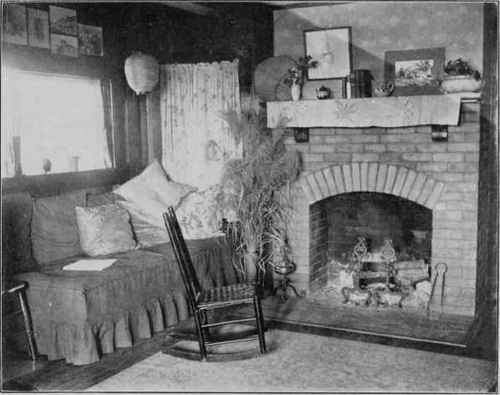
A ROOM THAT IS LIVED IN.
The question of a frieze or border for the living room is easily disposed of when the ceiling is less than nine feet. No ornamental finish except the picture moulding is then needed at the cornice. The regular frieze made to accompany plain papers is so obtrusive in design and distracting in colour that it may be discarded for a living room. In its place a figured paper intended for the side wall may be adopted by having it cut into strips the desired length for the upper wall.
The continuous use of this room will suggest a rug instead of a carpet, to avoid the interruptions of a spring or fall cleaning time. A large rug gives a sense of repose that is not accomplished by small rugs, and minimises the care of the bare floor, but sometimes the floor lines are so irregular that a rug cannot be found for the uneven spaces. Then the velvet, Brussels or Wilton carpel in rug patterns may be sewed together to fit the floor, the border following the outside edges within eighteen inches of the wall.
The restraint shown in selecting the colour and pattern for the wall covering of the living room may extend also to the floor covering. If mixed colours are preferred for the carpet or rug, they may be in soft tones in an unaggressive pattern, in a material as fine as is consistent with the rest of the furnishings. The two-toned effect may again be recommended for this room, as it has almost the full charm of a plain surface with more practical advantages.
The "livable" element would be defeated if the individual requirements of the family were not recognised in the selection of the furniture. Yet a preference for rockers, Morris chairs, low seats or high backs, soft cushions or hard wood need not be gratified at the expense of a good style, for a wide range is at hand from colonial designs to the modified mission of the present day.
An English fireside chair with wings or "ears" against which to lean one's head for forty winks, is a picturesque selection. This piece may be upholstered in a needlework tapestry, woven, to be sure, by machine, but with a hint of the old-time hand-work on its texture. A plain, comfortable rocker is not easy to find, but one may be searched for in a flag seat or an upholstered seat and back, that is not too ornate for its position. The test of an easy chair is whether on first occupying it one wishes to remain from choice. Applying this test to many of the so-called "easy chairs," in considering them for the living room, would bar out a large percentage that, on the moment, might seem exactly suitable.
Stools or benches of willow or with flag seats, of Moorish make or in plain wood, are convenient for the children, and two floor cushions that may be laid one on the other are easily provided. The cushions may be covered with corduroy or a soft-finished burlap, or a tapestry in well-mixed colours.
In a living room extensive enough to accom-modate a swinging settle a pretty colour effect may be accomplished with the covers of down pillows. Bulgarian embroideries may be cut into squares for this purpose, or some Oriental patterns made on the loom may be the selection. The swinging settle will not, however, take the place of a lounge or divan, and the utmost comfort may be reached with a simple frame fitted with springs on which a mattress is laid. If such a divan without a back is the choice, three stiff pillows filled with moss or hair will be needed to place against the wall and as a brace for some soft small cushions. A fitted cover may be made for a divan, with a box-plaited ruffle on the lower edges below the seat, and the large back pillow may be covered with the material of the cover. With such a cover material by the yard may be sought for. If a regular lounge spread is preferred the plain one-colour Bagdads are better than the much-seen five-stripe variety. The modern Kelim rugs make an enduring cover for a lounge, and Oriental embroideries on red or green cottons are attractive.
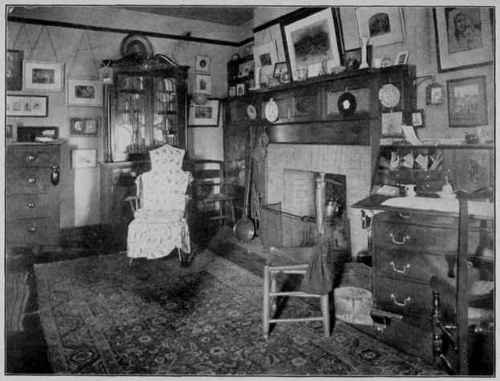
EVERY ARTICLE IS A GENUINE ANTIQUE.
A writing desk or secretary is one of the absolute requirements of the living room. One of the slope-front desks with large drawers below the lid is convenient, or a writing table with an open top and pigeon-holes may be chosen. In a large household more than one desk or writing table may be called for.
A generous-sized table, round, square or oblong, will afford a general centre for reading and evening work, but other small stands may be added for individual use in other portions of the room. A card table to fold away when not in use, a tip-table reserved for the tray of tea, a sewing stand for the needle-worker may be noted in equipping the living room with tables.
Bookshelves will naturally be provided for this room, and the open shelves will more readily suit the conditions than the closed cases. If standing space is limited, the hanging shelves may be fastened to or built against the upper walls, over a sofa or desk, mantel or table.
Evening enjoyment of the living room will turn upon a cornet lighting, and whatever medium is used it should be brought Low enough to do away with eye-Strain. If decorated shades are preferred in the daytime the useful plain ones may be adopted at night.
The treatment of the living-room windows may be with direct reference to their utility. This may be achieved by studying the spaces for light and air and suiting the drapery to the conditions. The simplest curtaining in this room is the best. If shutters are provided a shade is not imperative, but long or three-quarter hangings (the latter coming to the sill) may be pushed aside in the daylight hours and drawn in the evening.
Sometimes a semi-transparent curtain is more fitting than cither a thin material or an opaque goods. Embroidered madras or a stained glass net will give a characteristic touch to the living room windows. An all-over stencilling on organdie or rough-finished silk makes an unusual, attractive curtain, or home talent may embroider and hemstitch scrim or canvas.
In some homes a lack of ideas is evidenced in having the door hangings exactly like the over-curtains for the windows. The object of the two is something alike, but their positions are quite different. A material that hangs in soft folds may be made up for the portiere, of a single or a double-faced goods according to the plan to be carried out. There is a larger variety always in the single-faced upholstery goods. A figured effect will be a relief at the doorways if the walls are plain, and a plain hanging will balance walls that are strikingly patterned; but harmonious tones and good designs that have some affinity for the woodwork and walls will be the surest means for securing artistic rooms. No loopings nor festoons are desirable, but the mechanical contrivances for correct hanging and smooth running should not be given up on account of their expense.
A fireplace for the living room is a foregone conclusion to every home builder of our times; but when a rented house without provision for a fire on the hearth seems to eliminate this feature it is well to inquire into the substitutes that are on the market in gas logs that do not demand chimney or flue, and Franklin stoves that may be set with only a chimney hole.
In an old house that had seen Revolutionary days the fire on the hearth was never allowed to become quite extinguished in summer or winter, and the presence of the warm ashes made an easy re-kindling of the fire scarcely a moment's work. The homely adjunct of an iron crane suits the living-room fireplace, and if, at either side, there is a little hob, the water kettle will find a convenient resting place when not in use.
There is a more intimate enjoyment of pictures in the living room than in any other part of the house, and each selection may well be made with this fact in mind. If water colours, pastels or oil paintings are out of question from their cost, there are many satisfying prints in colour and in monotones. Some of the tinted engravings or the carbon copies of the old and new masters are less hackneyed than the copies of popular paintings.
An inexpensive decoration was made for the walls of a living room with three or four full-page coloured illustrations from a high-class magazine, by placing them under a gold mat with a narrow gold frame.
Continue to:


My Books

