


III. The Dining Room
Description
This section is from the book "Home Furnishing, Practical And Artistic", by Alice M. Kellogg. Also available from Amazon: Home Furnishings, Practical And Artistic.
III. The Dining Room
Originality and taste are often expended in the different parts of the house to the exclusion of the dining room. As a place to go to at meal times this room is provided with a table and chairs, a sideboard and china closet. The windows are curtained, the floor is laid with a rug or carpet, the wall is papered, pictures are hung and the room is finished.
What are the possibilities for making this part of the home interesting? If we begin when the plans of the different rooms are drawn up by the architect, we would put in a plea for placing the dining room in a position where it will get the morning sunshine, the full light of day hours, and the lingering gleams of sunset. This means an exposure of east, south and west; but if this happy combination is impossible to reach, then one of the three may be the substitute. If only a north light, however, is available for the dining room, especial care must be given to the colouring to make up for its cold outlook.
One point that may well be thought of in making a new dining room is its shape. Long, straight lines, or those exactly square, are almost sure to create an uninteresting interior, unless helped out by built-in furniture or artistic woodwork.
A plate shelf may often be made an architectural feature in the dining room. Its mission is to hold pieces of china that are worth exhibiting from an artistic or historical point and that are not needed for daily use. Usually the plate shelf is placed in line with some other part of the woodwork, the top of the mantel, the upper framing of the windows or doors, or it may be quite independent of any of these. If the wall below the plate shelf is panelled in wood to form a wainscot, only the space above needs a covering Water or oil colours may give this part a plain tint, or a paper may be used; or one of the heavier wall coverings such as burlap, grass cloth, Japanese leather or buckram may be selected, a plain surface showing the contents of the plate shelf to better advantage than a figured one.
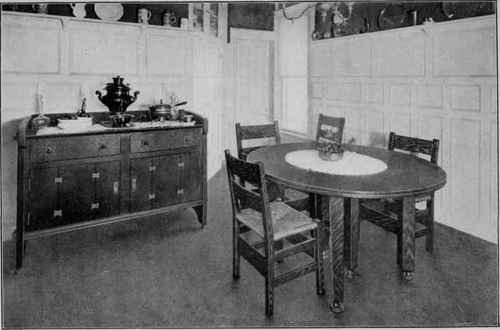
THE MISSION IDEA IN DINING ROOM FURNITURE.
China closets that are built into or against the wall are another means of bringing interest into the dining room. Sometimes these closets are united with the fireplace to balance the lines of the room.
A long window seat with casement windows is a pictorial addition to a dining room, and of service for afternoon or evening entertainments.
If a choice may be made in the woodwork of this room it may fall on whatever will suit the furniture the best, and as a decided preference is generally felt for dining-room pieces in mahogany or oak, the background of wood may, with the former, be of white painted wood, or, with the latter, some shade of brown or green.
In rented houses the dining rooms are often spoiled by a cheap wood finish, and the only improvement to be made is with paint of a quiet, harmonising colour.
The colour of the walls and the colour of the floor covering are the important items in the dining room from a decorative standpoint. If the exposure renders the room habitually dark and gloomy, great care should be given to bring bright tones into the wall treatment. If, on the contrary, there is considerable window glass and a glare of light, the room will require toning down with papers of subdued hues.
The question of a plain or figured wall paper for the dining room must depend upon certain conditions - whether a purely decorative result is wanted or whether the walls must be a background for pictures or china. The style of furniture, too, will modify the selection, as chairs and table that are massively carved must be sustained by a depth of colour behind them.
A large rug is the best covering for the dining-room floor. If the boards showing outside of the rug are not in condition for a stained or waxed finish, they may be painted a soft dark colour that does not obtrude itself against the colours of the rug. The size of the rug should be generous enough to allow the chairs to be pushed back from the table without scraping the bare floor.
A plain-coloured rug is not as serviceable for this room as well-mixed colours in a close-set pattern. The Wilton rugs and the Scotch (the latter reversible) are in good taste and give good wear at a medium price. Velvet or Wilton carpeting that is six, nine or twelve feet wide may be cut the right length and used as a rug without any border. Oriental rugs of not too heavy a pile are the most enduring here as in every other part of the home, but a strongly marked centre figure is often difficult to adjust evenly under a table.
The drop-leaf table around which our forefathers consumed their meals was increased in size for the comfort of guests by joining a side table of the same height and width at each end. Our later-day contrivance, the extension table, is an advance so far as utility is concerned, but for beauty it is not at all a success. The oblong size with rounded ends is seldom seen nowadays; square ones are still made; the round table, however, is growing more and more into popular favour.
The prominence of this piece of furniture and its cost make its choice a critical one in the fitting up of the dining room. The construction of the supports may be carefully noted, and if the table is to remain in an extended position the centre pillar may be discarded for a style with posts at each corner.
A round table four feet six inches across seats several persons and allows an extra place to be added without the use of extension leaves. It may be extended, if necessary, to eight, ten or twelve feet, according to the number of leaves. Of course, the rounded edges occasion a loss of space for the serving dishes that the square table affords. Table-cloths are made for the round table, and the usual small pieces of linen for the centre, plate doilies, etc., each item adding its share to the symmetrical appearance of the table.
A polished wood for the top of a dining table soon becomes seared with hot dishes if no precautions are used. Large asbestos pads are manufactured to lay under the cloth, or, if a bare table is preferred for breakfasts and luncheons, small asbestos mats may be slipped under plate doilies.
Dining-room chairs should match the table in wood and general style. Mahogany chairs of the best make are sometimes copied from the English designers, Chippendale, Sheraton, and Heppelwhite. Chairs carved in dark oak return to the earlier period of English decoration, the Jacobean. Mission chairs and tables in austere lines and deep-coloured finish suit some conditions better than any other type. Painted chairs are not usual in the dining room, but the idea was adopted with success to match the sage-green paint on the woodwork. The reproductions of the Windsor chair without arms may be treated to paint with good results.
A sideboard of some kind, when the spaces of the room permit, is one of the real requirements of the dining room. So many varieties of this article exist in old pieces and new that the choice must turn upon the price that is to be paid, and its location and surroundings. Some of the old Southern sideboards of San Domingo mahogany are typical of lavish hospitality and generous-sized homes. A fine sideboard that has descended through generations is a treasured inheritance, but one that is merely an antique without any claims of association, beauty of design or integrity of wood, is valueless.
Besides the sideboard which holds the flat silver and linen in its drawers and accommodates other silver and glassware on the top, a serving table is useful as an auxiliary. This is made with one drawer and a shelf below, and the top is kept free for removing dishes to and from the table during the progress of the meal.
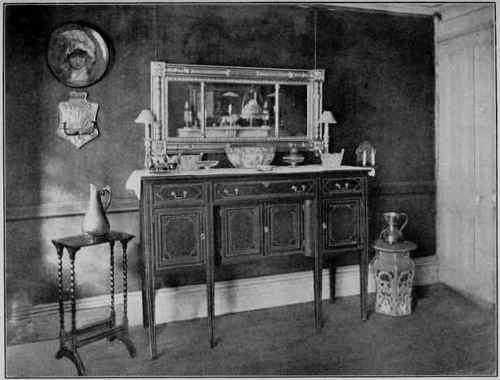
A SIDEBOARD IN SHERATON STYLE.
A china closet with glass doors and mirrors at the back is made in different woods and several styles to fit against the wall or to stand in the corner. Much expense is put into some of these closets, fine carving and careful finish adding to the cost of the handsome wood; and sometimes the shelves and sides are made of glass to show the interior contents to better advantage.
The lighting and heating of the dining room require a thoughtful consideration to give the acme of comfort with due reference to aesthetic appearance. Unless there are ample spaces to the dining room the open fireplace may be dispensed with, as close contact is a source of discomfort when it is too near the table. A recessed fireplace with built-in seats placed at the farther end of the room is the ideal arrangement for this feature in this part of the home. If hot-water radiators supply the heat, a warming oven may be attached to one of the radiators for use in the coldest weather.
To sit facing a glare of light will spoil the most enjoyable meal, and a table poorly lighted will bring equal discomfort. Just the right amount of light may be reached after a little experimenting with curtains and gas or electric shades. All of the windows should have practical means for shifting the curtains readily according to the needs for increasing or decreasing the light.
The articles related to the dining room, china, glass and silver, afford so large an opportunity for appropriate decoration that pictures seem almost needless. Yet the attraction that an interesting picture lends to any room should not be forgotten here. A reaction has happily set in against the unpleasantly realistic paintings of fish and animals that a few years ago were considered the proper selection for dining-room walls. Instead, there is a popular liking for the English and American coloured prints of hunting and golf scenes, and for a higher grade of pictures of still life, flowers and fruit.
Whatever the choice of pictures for the walls of the dining room, it should attract and hold the attention pleasantly, and lend towards the entertainment of the meal hour.
A between-meals cloth is not so much seen now as in other years, and a round mat of some kind takes its place. The tooled leather makes a substantial and beautiful mat for this place; or an embroidered circle of thick brown linen may be made by home talent. A bowl of fresh flowers or a small jardiniere may be placed on the mat and the rest of the table left bare.
Continue to:


My Books

