


Pictures And Bric-A-Brac. Continued
Description
This section is from the book "Home Furnishing, Practical And Artistic", by Alice M. Kellogg. Also available from Amazon: Home Furnishings, Practical And Artistic.
Pictures And Bric-A-Brac. Continued
Two methods of hanging pictures with a wire cord are followed. One is to use one hook for the picture and have the cord form an acute angle at the top where it falls over the hook. The other plan is to use two hooks and two separate cords, the cords making two separate perpendicular lines from the back of the frame to the moulding. The latter is better and safer for large, heavy pictures, the former more suited to pictures light in weight. Whichever way is preferred, every precaution for security should be taken and the risk of injury to the picture and the possibility of accident to anyone near a falling picture should be guarded against not only by a careful attention to the picture when first hung but by a general examination from time to time. The superstition about the falling mirror would soon be dispelled if common-sense measures for safety were observed. String should not, of course, be used for picture hanging as it is likely to give way at any moment. The wire picture cord in silver finish sometimes stands out too brightly on a wall and the gilt finish may then be substituted.
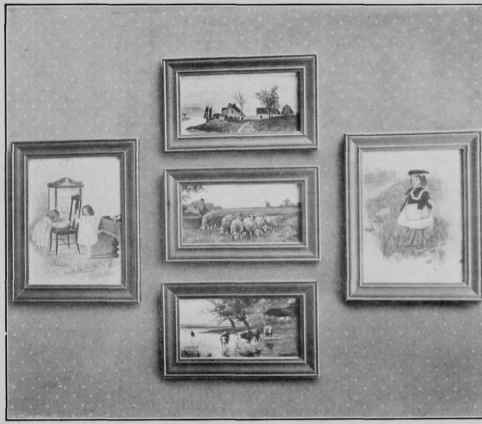
SMALL PICTURES FRAMED ALIKE LOOK BETTER HUNG CLOSELY TOGETHER.

SEVERAL PICTURES MAY BE HUNG FROM ONE HOOK.

PICTURES AND BRIC-A-BRAC.
Pictures that are too small to be seen in reasonable detail from any part of the room need not be placed upon the walls. In arranging pictures the aim should be to convey a sense of repose and dignity, and this is never achieved where there is overcrowding.
Almost every picture looks best when hung flat or nearly flat against the wall. This is done by having the rings or screws on the back of the frame (by which the picture is hung) fastened near the top. If, however, the picture requires tipping forward to catch the light, it may be kept in position by a tack placed under the lower part of the frame.
The proper height at which to hang a picture is often questioned. A good general rule is to bring the centre of the picture within range of the eyes of a person of ordinary height as he stands before it. Sometimes three pictures framed alike and similar in composition or colouring are to be hung one above another. The middle picture, which will look better if it is a size smaller than the two others, should be the one selected to be in eye range. The space of an inch or two, in such conditions, may be left between the pictures.
One common mistake of an inexperienced picture hanger is to bring into juxtaposition dark and light mats. Harmonious results are impossible to attain when this is done.
In some houses the hallway is quite overlooked in the matter of picture decoration.
The opportunity, either in a living or an entrance hall, is too good to be lost, and when well met adds to the good impression that is desirable for the entrance to the home.
Bric-a-brac in the cheap meaning of the word is not in good taste. Rare, beautiful objects and those of historical interest bear quite a different character in the decoration of the home. A collection of old china serves more than one purpose when carried out with intelligence, and so with other fancies for gathering representative pieces, whether they are tea pots, tea caddies, jugs, pepper pots or steins.
Faience, the name for glazed pottery, came from the city of Faienza in Italy. The Italians borrowed this art from the Moors in Spain and reached their highest mark of excellence in the fifteenth century. A return to the simplicity and beauty of those times has lately been made in America in a unique ware called the Grueby, in which the glaze is soft and dull and lightly decorated in self-colour. The arc turned on the primitive potter's wheel that dates back to ancient Egypt; then the clay is dried slightly, and while still damp the outline of the decoration (a leaf or a flower) is drawn on it, and a thin rope of clay pressed in place and modelled in shape. This is baked and then the enamel is fired on it. Each piece is different from the next, and individually attractive. The colours of the Grueby pottery are exquisite shades of green, blue, brown, red and yellow.
Another pottery distinctly American, for which a position may be claimed with that of older nations, is the Rookwood. New styles have each year been brought out, until now every room in the house may have a suitable kind. The Newcomb, Merrimac, Volkmar, Poillon, Van Briggle and Dedham ware are all intrinsically interesting for home decoration.
The appreciation of plaster casts has gradually increased and with it a larger variety is at hand from which to make selections for the home. The prices, too, bring the casts within reach of the most modest incomes. Some well-known subjects are the musical Cupids, the Venus de Milo, the bust of Dona-tello, famous authors or composers, the Tanagra figures, Barye's lion, the Madonnas, and fancy heads. The ivory-tinted casts take their place better in a private room than the white ones. If white ones are to be used a simple method for changing the colour is to dissolve beeswax in turpentine and add a little burnt umber. This may be rubbed on carefully and wiped off, leaving whatever amount of tint is desired. One of the useful kinds of bric-a-brac is the flower holder. Whatever is selected for this office may be chosen as the frame is chosen for a picture, to set off the beauty of the blossoms. The plain glass fish globes are the least expensive flower holder for the centre of the dining table; iridescent glass is higher priced but not costly. If heavier jars are preferred for certain flowers the Japanese vases offer a wide variety.
Continue to:


My Books

