


I. The Hall, Vestibule And Stairs
Description
This section is from the book "Home Furnishing, Practical And Artistic", by Alice M. Kellogg. Also available from Amazon: Home Furnishings, Practical And Artistic.
I. The Hall, Vestibule And Stairs
The impression that a hall leaves with one is not so much of detail as of a hospitable or inhospitable atmosphere. The furnishings are the fewest that are gathered into any room in the house, the decorations are the simplest; the right selection of each is imperative if the hall is to be made attractive.
Interest in home furnishing is often too closely concentrated upon the living rooms to the neglect of the hall and stairway; yet the latter really exacts the larger amount of attention, from two standpoints - prominent position and constant usage.
In the early days in England the hall was an imposing chamber, where much of the social life was passed. Tables were brought in at meal times, and privacy was secured by screening off certain portions of the apartment. After a time regular rooms were arranged for receiving visitors, eating and sleeping, and the hall became a place distinctive in itself.
Modern halls are an outcome of all of the styles that have gone before. Sometimes they appear simply as a means of egress and entrance, and as a passageway into the various rooms of the house. Or, the hall is sometimes combined with the reception room or parlour, or made the chief living room in the establishment.
The wide, straight hallway, of colonial architecture, that extended from the front of the house to the back, is still seen in many modern homes, besides those constructed after the old style. A treatment that followed the early colonial is that of placing the staircase in a passageway out of sight of the front door, at the right or left of the entrance. This kind of hall, with the doors at opposite ends, makes a pleasant sitting place in summer when cool currents of air draw through the openings.
An economy of space in small houses is attained by adopting a floor plan in which the hall and parlour each occupies one-half of the front of the house, the kitchen and dining room taking the rear.
Before looking into the requirements of the ordinary entrance hall, the fittings for the living hall may be considered. In southern climates and in summer places the living hall forms a delightful centre for the family and its guests. The situation calls for good furnishings and a more orderly arrangement than is necessary in a living room; but plenty of provision for comfortable seating with chairs of various kinds, a number of tables and stands, rugs, window curtains and some decorative accessories.
If no vestibule precedes the entrance to the living hall, a niche or corner near the front door may be arranged for laying aside wraps, umbrellas and overshoes. This may be made convenient without specific attention being called to its office of usefulness.
If a fireplace is present it may have a settle or a high-backed sofa drawn near it, screened from draughts from the door in chilly weather. The fittings for this fireplace may be chosen for their expression of dignity, with lines plain and clear-cut.
If small rugs are laid on the floor their positions should follow the lines facing the entrance, if possible without much bare floor showing between. Dark, subdued colourings on the floor will be preferable to light, insignificant tones, and geometrical designs to floral effects.
Sometimes a piano is placed in the living hall, but the interruptions incident to the entrance-way bar out a restful enjoyment of music. A music-box or other mechanical instrument may, however, be a means of entertainment without this objection.
The colour scheme for the living hall is peculiarly dependent upon its shape and size, besides other conditions that always enter into a choice for this part of home decoration. A deep pumpkin yellow will transform a gloomy wall, and the brightness may be increased with white-painted woodwork. The mahogany tones of Bokhara rugs, or a carpet in two tones of bronze with a trace of deep blue will harmonise with the pumpkin-coloured wall, and old mahogany or cathedral oak furniture will complete the colour plan. Some of the old Dutch copper or brass milk cans will fit into the tall lines of the hall as flower holders on a large scale.
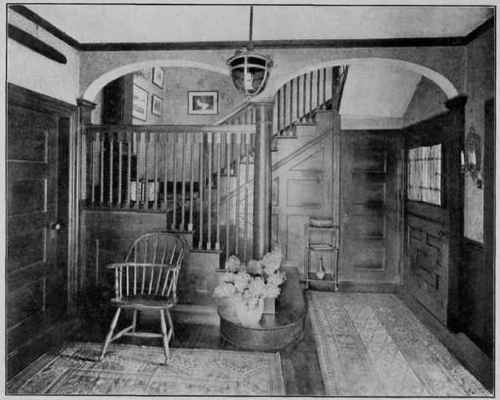
A COMFORTABLE CHAIR FOR A HALL.
Curtains for the living hall may need, on account of a lack of light, to be of the sheerest net, but without the lace-like designs that are appropriate elsewhere. In each detail of its furnishings the living hall requires perfect suitability to its use and conditions to be successful.
In the homes that are planned in a commodious fashion, a hall that has its walls panelled with wood presents the most dignified appearance; but halls that are contracted in size are not benefited by this treatment. A wainscot of wood, either low or high, according to the length, width and height of the hallway, is a protection from the continuous passing and moving of furniture or luggage. When a wainscot must be excluded from reasons of economy, its substitute may be made with some one of the heavy wall coverings made especially for the purpose.
The wood selected for the hall, even among the cheaper grades, may contribute a quiet, refined expression to the entrance of the house if treated with one of the new dead-lustre stains. A stain is preferable to paint, as it gives a variation of light and shade to the wood; and the dull finishes are now more in evidence than those that are polished and varnished.
Sometimes an entire house is finished with white-painted woodwork, as in the days of our forefathers, a style that is to be preferred to that of a later period when an imitation of grained oak came in vogue.
Just what colour in which to finish the woodwork that has, by limitation of cost and personal preference, been chosen for the hall-trim is often a puzzling problem to the home builder. A definite guide, however, is at hand in the furniture that is to be used, for mahogany looks its best against white paint; Flemish oak needs a corresponding finish around it; dark oak may have almost any oak tone; light oak may have its corresponding finish or a green stain or paint.
Continue to:


My Books

