


XXV. Baskets And Jardinieres
Description
This section is from the book "Home Furnishing, Practical And Artistic", by Alice M. Kellogg. Also available from Amazon: Home Furnishings, Practical And Artistic.
XXV. Baskets And Jardinieres
Baskets will always, by their office of utility, claim a certain amount of attention in the home. A few years ago the selection of a basket for household use was quickly made; in fact, the variety to be found in the shops was so limited that it was scarcely a matter of choice. Interest in basketry, however, has developed at a rapid pace, and through the Arts and Crafts movement and an appreciative collecting of Indian work this item in home furnishing is on a higher plane than ever before. It follows that the productions of the hand workers have naturally raised the standard of machine-wrought articles, and a better variety may be found now in these than ever before.
Indian baskets are as fascinating to some collectors as rugs, silver, furniture or china to others. Their value is recognised by museums in large towns, and their accumulation is a matter of civic pride. The old baskets, many of them, are so softly coloured that they remind one of antique tapestries, and their quaint, curious patterns, symbolic of the life and illustrative of the legends of a passing race, are so finely woven that the making of a single round often consumes an entire day. The process of splitting, curing and bleaching the grasses and reeds is tedious and slow. The dyes are made by steeping the peel or bark of trees, the juice of berries being used as an immersion. The fine black strands that are frequently seen outlining a design are the stems of maiden-hair ferns.
Among the fifty-eight tribes of Indians in this country there are a number noted for their skilful weaving of baskets. The Mokis, who live in pueblos in Arizona, are famous for their fine baskets, and their manufacture is a profitable source of income. This tribe regards its baskets as sacred and makes them a part of religious ceremonials. The Klickitas, sometimes called the Iroquois of the West, adopt the imbricated style, or overlapping weave, in the construction of their baskets. Their burden baskets are well-known - generally oblong in shape, very deep and formed on a block. The pattern shows only on one side and is usually the lightning or rattlesnake motive. The inhabitants of the Aleutian Islands have a distinctive art in their basketry. The broad, stiff grass is shredded fine and woven so closely as to be waterproof. It is soft and pliable, and when not in use the fabric may be folded away like a piece of cloth. The introduction of coloured worsted and occasional bits of feathers marks the Aleutian baskets. The Apache tribe makes a basket well-proportioned and carefully woven. The Ute make is distinguished by rougher weaving than that of the other Indians. The Shinumos show fine quality and great variety in their baskets, and when intended as a water-jug a basket is given a coat of pitch and gum to make it water-tight.
A curious difference is noticed in the baskets of stationary and wandering tribes, the latter showing a pouch or bag that is more suitable for carrying than the designs made by the Indians who stay at home, Indian baskets are nearly imperishable, and a collection of them serves many utilitarian purposes. In one home these baskets were distributed throughout the rooms and put to every-day use. In another house the baskets were grouped around the brickwork of the fireplace, a centre of attraction.
Outside of the Indian baskets, those of hand-made willow in natural colour are the most commonly known. Different shapes in willow can be made and then stained to fit them into the colours of a room. Baskets made of palmetto are light and soft, yet durable, and the natural colour suits any surroundings. Raffia and reed baskets can be made by the amateur in real craftsman's manner, designing and constructing at the same time.
Jardinieres and flower holders arc among the articles of furnishing that do a large share towards giving a homelike, livable atmosphere. Fortunately for the large majority of homes where only a moderate outlay may be made in this direction, there is a good variety in choice and price.
The decoration of the house with plants and flowers was, until of late years, confined chiefly to the cottage-window display of geraniums, and, in finer dwellings, to a formal arrangement on gala occasions with foliage plants from the florists; but nowadays the decorative quality of plant life brought indoors is, with the awakened interest in beautifying the home, better appreciated. Flowers on the dining table, plants in the living room, experiments in seed raising in the nursery and even a miniature fernery in the bath room, are not infrequently seen at this time.
A jardiniere to be "a thing of beauty" must be of good design, harmoniously coloured and suited to its environment. These three requirements are not easy to meet, but they are essential for the all-around success of the jardiniere. A common mistake in selecting this article is to forget the relative values of the plant and its holder. A jar that is garishly coloured and very ornate in design defeats its object of framing or holding the plant. The Japanese have a highly cultivated sense of the decorative value of plants and flowers. One exquisite blossom placed in a graceful vase expresses more to these people than our indiscriminate massing of many varieties in a showy holder. The dwarf trees brought over from Japan are often more curious than beautiful, but their ornamental purpose is undeniable. Each specimen is grown in a jardiniere without an inner pot, and an opening at the bottom acts as a drain. The same idea might be adopted with our native plants when in bloom, transplanting them in jardinieres for the house while they are in bloom and returning them to the garden when their blossoms disappear.
Among the jardinieres that may always be found in the Japanese ware is the white kind, printed in blue, and the terra-cotta. The first is well-suited to the dining table, for ferns or plants, and the other is useful in any part of the home.
Hammered brass pots can be used when pottery fails to meet the colour scheme of the room, and the polished surface of the metal is distinctly useful in apartments that are lacking in sunlight.
Modern potteries, such as the Grueby, Rookwood, Poillon, Merrimac, Newcomb and others, have made a valuable contribution to indoor garden effects by designing artistic tubs to hold bay, box and rubber trees.
Holders for flower pots may be made at home from reed, willow and raffia, and while not capable of hard wear these holders often meet a temporary need better than heavy pottery.
In buying vases to hold cut flowers a pretty shape may make a strong appeal to the purchaser, but when put to the test of usefulness may prove quite disappointing. The preference should be for those simple in design, quiet in colour, with a firm base to support the weight of the flowers.

A TREE TUB IN POTTERY.
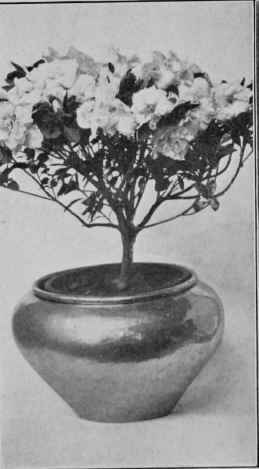
A HAMMERED BRASS JARDINIERE.
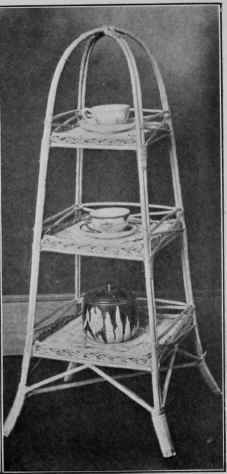
A THREE-TIER STAND MADE OF WILLOW.


BASKETS AND JARDINIERES.
In making a home in the country, a lover of flowers determined to accumulate no useless bric-a-brac, but to gather instead a collection of vases and bowls to hold cut flowers. Certain pieces were kept in a closed cabinet; others were displayed on tables and shelves. Plain or iridescent glass was reserved for sweet peas; tall, tapering vases were used for roses; some Spanish pottery was dedicated to nasturtiums; large, cylindrical jars of dull green were brought out in the time of hollyhocks; and hardy chrysanthemums, the garden's last contribution to the decoration of the house, were always placed in terra-cotta Mexican dishes. Such an assortment as this is not beyond the most limited income, and, chosen by degrees, contributes a continuous interest to the making of a home.
Continue to:


My Books

