


The Bedroom. Continued
Description
This section is from the book "Home Furnishing, Practical And Artistic", by Alice M. Kellogg. Also available from Amazon: Home Furnishings, Practical And Artistic.
The Bedroom. Continued
The three pieces of furniture that are usually included in the furnishing of a bedroom that is also used for dressing are a bureau, dressing table and chiffonier. Sometimes the chiffonier and bureau answer all the necessary requirements, if the latter piece has a dressing mirror attached to it. A chiffonier for a man's clothing is a late invention in which open trays take the place of drawers, with wardrobe doors as a protection from dust.
A unique bureau, patterned after the Japanese travelling bureau, is sometimes admitted in the bedroom. It is made in two parts, each one having handles of iron through which a pole may be slipped if the chest is to be carried by hand.
A bureau with two small drawers at the top, for holding the minor articles of dress, is more convenient than one with drawers all of one size; but any cabinet maker can add interior compartments to a large top drawer for the convenient disposal of gloves, handkerchiefs and collars.
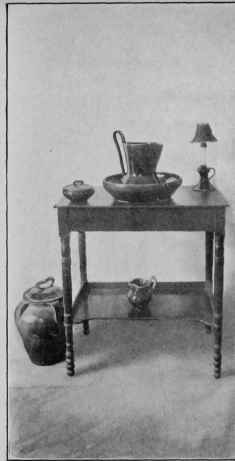
A TOILET SET IN POILLON POTTERY.
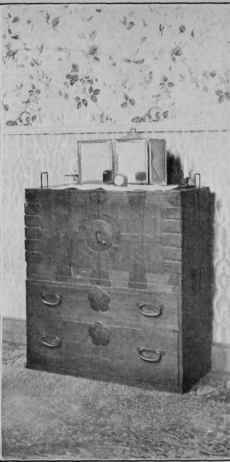
A JAPANESE TRAVELLING BUREAU.
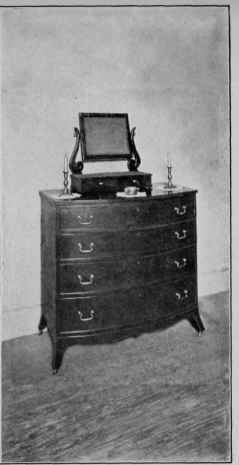
AN OLD-TIME CHEST OF DRAWERS WITH SHAVING MIRROR.
Bureau drawers that are more than three feet across the front are heavy to open and close, and increase the difficulties experienced with unseasoned wood in damp weather. In linen closets the drawers are sometimes placed on rollers to facilitate their easy moving.
If a dressing table is used in place of a bureau, it should not be too high to use with a chair or bench. The low-boy, or low chest of drawers of colonial times, is now reproduced in the old way without a mirror, and also with an up-to-date adjustable mirror.
An inexpensive dressing table may be constructed by an amateur worker with tools by fastening together some pine boards and nailing them to the top of a barrel. The boards may then be covered with double-faced canton flannel and an opaque dimity gathered around the front and sides, with a cover of the same material laid on the top. Such a dressing table, to be really serviceable, should not be smaller than thirty-four inches broad and twenty-two inches deep. The same contrivance may be adopted for a washstand, and if it is fitted into an angle of the room with a protector of sheer muslin gathered and tacked against the wall to a height (above the top of the stand) of twenty-four inches, a dainty furnishing will be given the room at a minimum expense.
The bureau of to-day has been many years in reaching its present practical form. Its earliest estate was a plain chest in which clothes and household linen were laid away, but the introduction of a drawer in the lower part (leaving a well or space above) proved to be of such advantage that other drawers were added. Sometimes the chests with drawers were made in two parts and placed one upon the other; sometimes they were made in one tall frame, familiarly known by the name of "tall-boy" or "high-boy."
The tall chest of drawers was at one period of its existence put aside for a more up-to-date piece of furniture and received into the attic for storage, but in the revived interest in old furniture it has been restored to its old position of usefulness.
The early Dutch chests that were brought over to this country were made of walnut, and few of these have survived the years, except as they have been preserved in museums. Some of the old mahogany chests of drawers of the late eighteenth century, with inlaid lines or carved pillars, are still existing in houses where their value has been appreciated from one generation to another.
The inconvenience of dressing with a mirror hung against the wall produced another step in the evolution of the bureau, and a small glass attached to a box was placed on the top of the case. After a time a mirror was fitted to upright mahogany posts and fastened with adjustable screws, and the bureau of to-day was complete.
The designs for washstands are not numer ous, and the more simple their style the more sanitary is their condition. "Art Nouveau" has introduced some washstand patterns almost austere in outline, but better adapted for practical purposes than the carved, ornamented work of our own country. The square and corner washstands of the colonial era are quaint belongings for the old-fashioned bedroom, but their contracted size and the necessity for small toilet sets make them unsuitable for an age devoted to good bathing facilities.
An artistic combination of shape and decoration seems almost impossible to reach in the commercial toilet sets. Form is of primary importance; colour effect may be secondary. Plain tints may be selected when a pattern is too aggressive, and cream white turned to if both colour and decoration are inappropriate.
A correct placing of the bureau and wash-stand contributes not only to comfort but to the distinction of the room. The best position for a bureau is between two windows for daytime dressing, with artificial lights at each side for the evening. The washstand should be out of sight of the entrance door, and if it can be recessed it will be a less conspicuous feature in the room.
A screen may be remembered in fitting up a bedroom, and a simple frame made at home may be covered with cretonne at a slight cost; or one of the Japanese screens will answer for the bedroom. The latter are made in many different sizes, they are light and easily handled and found in a variety of colours and designs, in paper, cotton and silk. If a screen that is heavier in weight is preferred, an oak frame in three or four panels may be covered with burlap, and to relieve the plainness a picture panel may fill the upper part of each leaf.
A door guard has been originated to screen a bedroom when the door is left partially open. A strip of thick brown linen is cut the length of the door and five inches wide, ornamented with Japanese sword-hilts that give weight enough to keep it from blowing aside, and then hung on the inside of the room over the opening between the two pairs of hinges.
There is so much interest in old furniture nowadays that a bedroom fitted up in antique pieces or their reproductions makes a pleasant change from modern fittings. An old four-poster may be made comfortable with wire springs and a hair mattress; an old chest may hold the hand-woven linen and blankets; a low-boy take the place of a dresser, and a highboy become the chiffonier. Instead of a bureau a chest of drawers may have a shaving mirror in the by-gone fashion placed on its top. A corner or square washstand may be equipped with an old-blue china bowl and pitcher, and a candle-stand, work table, rush-seated chairs and rag carpet carry out the quaint ideas of the past.
Continue to:


My Books

