


XI. The Child's Room
Description
This section is from the book "Home Furnishing, Practical And Artistic", by Alice M. Kellogg. Also available from Amazon: Home Furnishings, Practical And Artistic.
XI. The Child's Room
The element of interest is not always considered in furnishing the child's room. Comfort, of course, should be of the first importance, and an artistic selection made whenever possible, but a touch of the unique and entertaining makes the most vital appeal to the plastic nature of the child.
The child's own expression of taste may receive sufficient deference, in furnishing this room, to give him a sense of ownership in his surroundings, laying besides the foundations for the responsibilities of the home in which, in time, he will be the master.
Modern conveniences are so eagerly adopted by the American people that the child's room is not apt to be overlooked in these matters. The windows should be screened and shuttered to keep out insects and a too-hot sun in summer; the sashes so placed as to secure the best ventilation; the heating apparatus chosen for efficiency; the plumbing made sanitary; the location isolated from the other rooms as much as possible. In arranging for each one of these details for comfort the point of permanence must be taken into consideration, and the price paid for it.
A common mistake in furnishing a child's room is to fancy that anything that is not wanted in other rooms may be turned to account there. In one house, perhaps, when the carpet from the first floor hall is too worn for its position it is brought up to the nursery. In another home, the furniture that is too disabled for parlour or library is passed on to the room devoted to the children. In like manner the child's room receives faded curtains, half-worn portieres and soiled sofa pillows. Sometimes the refurnishing of some one room leaves certain pieces that do not fit into the new colour scheme. The children's room is immediately thought of as a place to receive articles that are "altogether too good to be thrown away." Under such rulings as these the child's room naturally loses any characteristic quality of its own, and takes on the appearance of a second-rate auction shop.
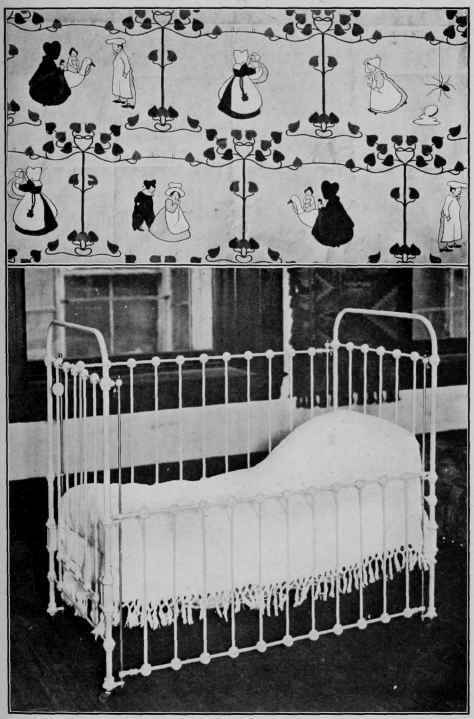
A MOTHER GOOSE CHINTZ A CRIB WITH SLIDING SIDES.
Three connecting rooms for sleeping, playing and bathing, with each item of furnishing and decoration carefully planned, form the ideal suite for the child. In the sleeping room there need be few articles of furniture - a crib or bedstead, a chair or two, a chiffonier or chest of drawers, with closets conveniently fitted up for holding clothing. The floor may be laid with rugs that are small in size and soft in texture; the walls may be painted in oil and trimmed with a narrow stencil border around doors and windows. The windows may be hung with muslin curtains and dark shades, shutters being put up for the summer months.
In a bathroom that is the exclusive property of a child the space above the wainscot may be decorated with a picture paper in sanitary finish. A dainty look will be given with pink and white for the colours in rugs and woodwork. In one little girl's bathroom a touch of plant life was always present in a growing fern that was set on the wide window-sill.
The wall decoration has a large share in making a child's room attractive. Only too often ignorance of this fact allows the walls to be painted or tinted in a crude colour, or an inartistic paper to be hung, or a careless combination to be made with side walls and frieze. The wall colour itself is of so much moment that it should take the precedence in planning a general scheme for the room.
In the day nursery or playroom the walls may be treated in different ways, but whatever style is adopted it is best to keep the ceiling in a cream-white tint. If the walls are higher than nine feet, the ceiling tint may be brought down on the side wall for twelve or eighteen inches, with a picture moulding joining it to the paper below it. A paper for the walls should be selected with care, and an endeavour made to secure only a few harmonious colours in a good design.
When a painted or tinted wall is desired, the colour may be suited to the window light and exposure. A sunny outlook, or a many-windowed room, will require to have the light tempered with green, blue or gray on the walls. When sunlight is deficient, a soft pink or buff will be the right tone to put on the walls. A plain-painted wall lacks interest for a child who loves the pictorial element near him, and some atonement should be rendered with framed or unframed pictures.
A wall that is tinted in water colour or kalso-mine is easily soiled and not advisable for the child's room. The egg-shell finish given with oil paints is preferable, as the common gloss is too smooth-looking to be artistic. Walls in the egg-shell finish may easily be cleaned with soap and water, and pencil marks, finger prints and the like will not do irreparable damage.
Plain-painted walls may be decorated in a variety of ways by the use of stencils. A light colour may have a pattern stencilled upon it, giving a pleasant, two-toned appearand The design may be simple or intricate, the colours may be few, the expense of time and money small or large, but the decorator should always keep in mind that little folks are to live in the room upon which he is expending his skill. The space above the mantel-shelf gives an opportunity for hanging a picture that will appeal particularly to childish eyes. The Mother Goose chintz may be utilised as an overmantel decoration at a slight cost. In another room a section of the Parthenon frieze in plaster may be fitted in the wall above the mantel. The Delia Robbia singing boys have become so popular for this purpose that architects incorporate the plaster reliefs in the woodwork that is designed for the nursery.
It is better to cover nearly the entire floor of the child's playroom. If a rug of the right size cannot be procured, a substitute can always be had in carpet which may be made up with or without a border. The mottled velvets are well suited to this room, their effect being like a plain carpet with less delicacy in wearing. There are also Wilton rugs and ingrain rugs made in Scotland that will be liked in this room.
In making a study of the needs of the child, chairs may be selected for comfort, bookshelves placed within reach, and tables chosen of the right height. Artistic furniture for the use of children has never until lately been manufactured in much variety; but nearly all of the shapes made for older people may be found now in miniature sizes. A chest for toys, sixteen by thirty-one inches, may be devised at home, using white wood and staining it in willow-green. The top, front and sides may be covered with a nursery chintz, and the edges of the material covered with furniture gimp. A shallow tray divided into compartments may be fitted into the inside of the chest, and brass handles, a lock and a key added.
The shading of the windows of the child's room should be essentially practical, but not to the exclusion of some pretty curtains. The usefulness of the open fireplace is nowhere in the house so conclusively demonstrated as in the nursery. It may be of the plainest type and of the utmost simplicity in its fittings, yet accomplish as much good as one of a more expensive character. A spark guard of wire netting should be provided to protect the children from accidental contact with the fire.
In a room used by a boy or a girl for playing, studying and sleeping there is a triple opportunity for interesting furnishing. A young lad who was fond of Indian life and history collected some different trophies which were made a wall decoration in one corner of his room. A Navajo blanket was tacked to another side of the wall, and a floor rug made with a second Indian blanket.
A young girl who had considerable musical talent was encouraged by having a piano placed in her own room where lessons and practising could go on without interrupting the family occupations. The experiment proved thoroughly successful in furthering the progress of the girl's studies in music, and also established a helpful atmosphere of musical art in her own room.
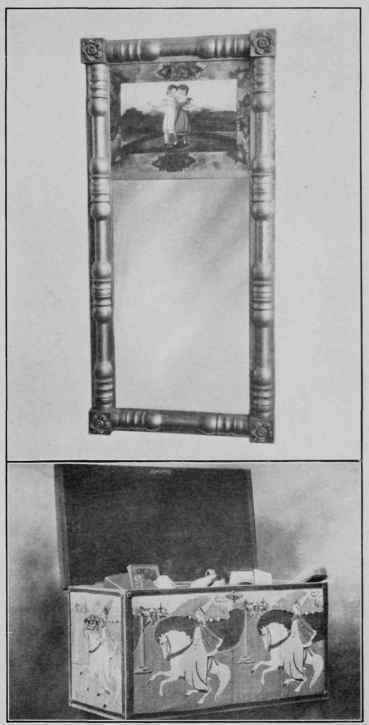
AN OLD PICTURE MIRROR A CHEST FOR TOYS.
The care of children during contagious illnesses is often a perplexing matter to the household. The location of the nursery at such a time shows the wisdom, or lack of it, of the builder. A plan adopted by a family who lived in a country town was to keep a room ready in the barn where a child ill with a contagious disease could be cared for by a nurse. The equipment was like that of a private hospital, with white enamelled bed, table, chairs and conveniences for nursing, and a telephone connection with the house. Attraction was lent to the novel scheme by keeping certain books and toys for entertainment during convalescence, and using a set of dishes decorated with scenes from Mother Goose tales.
Continue to:


My Books

